


A top lobbyist in Washington, D.C. says the effort to renew federal support for Carolina Beach’s shoreline and other federally engineered beaches has a decent shot at passing this year.
That would be timely for Carolina Beach, whose 50-year program of federal funding help–with crucial infusions of enabling dollars from Congress–is set to expire at year’s end.
U.S. Rep. Mike McIntyre (D-7) in January introduced the “Bringing Economic Advancement and Coastal Health Act”–or BEACH Act–to create an avenue for Congress to reauthorize soon-to-expire 50-year beach partnerships. It would require U.S. Army Corps of Engineers leadership to study the feasibility of continuing an individual, federal beach nourishment project and report a recommendation to the Capitol.
Carolina Beach is billed as the first of the current 50-year projects about to time out. For the partnership’s duration, Carolina Beach has generally received some level of federal funding for the pricey sand placement projects every three years. Losing that would mean full reliance on state and local pockets–millions of dollars each time.

Federal lobbyist Howard Marlowe, who by contract advocates for numerous beach towns and counties–including New Hanover–said Thursday the spirit of McIntyre’s bill could find success in the confines of greater legislation.
“The chances of the congressman’s bill passing as an amendment to the Water Resources Development Act (WRDA) this year are good,” Marlowe said, adding he expected the U.S. House Transportation and Infrastructure Committee to take up that enormous piece of legislation in two months or so.
WRDA is a federal package of authorizations for miscellaneous water resources projects, like flood protection, dredging and beach nourishment.
What may make the reauthorization of an expiring 50-year project difficult is lack of enthusiasm to hold open a door for spending. Coastal officials also often observe an inland perspective that beach nourishment projects ought to be funded non-federally, meaning on the state or completely local levels.
Last month a consultant told the Carolina Beach Town Council it should save $550,000 or more annually for a local beach nourishment fund in case federal and state support goes away. (Related story)
Reauthorizations, along with new projects, are often termed “new starts” for spending, though officials like McIntyre often point out the investments create vast tax-revenue returns as healthy beaches draw tourism money and support related business.
Marlowe on Thursday said the spending stigma with “new starts” is one his staff is discussing with the White House Office of Management and Budget.
But he and other officials have said last year’s Superstorm Sandy, which rocked the New York and New Jersey shores, might have been a game changer, showing congressmen and federal budget officials that beach projects protect homes and lives.
“The aftermath of Superstorm Sandy showed clear evidence of the success of coastal storm damage reduction (CSDR) projects that were properly engineered and maintained,” said Harry Simmons, president of the American Shore & Beach Preservation Association and mayor of Caswell Beach. “Damages were dramatically less in those places with those projects, in some cases right next to devastated communities that had, for one reason or another, not built a wide beach and high dune.
“Thus, many in Washington are now understanding the value of the CSDR project unlike at any time since I’ve been involved in this issue.”
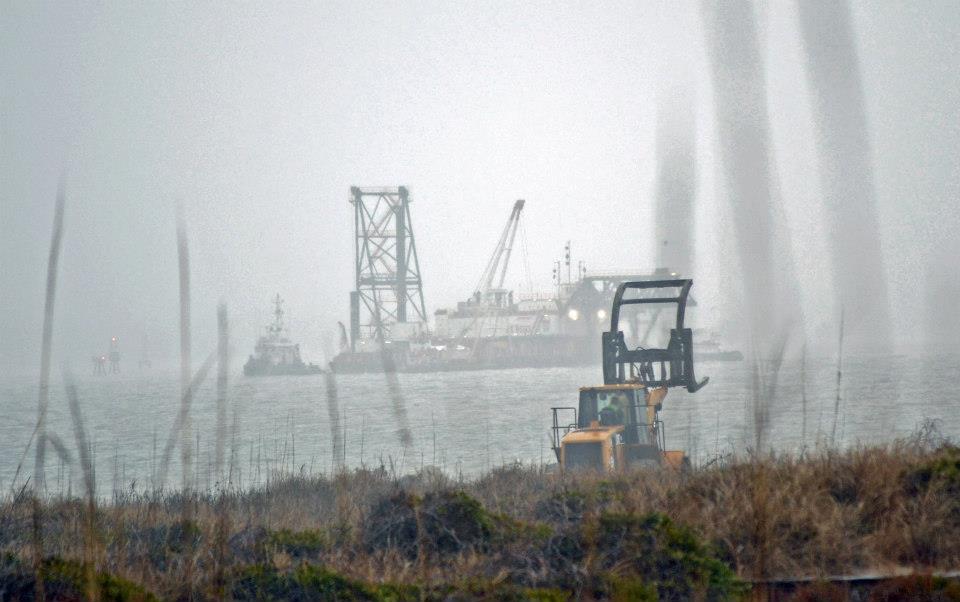
Until reauthorization, Carolina Beach is about to receive what otherwise is its final round of federally subsidized sand, dredged from Carolina Beach Inlet, in a project that should wrap before the end of April.
The estimated placement is about 700,000 cubic yards of sand. Grouped with another 450,000 cubic yards of sand placed on eroded parts of the adjacent Kure Beach shoreline, the project altogether was priced at about $9.3 million, of which the federal government is covering 65 percent, while the state and New Hanover County committed the rest.
McIntyre told Port City Daily in January, after filing the BEACH Act, that his legislation would allow local governments to continue that commitment.
A followup email to the congressman Thursday was not immediately returned.
Ben Brown is a news reporter at Port City Daily. Reach him at [email protected] or (910) 772-6335. On Twitter: @benbrownmedia
