


BALD HEAD ISLAND – Bullets or birth control.
They’re the options for deer population-management in developed areas that seek it, but on Bald Head Island—like most places—the lethal approach has always taken precedence. Touted as effective, non-experimental and comparably cheap, sharp-shoots are conducted as needed with hired marksmen or specialized employees of the village’s government.
But the culls have long divided Bald Head’s populace, and some residents are urging the village to explore a softer, more humane approach. Chiefly, that would be “immunocontraception”—introducing a portion of the herd to birth-control drugs. The Bald Head Island Conservancy on Wednesday hosted an info-gathering meeting on that possibility.
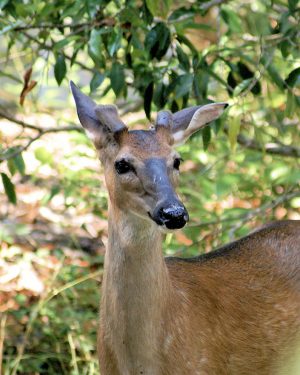
“The long and short of it is the (N.C. Wildlife Resources Commission, which would permit the activity) is willing to consider a proposal from BHI about non-lethal management,” said Suzanne Dorsey, the conservancy’s executive director.
The conservancy has already collaborated on studies that show the local white-tailed deer aren’t migrating off Bald Head Island, so officials are confident the experiment would be contained. (They’re also confident the drug-injected deer wouldn’t end up in the sights of hunters elsewhere.) Ever since Corncake Inlet shoaled to a close in 1999, Bald Head’s northern terminus has land-linked with Pleasure Island.
But there’s a hang-up: The Bald Head Island Village Council in its current form hasn’t thrown support behind immunocontraception, mostly for its costs. While the last cull, using village employees, involved less than $15,000, the birth control effort with varying annual activities would cost around $50,000 for the first year and up to $150,000 for year-two before annual costs stabilize to the $20,000 range.
At this time, the Environmental Protection Agency has authorized only one wildlife birth-control drug: GonaCon, which works like a vaccine against reproductive abilities.
“Gonadotropin-releasing hormone (GnRH) is part of a pathway that signals the body to produce sex hormones. GnRH is produced by the hypothalamus, a major organ in the brain. Without GnRH, very little estrogen, progesterone, or testosterone are made,” the U.S. Department of Agriculture explains.
“The aim of a GnRH vaccine is to bind to or ‘tie up’ the GnRH produced within an animal’s body so that it does not trigger reproduction. The vaccine induces the body to make antibodies against its own GnRH.”
But, Dorsey noted, the drug must be administered by first anesthetizing the deer, then injecting it directly. That’s more involved, and subsequently more expensive, than the alternative drug, Porcine zona pellucida, which deer managers could administer remotely with a dart gun. It has not, however, received federal authorization.
With support lacking from the village government to pursue a GonaCon program, supporters of immunocontraception are weighing scenarios.
“The obstacle they still don’t have an answer to is how to fund it,” said Karen Ellison, spokeswoman for the Village of Bald Head Island. “Without increasing taxes, it probably would need to be privately funded.”
The village’s focus on the island’s eroding shoreline and a related lawsuit against the U.S. Army Corps of Engineers have consumed a considerable amount of time and money, meaning a potentially expensive reform of its deer management program isn’t high on the priority list right now.
The village would have to be the permit holder in any such deer birth-control program, Dorsey noted, so it would likely have to be under a partnership between the conservancy and the village. A group of residents opposed to lethal management would help fundraise for the effort.
But in order to reduce the herd to a size manageable enough for immunocontraception, the program might have to begin with what it seeks to replace–a lethal cull.
In a proposal for non-lethal management in 2008, the conservancy recommended culling at least 74 does and 25 bucks on Bald Head. “This will reduce the population to between 77 (and) 100 does in 2009 and may preclude the need to cull in 2010. This sets up the immunocontraception management plan nicely,” the proposal stated.
The plan was never put into action, the village preferring the cheaper cull. The last one wrapped up in February and took down 72 deer in order to keep the population below 200. The village put its own employees to the task and used, with authorization by the state, .22-caliber rounds—low fire-power, but delivered to the head at close range.
Most of the carcasses were processed into sanitary meat, which the village donated to a food bank.
But the exploration of immunocontraception carries on, and interested parties are rounding up specifics for a proposal to the state. Dorsey said the group will meet again on Nov. 16.
Ellison said she was not aware of any plans for another cull in the near future. “Not at this point. It just depends on what the group comes back with and what the conservancy recommends,” she said. “The village depends on the conservancy to be the experts about the vitality of the herd and the health of the forest. At this point, they’re not making recommendations; they just need to nail down these (immunocontraception or cull) scenarios a bit more. But they’re getting close.”
One agreement among the parties: the herd needs management in some form. Left unchecked, the deer may over-breed, which would lead to over-competition for food in the maritime forest and, subsequently, an unhealthy and disease-vulnerable population.
Contact Ben Brown at [email protected] or (910) 772-6335. On Twitter: @benbrownmedia
