


WILMINGTON — The same downtown house that the Historic Wilmington Foundation (HWF) added to its list of “Most Threatened Historic Places” this year was the subject of a demolition debate at the last Wilmington City Council meeting.
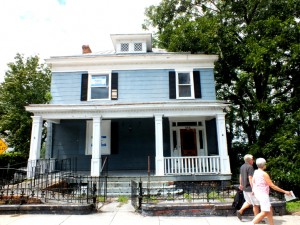
Ultimately, it got a reprieve. But unless improvements are made, the dilapidated building may disappear.
The blue, two-story structure at 226 S. Front Street downtown—in recent history it housed the popular Taste of Country southern-cooking buffet—was built in the 1890s and today sits in a state of “severe deterioration,” as HWF wrote in its entry, and the City of Wilmington has deemed it “unfit for human habitation.” But it’s considered stable and suitable for restoration.
Councilman Kevin O’Grady at Tuesday’s council meeting called it an “eyesore in one of the most beautiful neighborhoods in the city” and asked what owner Mark S. Evans proposed to do about it.
Evans, who according to New Hanover County tax records purchased the property for $695,000 in April 2006, said he is in search of tax credits that might enable him to rehab the structure. He said he envisions possibly turning the place into apartments.
He has also placed it on the market and recently reduced the asking price to $392,000. Last month the listing, through Creative Commercial Properties, asked $475,000.
According to the city, “The structure has been determined to be dilapidated based on a tax value of $149,948 and an estimated rehabilitation cost of $516,250” to meet codes. (Details here.)
Money owed on the property includes $1,144 in public nuisance liens, $3,800 in citations, and $7,698 in back taxes.
The property’s age makes it eligible for federal and state preservation tax credits that could boost such a revitalization effort, according to HWF, though the building’s real estate listing indicates a demolition permit is in hand should the buyer have other development plans.
Evans told the city Tuesday he might know about the tax credits’ availability sometime in October and asked the council for a six month extension to allow for a possible renovation or sale. To satisfy the concerns about the building’s appearance, he said he would add some fresh paint. He also agreed to meet with the city’s legal department to discuss commitments for further improvements as the house on Tuesday was the subject of a condemnation and repair-or-demolition discussion.
“The consequence of not approving this demolition would be to continue to have a dilapidated dwelling that poses a public safety and health hazard; the consequence of approving the demolition will be the removal of this public safety and health hazard,” a city memo said.
O’Grady and fellow council members noted the building is also on a heavily foot-trafficked strip, Front Street, in downtown’s tourist district. It’s a bad image, they said.
“It’s very discouraging to see what has happened to this property in the last few years because it didn’t used to look that way,” said Councilwoman Laura Padgett.
In a request the council ultimately granted Tuesday, HWF Executive Director George Edwards, like Evans, urged a six-month extension for the property so Evans or a buyer could make good. Edwards said HWF had worked with Evans in several past projects to stabilize derelict, historic structures and was dedicated to the cause.
The for-sale listing also appears on Preservation North Carolina’s website in an effort to reach specialty rehabbers.
“Although this building is in need of rehabilitation, it features original windows, beautiful hardwood floors, numerous historic fireplaces, and a partially open staircase,” that listing says. “This diamond in the rough has a 3,781 (square feet) footprint, which includes 12-15 rooms.”
HWF in May announced the building’s inclusion on its 2012 “Most Threatened Historic Places” list to help find an investor. It’s also featured on HWF’s traveling exhibit about the annual list.
Said Edwards, “Let’s see if we can’t make something happen in six months.”
