


WILMINGTON – Atlanta Braves General Manager Frank Wren told Wilmingtonians Wednesday morning that his team’s plan to establish a minor-league affiliate here fits right in with its vision to concentrate its brand in the southeastern U.S.
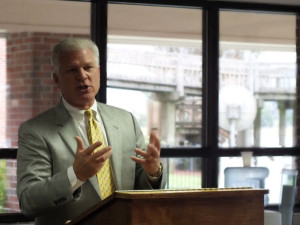
And despite the lack of success of past minor-league teams in Wilmington—the Port City Roosters and Wilmington Waves are commonly cited—“I think the level of baseball you’re going to see is very different than what you’ve seen in the past,” Wren said.
He added: “As we said, we promise to be here for a long time.”
Wren delivered his remarks Wednesday morning at the Wilmington Chamber of Commerce, whose office overlooks the Cape Fear River downtown. With voter approval of a $37 million financing method on November 6, a 6,200-seat stadium for the Braves affiliate could take shape on a nearby tract.
The previous night, Wilmington City Council approved a 20-year agreement with the Braves and sports entertainment group Mandalay Baseball Properties to solidify many of the proposal’s fine points, including its contingency on the referendum’s passage. A 2.5-cent property tax increase would generate revenue to pay the debt and establish a capital reserve while the Braves-Mandalay would pay the city $500,000 each year for stadium management fees and rent.
The chamber event Wednesday morning, a press conference, was meant to kick off a campaign to convince Wilmington voters to approve the referendum. Organizer Terry Spencer said to expect a “shoe leather” style approach of handshakes, one-on-one conversations and a focus on the positive. Spencer said the issue is greater than baseball; it’s about economic development and putting Wilmington on the map as a progressive, business nurturing community.
“There is a clear desire to see Wilmington do more,” he said.
On the other side of the field, the stadium proposal has its opponents who believe the city should not involve taxpayers’ money.
“The taxpayers have skin in the game. All their skin,” said Scott Harry, a local hardware store owner and collaborator fighting the proposal. “It’s just not fair. It’s not right for the government to be building facilities for for-profit corporations.”
Harry, who runs https://www.votenostadiumtax.com, said he and allies plan to hold a press conference of their own Thursday, at 3 p.m. on the steps of the Wilmington Convention Center. He said he expected to have yard signs and bumper stickers ready to hand out for the vote-no campaign ahead.
Asked his immediate concerns, Harry called the city’s agreement with the Braves “a joke” and noted that it affords the Braves-Mandalay essentially all the revenues after the City of Wilmington covers the construction and land purchase.
The Braves-Mandalay would, however, cover operating expenses in addition to paying the city rent and management fees.
“We’ve got so much that needs to be done in this city,” Harry continued, opining that priorities should be education, public safety and water and sewer, among other essentials. “I don’t see how you can in good conscience put baseball in there. It’s just not what the government’s supposed to do.”
Officials at the Chamber press conference Wednesday morning suggested otherwise. Chamber Board of Directors Chairwoman Emily Longley, for one, said the stadium would be a major “shot in the arm” for the local economy.
“Across the country we’ve seen projects like this transform communities,” Longley said, referring to stadiums like Fifth Third Field in Dayton, Ohio, constructed in 2000 mostly with public dollars.
Longley also referenced the National Sports Services report, given to Wilmington City Council in June, that said the proposed stadium here could generate $168 million in direct new spending. “”To put things simply,” she said, “the city can expect a great return on its investment.”
Wren, the Braves’ GM, said the stadium if built “will be a magnet for this part of North Carolina.”
Live Oak Bank Director of Marketing James S. Mahan IV said it would be a “brand new recruiting tool” for economic development in Wilmington. “It’s another feather in our cap.”
Wilmington Mayor Bill Saffo called it “an investment in the community” and said that if the city’s residents decline the arrangement, and the riverside tract eyed for the stadium is developed into something else, the chance will disappear forever.
Officials have looked at an 8.5-acre riverside tract near the PPD office building downtown but have not made a purchase. The city could develop a public park on the site as well but, per the agreement approved Tuesday, the city would have to develop and finance it separately from the stadium project. The Braves-Mandalay would have “no responsibility for the public park’s financing or development.”
“At the end of the day, it’s the people’s decision to make on this,” Saffo said of the referendum.
The full agreement the city approved Tuesday is viewable here.
