


Before the New Hanover County Board of Commissioners considers approval of a $32.6 million refurbishment of its waste-to-energy conversion facility on Monday, the public will have the floor for comments.
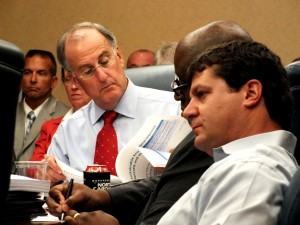
Fifteen minutes will be allocated to each side of the issue: supportive of the plan to revive the sustainable energy facility (SEF), which many call an incinerator; or opposed.
But Chairman Ted Davis during a workshop on the topic Thursday insisted the public should understand the plan is self-sufficiency and not an impact to the general fund. In other words, property tax dollars would not be the source of spending, he said.
“Repayment of that loan was factored in on the (proposed) tipping fee,” Davis said Thursday. “A lot of people have the misconception that it was going to be the ad valorem tax money used to pay…. That is not the case, unless the tipping fee doesn’t cover it.”
County analyst Beth Schrader said Thursday the proposed tipping fee would be between $88 and $90 per ton to cover the 20 year life of the SEF refurbishment project and were calculated conservatively.
While those fees may cause sticker shock, Schrader said, the average cost to a residence would be $2.10 per month, which she called “minor.”
The current tipping fee for a ton of municipal solid waste is $59.
Based on staff’s recommendation, the county commission at its 9 a.m. Monday meeting will consider a contract with Covanta Energy to refurbish the currently offline SEF and operate it for 20 years. The county would remain its owner.
“We think that it’s the right part for our portfolio,” County Manager Chris Coudriet told commissioners.
Officials called it the best answer for the county’s solid waste dilemma, most seriously portrayed in the fact that the county has only an estimated six years of permitted space left in its landfill, off U.S. 421. The county is working on an expansion that would allow for 45 years more of dumping, but that’s a project with years of work ahead and county officials said they need a way to thin the waste stream to avoid a crisis in immediately available space.
Refurbishing the county’s waste-to-energy facility—which Schrader said should not be called an incinerator—is not remarkably more expensive than the county’s alternatives, officials said Thursday.
With the heart of the issue being the few years of life the county landfill has left—the SEF would make sellable energy out of trash, reducing the amount of material entering the landfill—the county said the primary alternative would be shipping a portion of the waste stream to another facility, such as the dump in Sampson County. Schrader said that wouldn’t reduce costs considerably enough as the tip fee would still have to be in the range of $78 to $87 per ton.
But even if the county goes that route, it would just be deferring its attack on the greater space issue, officials said.
“It’s sustainable in that it maximizes the long-term space in our landfill, and that is absolutely critical,” Coudriet said of the SEF plan.
Annual debt payments on the refurbishment would be roughly $2.2 million for 20 years.
But there are parties that insist the Covanta plan is the wrong direction. N.C. Coastal Federation Coastkeeper Mike Giles said the SEF, which he insisted is no different than an incinerator, would only add to air quality woes.
During Thursday’s presentation, officials noted the SEF would emit mercury, lead and acid gases like sulfur dioxide and hydrogen chloride, but the county said it could abate them by spending $1.8 million to add pollution control devices. That would equate another $1.65 per ton on the tipping fee.
Anyway, county staffers said, simply expanding the landfill alone or shipping waste to another dump is no grace for air quality. “One of the things that most people don’t know is landfill gas is largely unregulated and contains a lot of mercury,” said Schrader.
Staffers did say recycling would be a big part of the solution in tandem with the SEF.
“We’ve seen historically that communities that have waste-to-energy facilities have higher rates of recycling participation than communities that don’t,” Environmental Management Director Joe Suleyman said.
Covanta’s website also boasts environmental stewardship with its more than 40 energy-from-waste facilities.
“In total,” the company says, “Covanta’s facilities have processed more than 350 million tons of waste, offsetting 350 million tons of greenhouse gases, which is equivalent to planting over 8 billion trees.”
In the meantime, the county is trying to move forward with its landfill expansion, the life of which could be doubled by the SEF, officials noted. But it won’t be a speedy process. Permitting alone could take three to four years, Suleyman said.
The draft agreement with Covanta is viewable here.
