


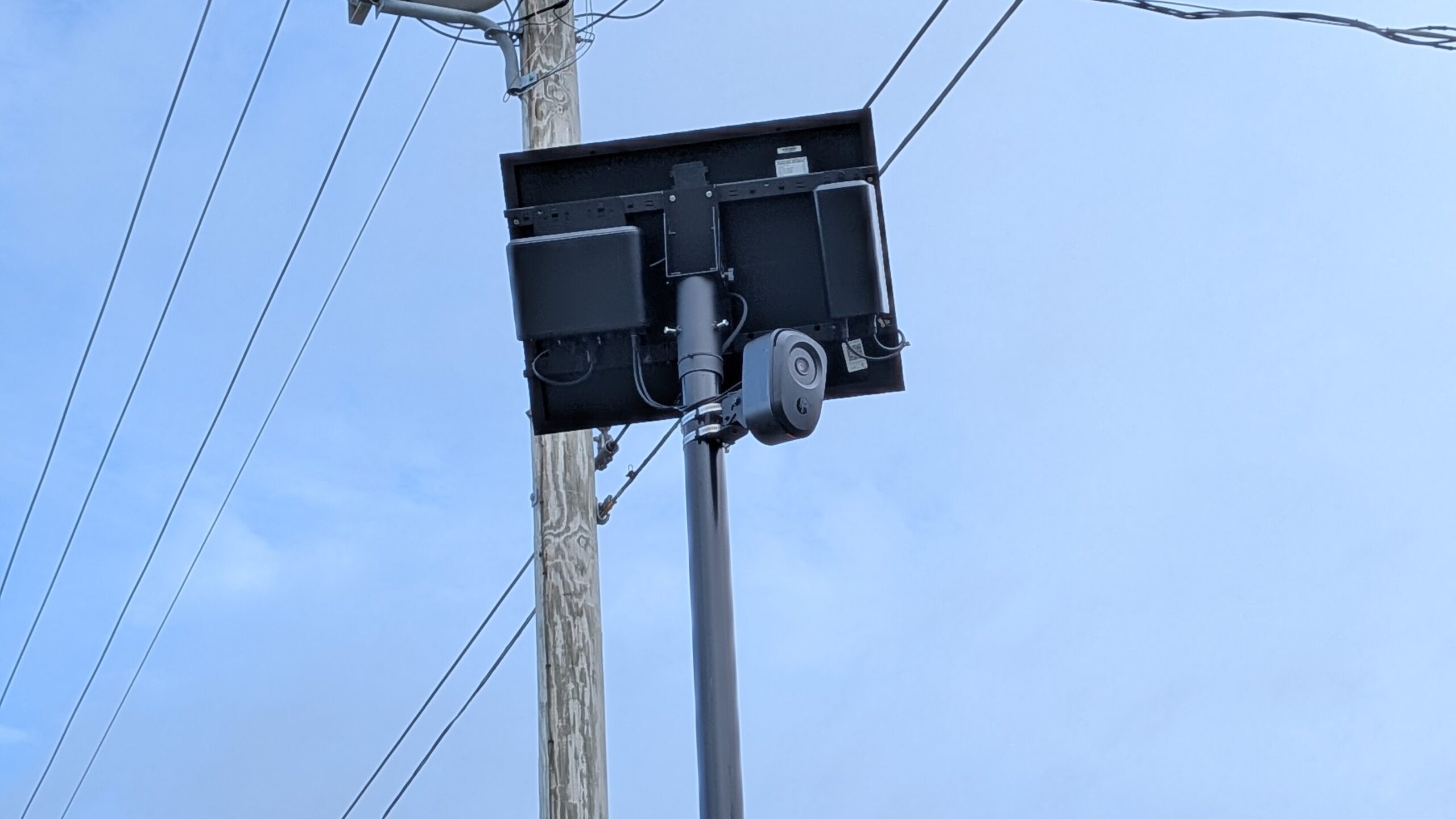
BRUNSWICK COUNTY — Brunswick County commissioners agreed Monday to a 30-day pause on purchasing any new automated license plate readers and to create a committee to discuss the technology. Currently, the county has eight contracted Flock cameras but 15 are operational within the county; it also has at least 94 Axon cameras.
While ALPRs weren’t initially on the agenda for Monday night’s meeting, Commissioner Randy Thompson asked the board to consider his motion, seconded by Frank Williams, for a purchasing pause and committee formation. It passed unanimously.
“We need to have a review done by those that utilize the tool every day in county administration to make sure that we are properly educated on the use of the technology, the policies around the technology, the training, just so that we feel comfortable in granting the financial responsibility for continuing the contract,” Thompson told Port City Daily Wednesday.
READ MORE: County asks Flock for $53K ALPR refund, still on hook for Condor cameras
ALSO: Brunswick County deputy under SBI investigation for Flock misuse
Thompson said he brought the motion forward during the commissioners meeting because ALPR’s are a hot button topic in the community that have resulted in division on the issue.
At two recent meetings a few people spoke.
“Not only do Flock cameras help create a surveillance state, they also present ethical challenges and possible dangers when it comes to their use and applications as we have seen through recent conduct within our own police department,” Candidate for the District 2 board of commissioners’ seat Sara Singer said at the Sept. 8 commissioners meeting. Singer was referencing a recent incident of alleged misuse.
At Monday’s meeting retired law enforcement officer Joe Smith offered a different perspective.
“I am here tonight because I support the responsible use of automated license plate reader technology by law enforcement,” Smith said. “I also believe the recent alleged misuse of this system should be taken seriously. Those two positions are not contradictory”
Smith added an individual instance of misuse should not diminish the overall value of the tool.
Chair Mike Forte wasn’t against the ALPR cameras but did vote in favor of the policy.
“I proclaim that I am a law-and-order guy, that hasn’t changed one bit,” Forte said. “I personally don’t have a problem with the Flock camera. It’s a license plate reader. That’s kinda all that it does. There’s no expectation of privacy on your license. It’s there to identify the vehicle for anybody.”
Thompson acknowledged people who support it find it a “good tool” for officers while others decry it’s a “violation of the Fourth Amendment.”
Commissioner Pat Sykes cited Fourth Amendment concerns at the two most recent commissioners meetings. She told Port City Daily previously she was open to ending the Flock — or ALPR — contracts but did not mention doing so at Monday’s meeting.
Sykes believed the system is vulnerable to misuse and said commissioners have the same authority as the New Hanover County commissioners to initiate conversations about changing the contract, since they help fund it.
“Even with audit logs, Flock cannot prevent curiosity lookups, personal tracking, improper misuse, targeting individuals without probable cause,” Sykes said during a Sept. 10 interview. “We should not have a system that can be misused in ways that violate civil liberties and expose the county to liability.”
15 Flock cameras in use — only eight are contracted
The Flock contract with the sheriff’s office is for eight automated license plate readers; however, 15 remain in use.
A two-year Flock contract approved by the board in 2024 for eight ALPRs. The cost was $29,200 at the time of the contract signing with an annual recurring cost of $24,000.
Sheriff’s office spokesperson Emily Flax told Port City Daily the technology was initially put on private property with the permission of the land owners. The cameras were not allowed on land owned by the North Carolina Department of Transportation at the time.
However, eventually, the state included a provision to allow the cameras to be on state-owned property. The collaboration between NCDOT and the State Bureau of Investigation — allowing ALPRs on state-owned land — began temporarily, from January 2024 until July 2025. The agreement was then extended by one year before becoming permanent in July 2026.
Flock was contacted to remove the eight cameras from private property and eight additional cameras were installed on state-owned land. Flax says due to an oversight by Flock, seven of the eight original cameras on private land were never removed, meaning the county has 15 operational cameras.
The work order to remove the seven ALPRs on private property remains in place. Flock nor the sheriff’s office responded to Port City Daily by press on plans to remove them.
The sheriff’s office paid Flock $25,620 in November 2025 for the eight cameras it is currently contracted for.
Per the Brunswick County Sheriff’s Office’s Flock Transparency Portal, in the past 30 days, there have been 380 camera alerts with the top causes being 121 alerts about sex offenders, 104 alerts about protection orders and 71 alerts about stolen plates.
These alerts come from hotlists — inventory of license plates officers are looking for — which warn local law enforcement when a known wanted vehicle is detected by a Flock camera. According to the BCSO policy on ALPRs, hotlist hits typically involve stolen vehicles, gang or suspected terrorists, missing persons, stolen license plates and wanted persons with warrants.
The sheriff’s office launched its portal at the beginning of September and shared information regarding top offense types, vehicles detected, total searches and alerts within the past 30 days. The portal was live days after a Brunswick County Sheriff’s Office employee was under investigation for misuse of Flock.
The employee is being investigated by the State Bureau of Investigation after an internal review audit done by the sheriff’s office flagged information regarding an employee’s use of the surveillance as warranting further review.
A week later, a Wrightsville Beach police officer was indicted for misusing the county and town’s Flock cameras as well.
$4-million Axon contract
Aside from the sheriff’s office contracting with Flock, commissioners also agreed to a $4-million five-year contract with Axon Enterprise in November 2025 as part of the FY26 budget request for the sheriff’s office. Like the Flock contract, the Axon cameras are ALPRs, meaning they photograph and log license plate information, as well as a cars’ make, model and other identifying information. The contract pays for body worn cameras, dash cameras, and digital evidence systems.
Thompson said he learned from the recent discussions over ALPRs that all contracts should be examined more closely. A November 2025 contract, labeled “Axon,” was passed by commissioners as a consent agenda item — there was no conversation about it. The 80-page contract was signed by chair Mike Forte Nov. 18, one day after the item was passed at the commissioners meeting.
“Whenever you send me a 150-page agreement, I’m going to have to go through it with a blooming highlighter and highlight everything that is not totally understood,” Thompson said at Monday’s meeting.
In the November 2025 agenda packet, it included Axon’s contract’s $4 million, $1.4 million for ALPR cameras — pricing indicated 89 Fleet 3 advanced cameras and 5 Fleet 3 basic.
According to the contract payment summary, the county would have paid $747,820 in October 2025. The next payment is due October 2026 for the same amount and then a payment of $115,777 in November 2026.
Thompson told Port City Daily the agenda items involving ALPRs typically use verbiage relating to technology and software but not the word “Flock.”
“I don’t want to say that the agreements or the contracts were vague,” Thompson said. “I’ll just say that they’ve left a lot for interpretation, and so that’s why they’re in place today.”
At the meeting Sykes also questioned if a recent purchase order for Airship AI — a surveillance, sensor, and data management company would be impacted by the commissioners vote to pause purchases of ALPR technology.
The Airship AI website describes the software as giving customers structured data in real-time as well as at a later date. Real-time structured data use includes alarms on a specific license plate or the make, model or color of a vehicle. Non-real-time structured data use includes searching a database of video data that has been previously stored.
Commissioners did not vote on the policy, as County Finance Officer Aaron Smith said funds were available in the budget and it did not cost enough to warrant a commissioners vote.
County Spokesperson Meagan Kascsak told Port City Daily the Airship AI purchase order would be used on pole-mounted cameras used for investigations and not ALPR-cameras. The purchase order is not impacted by the Sept. 21 motion.
The county was unable to answer Port City Daily’s question by press on how much the purchase order was for.
Commissioners to create a review committee
Thompson would like more time to review the technology and its uses before committing to changing the contract. He said the recent ALPR cancellation in New Hanover — following statewide county and municipal Flock cancellations — has grasped the attention of policymakers.
New Hanover County commissioners decided on Sept. 8 to cancel the county’s ALPR contract with Flock. Twenty ALPRs were taken offline; however, eight Condor cameras — tilt-and-zoom cameras which provide real time video feeds for law enforcement — remain in use.
“It puts a lot of pressure on your elected body, primarily because of the action that your counterparts in another county,” he said.
Thompson hopes the purchasing pause and creation of a committee will act as an educational process for county decision-makers and residents alike.
“I think this goes for building public trust, addressing civil liberties and understanding better the whole county-wide operation,” Thompson told his colleagues Monday.
He said he would like to see the committee formed and the format outlined in the next week, but did not give a further timeline for when the committee should report back. The committee would review the legality, finances and operations of ALPRs, and report to commissioners, who then make any policy changes. The committee will likely include board members, communications staff, the sheriff’s office, and members of the county’s and sheriff’s legal teams.
Commissioner Marty Cooke also voted in favor of the motion, questioned initiating another committee: “We’re coming up with a committee for everything and it’s just getting to be a bureaucratic mess.”
While Sheriff Brian Chism was not at Monday’s meeting, he did provide a statement to Port City Daily saying the sheriff’s office appreciated commissioners’ willingness to learn more about the system.
“We welcome the opportunity to work with the commissioners and provide whatever information or assistance they need to better understand how the technology is used by our agency, the safeguards we have in place, and how we ensure the system is being used appropriately and in accordance with our policies,” he wrote.
Cooke, Forte and Williams did not respond to Port City Daily’s request for an interview.
Have tips or comments for Sophia DePhillips? Email [email protected]
At Port City Daily, we aim to keep locals informed on top-of-mind news facing the tri-county region. To support our work and help us reach more people in 2026, please, consider helping one of two ways: Subscribe here or make a one-time contribution here.
