


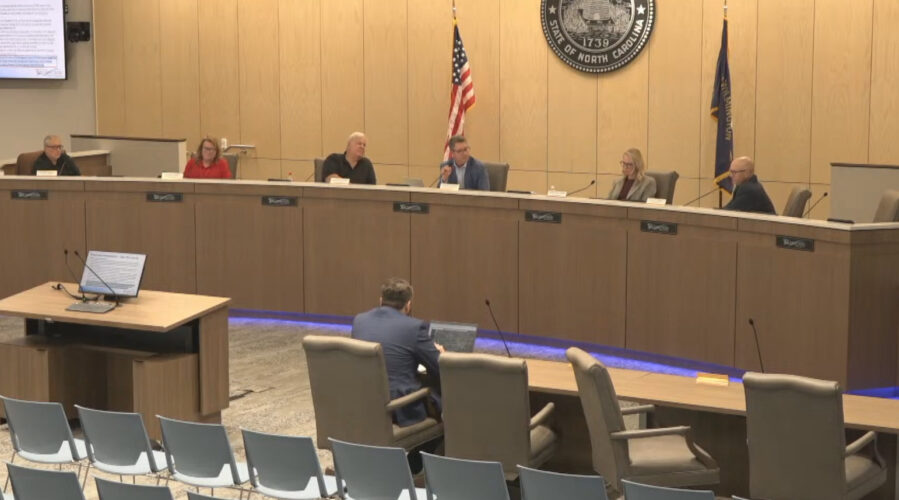
WILMINGTON — The City of Wilmington planning department is trying to resurrect a land code provision aimed at homeless day shelters, though staff weren’t able to revive the planning commission’s favor.
The commission, inclusive of two new members and missing Richard Collier, voted 3-3 on staff’s proposal to restrict group day facilities to certain zoning districts, as the city’s land code did before it was updated in 2021.
City planning staff are trying to reanimate the former classification after Living Hope Day Center’s attempt to relocate facilities for homeless individuals to the former Sorrow Drowner space at 10th and Dock streets.
ALSO: Living Hope Day Center pulls plans for 10th street facility
The shelter, which falls under community center use in the current land code, was allowed to move there by-right, many nearby residents called on the city to step in, citing concerns over concentrating people experiencing homelessness close to the area’s schools. Living Hope has since withdrawn its plans for the site.
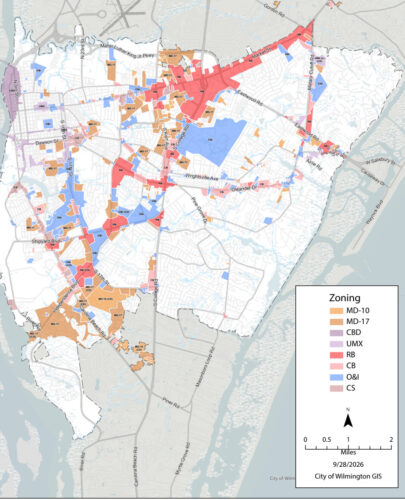
Under staff’s new proposal, group day facilities would be allowed in the following districts: both high-density residential zoning districts (MD-10 and MD-17), urban mixed use, the central business district, community business, regional business, office and institutional, and commercial services.
Group day facilities were allowed in these districts via approval of a special use permit in the old code, though now staff are suggesting they go through the conditional zoning process.
Thus, any property owner wanting to open a group day center would need to ensure it is located within an approved zoning district and apply for a conditional rezoning. The planning commission and city council would evaluate if the location is accommodating and further conditions are warranted.
The planning commission proposed a few conditions to staff’s proposal off the bat: a minimum lot size of 3,000 square feet and an operating manual establishing goals for patrons and supervision standards. The latter was one of the concerns the community brought to council over Living Hope — that an operational plan was not provided explaining how the owners would mitigate potential safety concerns for a no-barrier shelter.
In staff’s proposal, if a center accumulated more than three confirmed violations of the city code within one month or six within a year, its operations would be jeopardized.
“That [provision] wasn’t previously associated with a group day facility,” Assistant Planning Director Brian Chambers said at the planning commission’s meeting. “This was associated with a group home residential, which is what a homeless shelter would be classified as. Staff is bringing this forward for consideration because it would add another layer of enforcement to ensure compliance with city standards.”
However, two city residents that spoke during the commission’s public comment requested the land code amendment go even further. They suggested a 1,000-foot buffer between any facility and a school, daycare or park.
This split the planning commission.
“I think it’s discriminatory,” Livian Jones said.
Jones, who pointed to her involvement at the Wilmington Housing Authority and various nonprofits, said there are schools and daycares spread across the city, limiting any center’s location options.
The planning commissioner said she has paid attention to the backlash against Living Hope; she also pointed out no one had issues with it operating out of downtown’s First Baptist Church. St. Mary Catholic School is three blocks away.
“We should not not help these people because we’re afraid of them,” Jones said.
Stephanie Lanier, one of the new planning commissioners, indicated she was uncomfortable voting on the matter without seeing a map of available parcels under the 1,000-foot condition. Planning staff did provide a map of parcels that would be eligible for a facility per its proposed rules, though this did not include the buffer provision because staff didn’t endorse it.
“We are hesitant to have a specific standard that’s outlined that would apply to everything because every situation is going to be different, and then we want to make sure that we’re not over-regulating,” Chambers said.
However, planning commissioners Jack Pollock and Ace Cofer indicated support for the buffer. When Pollock made a motion to add the buffer to the proposed amendment, he said it should only apply to schools.
Still, the buffer addition failed to pass in a 3-3 vote. Pollock, Cofer and new commissioner Chris Bauer were in favor; new chair Danny Adams voted against, along with Jones and Lanier.
Aside from the buffer discussion, Pollock asked planning staff how the violation provision would work. Chambers said any violation would need to be confirmed — meaning any complaint by a neighbor would need to be investigated and upheld.
Pollock also questioned why the group day facility use was removed from the code in 2021. Planning staff were unable to find the reason.
“We’ve looked feverishly through old meeting minutes, the work sessions that were done between council and planning commission back when the code was being rewritten,” Chambers said.
The use’s untraceability irked Cofer, who said the amendment has merit because of its presence in the old code. The fact it hasn’t been “modernized” gave him pause.
Bauer also was “torn” over the amendment.
“Because I’ve experienced it in my neighborhood — it really tore the neighborhood apart when a group home was being introduced close to a school, and the community really felt that no one was listening to them,” Bauer said.
Ultimately, Adams made the motion to approve the land code amendment as staff recommended it. This vote again failed 3-3, though the members flipped in their support versus denial. Adams, Jones and Lanier were in favor; Bauer, Pollock and Cofer voted no.
The latter three did not explain whether they dissented due to the amendment’s lack of a 1,000-foot buffer or another matter, though Pollock shared he hoped staff would continue its effort to more clearly define a day center use.
“This by no means erases the need to have a use for, you know, on the books. I don’t think anybody up here has disagreed with that at all,” Pollock said. “I think all you’ve seen is need to go back and take a look at this and refine it a little more, and and bring it back as quickly as possible.”
However, planning staff have already filed an appeal to get their version before city council. The city’s rule is that the planning commission’s denial is final unless an applicant, in this case planning staff, makes an appeal; all recommendations from the planning commission go before council regardless.
The goal is for the amendment to be heard at a November council meeting.
At Port City Daily, we aim to keep locals informed on top-of-mind news facing the tri-county region. To support our work and help us reach more people in 2026, please, consider helping one of two ways: Subscribe here or make a one-time contribution here.
We appreciate your ongoing support.
