


PENDER COUNTY — Pender County commissioners were presented this week with the cost to take over and replace the Town of Atkinson’s aging sewer system: $86.2 million.
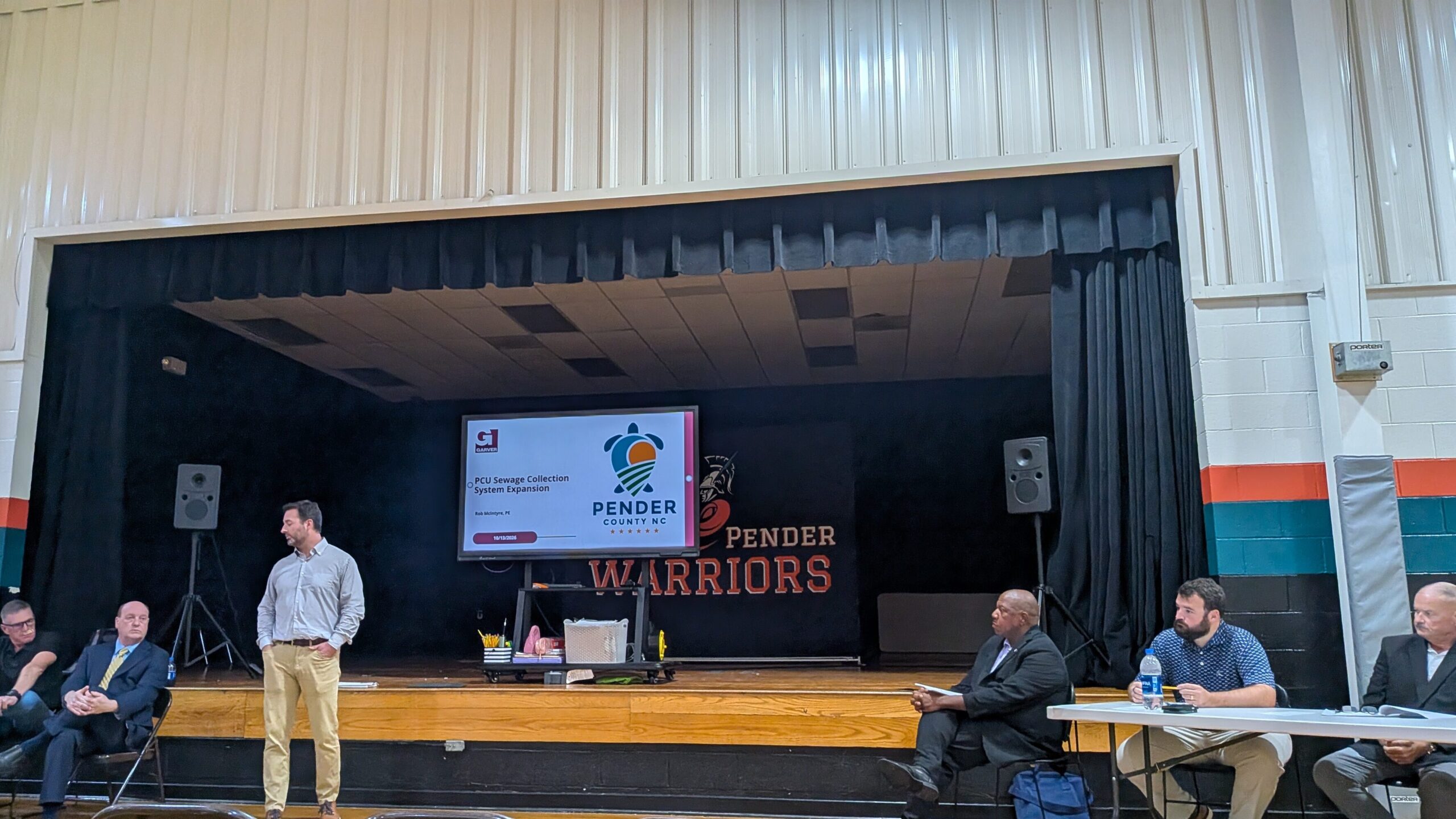
The estimate comes after a feasibility study — done by Garver Engineering — was presented to Atkinson town officials and the Pender County Board of Commissioners during a joint meeting Tuesday night.
“For the wastewater treatment plant — one million gallons per day plant — they’re not cheap,” Rob McIntyre with Garver said. “You gotta buy the land. You gotta put the infrastructure in.”
READ MORE: Pender town becomes first in the state to ban ALPR surveillance cameras
Tuesday’s meeting was an opportunity for commissioners and Atkinson officials to learn more about the possible project scope. No decisions were made in terms of moving forward with the sewer system.
The feasibility study for a regional wastewater collection and treatment system was conducted after the Town of Atkinson approached Pender County in the spring of 2025. The town and its residents currently operate on septic tanks, of which there are more than 250. Many of the septic systems are beginning to deteriorate and fail due to age.
Atkinson representatives went before the board of commissioners in December 2025 asking for $125,000 to fund the feasibility study. Commissioners unanimously approved of the funding under the condition it would later be reimbursed by the town, though the county would retain ownership of the new sewer system.
The study is the first step in a multi-year process to determine whether a regional wastewater system can be designed, permitted, funded and built to serve Atkinson and potentially future growth in surrounding Pender County. Pender County is the second fastest growing county in the state, with an annual growth rate of approximately 2.8%.
The study calls for the new system to include one waste treatment plant, location undefined, with pipe infrastructure running from Moores Creek Watershed to Mill Branch.
Per the study, the plant would have a final build out of 4.34 million gallons per day. Development would occur in phases in order to align the plant’s capacity with the area’s future growth. Phase one would have 1 million gallons per day and phase two would reach 2.5 million gallons per day before hitting the final build-out amount at phase three. All three phases would take three to five years to reach completion.
The system would include about 14,400 feet of 24-inch trunk sewer, a 12-inch line north of town, roughly 23,000 feet of 8-inch gravity sewer within Atkinson and about 400 manholes.
Installing the in-town gravity sewer would require digging up the streets. McIntyre said in Atkinson this would likely mean disrupting pavement every 400 feet at a time in the mile-long town.
“You’re gonna tear up a lot of things, unfortunately,” McIntyre said. “It’ll be several months of your street not looking good and then your street will look good, and neighbors will start talking about their street looks.”
It is unclear if Garver would also take care of repaving the streets. McIntyre added “hopefully” surfaces will be repaved as part of the project.
Should the project advance, its estimated potential wastewater flow — the average amount of used water sent from homes and businesses into the sewer system each day — from the Town of Atkinson into Mill Branch basin is estimated at 30,000 to 50,000 gallons. It is expected to hit 250,000 to 300,000 within the next 10 years, well within the treatment plant’s 1-million gallon capacity.
Though the town would ultimately be covering the cost of the new system, Atkinson citizens would need to pay for the connections to their home. McIntyre estimates residents need to pay between $5,000 to $10,000 to do so.
However, he noted this is cheaper than replacing a failing septic system. Septic systems typically last 30 to 40 years and cost anywhere between an estimated $25,000 to $40,000 to replace.
For citizens who cannot afford the cost, McIntyre noted grants — such as the federal Community Development Block Grant— are available and would cover the entire amount.
Commissioner Randy Burton pointed out grant funding is not guaranteed.
“This stuff’s expensive and just the funding and the grants and stuff is great, and people do get them but we get turned down too,” Burton said. “Folks past Highway 11, those folks have been needing water for 20 years. We got a CBDG grant application process for those folks last year, and were turned down.”
Monthly sewer rates and final connection charges have not yet been determined, however, the feasibility study provided Tuesday evening says a sewage collection system, including collection and treatment infrastructure, would come out to a total cost of $86.2 million. The collection system would be approximately $26.7 million with the treatment system costing around $59.5 million.
The town and county could apply for grants with possible funding routes including EPA funding, USDA loans or grants, state appropriations, legislative requests, and Community Development Block Grant assistance.
Commissioner Jimmy Tate suggested another joint meeting between the Pender Board of Commissioners, Atkinson town officials and state and federal representatives in order to explore feasible grants.
Atkinson Mayor Gary Alsup said he was already in talks with Congressman David Rouzer and Senator Brent Jackson.
McIntyre added the sewer project will likely be successful getting state funding, if the project is framed around regionalization and fixing an existing problem — not as addressing county growth.
“You stand a greater chance through merger regionalization, and, basically, that means that the larger utility would assume ownership of the asset once it was installed and then maintain the claim,” McIntyre said, adding it’s where Pender County gets involved.
At this point the project is more of a partnership between Atkinson and the county; years down the line when everything is complete, the sewer system would be owned and maintained by the county.
Another possible option to help with cost is by beginning with a package plant — a small wastewater treatment plant approximately the size of a tractor trailer that treats the wastewater and then discharges it to a nearby waterway.
A package plan could still service the whole town but became a temporary solution talking point, while Atkinson and Pender explored a more permanent system. The package plant would cost less upfront than a traditional facility but more per gallon to treat wastewater because of its smaller capacity.
McIntyre said a package plant could result in losing time and money, noting if they wait five years to put in a traditional plant, costs could rise upward of 40% of the currently proposed cost.
Overall, the project is still very new, with McIntyre telling attendees the plan was in its infant stages and just putting “mind on paper.”
The largest unknown and biggest current hurdle is that “speculative limits” have yet to be received by the state — Garver put their request in back in June.
Speculative limits are state guidance on how much is allowed to be discharged into Moores Creek and Mill Branch. The limits will solidify how large the waste water treatment plant can be, what treatment technology is required and if surface-water discharge is feasible or if a more expensive land-based discharge is needed.
The speculative limits would determine whether Garver’s feasibility study could be executed as proposed, while additional next steps include environmental studies, wetland delineation, permitting and design should the county decide to move forward.
Have tips or comments for Sophia DePhillips? Email [email protected]
At Port City Daily, we aim to keep locals informed on top-of-mind news facing the tri-county region. To support our work and help us reach more people in 2026, please, consider helping one of two ways: Subscribe here or make a one-time contribution here.
