


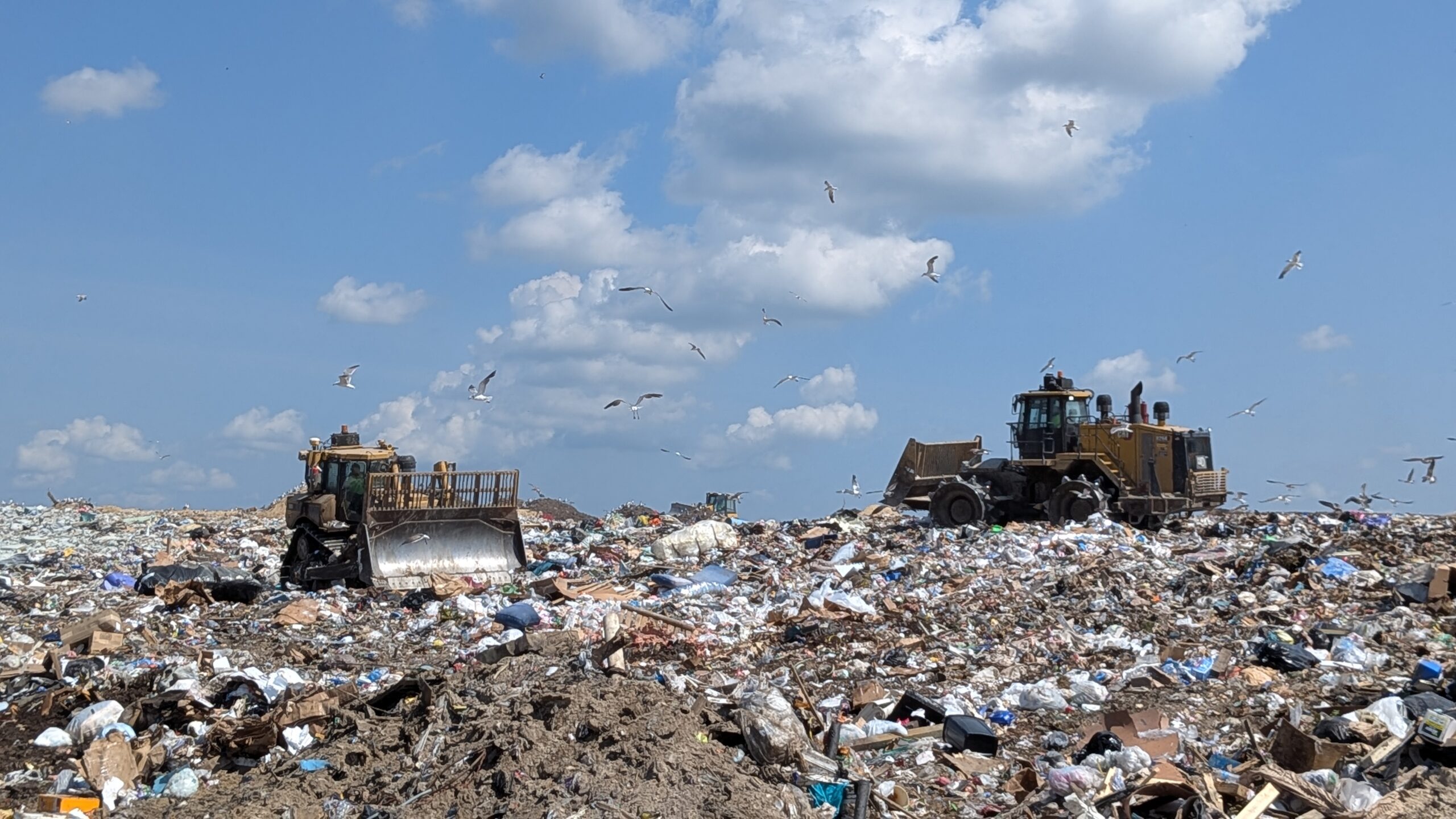
NEW HANOVER COUNTY — New Hanover County Landfill officials suspect a lithium battery is responsible for a fire that broke out at the landfill in the early morning hours of Thursday, Aug. 20.
Joe Suleyman, the director of recycling and solid waste for New Hanover County, said he thinks the battery was likely cracked or broken by a truck at the landfill toward the end of the landfill’s operating hours on Wednesday.
New Hanover County Fire Rescue was notified of a fire on the eastern side of the landfill around 3:45 a.m. Suleyman says he became aware of the flames shortly thereafter and alerted landfill staff to assist fire services.
READ MORE: Firefighters quash blaze in NHC recycling facility
The fire was 100-feet in diameter and subsurface, which means it starts underground and creates an intense and extremely hot flame that spreads quickly.
“This is one of the larger fires we’ve seen here at the site, but it’s not uncommon for us to have a small fire,” Suleyman said.
Suleyman said three to four small landfill fires annually is not out of the ordinary. He estimated the last fire happened three to four months ago, calling it “memorable” since the cause remains undetermined.
“It was a linear fire, which was very suspicious to us,” Suleyman said, adding the flames reminded him of a cartoon where gunpowder is laid down and when it’s lit, the fire runs from one end to the other. “That one I can’t explain, but it’s very unusual to see a fire like that.”
Thursday morning’s fire differed as there was not a lot of wind, meaning the fire did not drift and spread fairly evenly, allowing it to be contained.
He added chemical reactions from batteries can happen due to landfill waste interacting with day-to-day garbage that provides kindling. The battery suspected to be responsible for Thursday’s fire would have then increased its temperature and used trash in the landfill as fuel. During a thermal runaway — an uncontrolled self-heating process — lithium batteries can reach temperatures of up to 1,832°F compared to its average temperature range of 68°F to 77°F.
Along with the NHC Fire Rescue and landfill personnel, the New Hanover County Sheriff’s Office responded to the scene to assist with site access and security.
Because of the soft ground of the landfill slope, a typical fire apparatus could not access the area. Crews had to use specialized vehicles and equipment, such as pumper trucks, to extinguish the fire. Smaller trucks were able to reach the flames while shuttling water from larger trucks at the entrance.
Heavy equipment, like bulldozers, were used to turn the pile to expose and extinguish hot spots underground, and water was spread around the perimeter to prevent expansion.
The landfill also used its own water truck— typically brought out for dust suppression on landfill roadways. The tank is refilled daily before the vehicle is parked for the day, so if there is a site fire landfill staff can respond immediately to a site fire.
At 6:20 a.m. the fire was declared contained and NHC Fire Rescue handed the scene over to the landfill staff.
Landfill crews are now working to add layers of sand over the burned slope. Per Environmental Protection Agency Resource Conservation Act, the landfill must put at least 6 inches of cover over new waste daily.
Sand cover will suppress oxygen and smother possible remaining hot spots while preventing reignition. It also mitigates odors, prevents runoff and erosion, blocks disease carrying creatures like fleas and rats from accessing the trash, and stops litter from blowing around.
Suleyman stressed the importance of properly disposing old batteries: “Lithium batteries are in so many devices that we have now: laptop, cell phones, toys.”
Locations include the New Hanover County libraries, Cape Fear Community College campuses, UNC Wilmington and the Hazwagon, a weekly mobile hazardous waste collection service.
Residents can find the ‘Hazwagon’ from 10 a.m. to 2 p.m. at Ogden Park on Monday, Wrightsville Beach Municipal Complex on Wednesday, Carolina Beach on Friday and on the first Saturday of every month at Kure Beach Town Hall.
Suleyman added batteries also should be properly stored in homes.
“Same thing could happen in your garage or under your kitchen sink or God forbid in your kids bedroom,” he said.
Suleyman said the best way to store batteries in your home is to tape the battery terminal, or the positive and negative ends of the battery, using duct tape, electrical tape or even Scotch tape. This will prevent batteries from coming in contact with one another and possibly causing a reaction.
If a lithium battery begins to overheat, Suleyman suggests putting it in a metal container and placing it somewhere that won’t burn, like a patio or driveway. Then take it to a proper disposal site.
Have tips or comments for Sophia DePhillips? Email [email protected]
At Port City Daily, we aim to keep locals informed on top-of-mind news facing the tri-county region. To support our work and help us reach more people in 2026, please, consider helping one of two ways: Subscribe here or make a one-time contribution here.
