


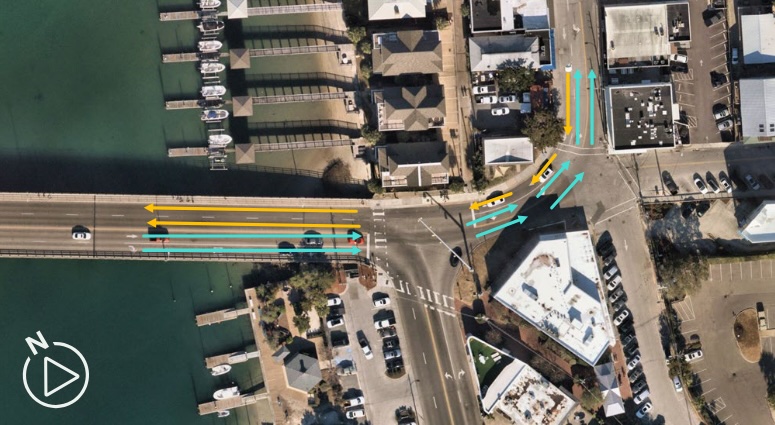
WRIGHTSVILLE BEACH — The North Carolina Department of Transportation unveiled an accelerated timeline for three bridge replacements coming to Wrightsville Beach in 2030. NCDOT also updated that it is in talks with the U.S. Coast Guard to limit the island’s drawbridge openings to help with traffic flow.
NCDOT is working on a $105-million project — up from the initially estimated $70 million — to replace three bridges in Wrightsville Beach that have begun to deteriorate with age. South Banks Channel Bridge on Causeway Drive and two on Salisbury Street were all built in the 1960s and ‘70s and are approaching their end-of-life expectancy.
All three are being rebuilt in a project to be completed two years early by NCDOT. Originally, it was anticipated to wrap by 2032, but will finish by spring 2030. Under the initial plan, one bridge was going to be built every two years, now all three bridges will be done in a span of four years.
“What I’m sharing with you today is our projection,” Division 3 Highway Engineer Trevor Carroll said. “It’s our target. It’s our goal, the collaboration that we’ve had so far helps us have some level of confidence that this is achievable.”
Construction will occur in three phases, not including utility relocation which already happened in July 2026. Phase one consists of replacing Lees Cut — the short bridge on Salisbury Street — with construction starting in late 2026 and taking one year to complete.
During this time, West Salisbury Street will be closed from Lookout Harbour to the eastern entrance of Pelican Drive during construction. During construction, two lanes in each direction will remain open on Causeway Drive, as will the multiuse path.
The new bridge structure will be built north of the existing bridge, with removal of the old and construction of the new occurring simultaneously. The new bridge will be in the same area, give or take a few feet.
During phase one, the bridge on Causeway Drive will remain open to vehicles and pedestrians.
Next, the Salisbury Long Bridge construction will begin in the summer of 2027, one year shy of previous estimations.
The newly constructed short bridge and Causeway will be open during this time. West Salisbury will be closed from Lookout Harbor to North Lumina Avenue, but parking will still be available on West Salisbury Street.
The new Salisbury bridges are proposed to have one 12-foot lane going in each direction and dedicated bike lanes on either side of the bridge. The bike lanes will be approximately 6-feet wide.
After the construction of Lees cut, work will begin on the new Causeway bridge.
“We have an opportunity to work on the long bridge on Salisbury and the bridge on Causeway at the same time,” Carroll said, adding the concurrent construction is a result of a pilot program, allowing the contractor to initiate two crews working at once.
This is considered a construction manager-general contractor delivery method — when the contractor, designer and NCDOT collaborate during the process rather than waiting for the design to be completed for construction to begin.
It was determined feasible after NCDOT participated in a pilot program in 2021 to test a new delivery method. Using the method to replace five bridges in Pigeon River Gorge showed that the construction manager-general contractor was a feasible alternative to traditional delivery methods.
Typically, NCDOT designs its construction plans, puts them out for a bid, awards a contract and the contractor begins construction, as mandated by General Statute 136-28.1.
In June 2026, the North Carolina General Assembly decided NCDOT could have 15 projects using the construction manager and general contractor delivery method, foregoing the traditional bidding process.
However, the Causeway bridge construction will take longer to complete as part of phase three. Salisbury bridges will be open during construction, lasting from 2028 to 2030. The detour will shift traffic to the newly constructed portion of Causeway bridge. Crews will move south to finish demolition of the existing Causeway bridge and then connect the two new bridge sections to complete the project.
The Causeway bridge will have four 11-foot wide lanes, with two going in both directions. There will also be a 6-foot wide bike lane on both sides of the bridge and a 12-foot wide multiuse path.
Concrete parapet walls will separate the multi-use path from the vehicle and bike lanes on all bridges.
The NCDOT is still working with New Hanover County and Wrightsville Beach to find ways to share all traffic information with emergency responders to ensure proper response time. Throughout the duration of construction, NCDOT has made a commitment to have two lanes open, going on and off Wrightsville Beach, at all times.
It also is working with the U.S. Coast Guard on the opening of the drawbridge. While the drawbridge is not a part of the current three bridge projects, Carroll said at a Friday media conference NCDOT is actively working to reduce the number of times the drawbridge opens daily. The goal is to help traffic flow during construction.
“Pleasure vessels will be able to traverse under the bridge during opening at the top of the hour,” Carroll said. “Commercial vessels will have to call for a 30-minute notice if they are a part of a towing operation or dredging operation.”
The bridge currently opens on the hour and on-demand for vessels.
Specific details are still being worked out with the Coast Guard but the goal is to
Carroll also noted that NCDOT has heard public concerns over two projects happening in close proximity to one another — the replacement of the three bridges and building an overpass over Military Cutoff Road.
NCDOT aims to have the majority of lane closures associated with the $81.4- million dollar elevation of Eastwood Road over Military Cutoff Road to be at nighttime to mitigate impact on traffic and the public.
“There is no such thing as a zero-impact project,” Carroll said. “We’re not trying to say it’s a minimal impact. We are trying to build plans to make sure that we mitigate those impacts as much as possible.”
The projects are 2 miles apart. The Military Cutoff Road flyover project will begin construction in fall of 2027 and take more than four years to complete.
Have tips or comments for Sophia DePhillips? Email [email protected]
At Port City Daily, we aim to keep locals informed on top-of-mind news facing the tri-county region. To support our work and help us reach more people in 2026, please, consider helping one of two ways: Subscribe here or make a one-time contribution here.
