


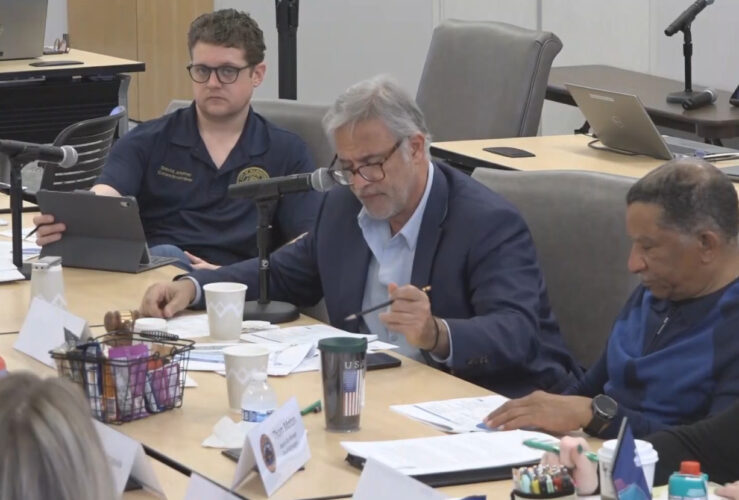
WILMINGTON — The City of Wilmington’s latest round of budget talks revealed the city is now estimating a need for more than 6 cents — on top of its 28.25-cent tax rate — to account for growing revenue needs, budget increases and, most expensively, implementation of a “living wage” for all city employees.
City Manager Becky Hawke presented a 4-cent, 5-cent, 6-cent and 6.26-cent tax rate increase at last week’s budget workshop.
For the city’s median residential home value of $445,000, the increases to property tax bills would break down in the additional amounts:
- 6.26 cents: $23 monthly, $128 annually
- 6 cents: $22 monthly, $127 annually
- 5 cents: $19 monthly, $123 annually
- 4 cents: $15 monthly, $120 annually
According to the city’s budget projections, only the 6.26-cent option would accomplish all the city’s goals for fiscal year 2026-2027 — maintaining current service levels, addressing core operating increases and implementing a living wage. The new budget goes into effect July 1.
“I honestly don’t see a scenario where there isn’t a tax increase, even if we kept employee wages completely flat,” Hawke told council members on March 27.
Hawke explained the city’s expected revenue is not keeping pace with higher costs brought on by inflationary pressures — employee health insurance coverage alone will need an additional $3.5 million. Also, an additional half cent would be required to see the city’s capital improvement plan through the rest of the decade due to rising construction costs.
Part of the revenue struggle is from last year’s tax rate, set almost at revenue neutral; at 28.75 cents, it brought in roughly the same amount of revenue as the 2024-2025 fiscal year. Thus, there’s little room for the current tax rate to accommodate increased revenue needs.
The city also can’t rely on natural growth in revenue from a larger tax base to keep pace with its needs — only $50,000 in additional revenue from development is expected next year — as new construction is what grows a tax base and land within city limits is largely built out. Nor can it rely on sales tax revenue, which in today’s uncertain economy continues to flatline; the city is only projecting a 2.5% increase compared to 3.6% last budget cycle, though this is still an “aggressive” projection.
On top of this, the city is anticipating having to adjust down its property tax revenue projections due to the number of successful homeowner appeals to their property value. During last year’s revaluation, values rose 67% on average across New Hanover County. The city is anticipating nearly $2 million in value loss from appeals.
The city is still vetting budget requests from its departments, though it has received at least $2.93-million in submittals, including:
- $1.6 million for fire and police safety equipment
- $499,000 in deferred core operating needs
- $147,000 for an in-house cyber security officer
- $184,000 for IT support for public safety
- $500,000 in repair and maintenance of facilities and equipment
However, the most expensive component of the potential hike, coming in at 4 cents, is the living wage implementation effort to recruit quality talent and retain current staff. The citywide vacancy rate is 12.4%, but in police and fire, it escalates to 20%.
Hawke said many public safety personnel have told the city they can’t afford to live in ara with the salaries Wilmington currently pays out.
“If we lose many more people, we’ll struggle to meet minimum staffing levels,” Hawke said.
Under the living wage model, all employees would make at least 60% of the area median income $75,885 with the living wage model. Area median income is the mechanism used by the U.S. Department of Housing and Urban Development to determine subsidized housing requirements; many affordable housing projects are restricted to people making 80% of their city’s AMI or less. According to the city, only a quarter of its employees live in the city.
For the City of Wilmington, meeting the 60% marker would require raising its base salary to $45,531; its lowest salary is currently $37,980. As a result, the city would need to adjust salary scales for all positions to avoid compression, though no employee would see a raise of more than $15,000. According to Hawke, most of the $14.2 million needed to accomplish the shift to a living wage would be spent on adjusting lower salaried workers, not people at the top of the organization.
At council’s February budget session, Hawke told council the “worst-case scenario” to cover the living wage would be 4.1 cents and she was committed to that number not going up.
By March 27, it had gone down, but only by one-tenth of a cent.
The city did undergo an organizational restructuring in the time since the last budget session, though Hawke told council the cost savings were minimal. Staff were able to reduce the city’s overall workforce by the equivalent of 25.19 full-time positions; further reductions are anticipated to occur through attrition.
Chief of Staff Dennis LaCaria shares some of the positions removed or restructured had been vacant for some time; he also said the team “took a hard look” at administrative assistants, shifting some to more customer-service roles. According to Hawke, no one is losing their job in this process.
Ultimately, the goal was to reduce duplication of duties throughout the organization, though cost-savings are an added bonus.
Based on the city’s calculations, with the living wage taking up 4 cents alone, any tax increase lower than 5 cents would not allow for the living-wage implementation. At 5 cents, the city could make the salary shifts and address health insurance escalations, but most of the deferred core needs would go unaddressed.
At 6 cents, the city could accomplish a living wage, health insurance and many of the core needs, but 6.26 cents is ultimately the number to cover everything.
“I can go ahead and tell you I’m not doing [that],” Mayor Bill Saffo said.
Saffo and a couple other council members expressed interest in implementing the living wage in phases over several years, though Hawke said it would most likely result in several tax increases in a row.
Saffo thought the city needed to reexamine what services it provides in relation to surrounding governing bodies instead.
“Everybody is using our services everyday,” he said. “Folks that are not paying taxes — the universities, the hospitals, the community colleges, government, churches — this is a significant amount of folks that are being extracted from all of that, and then you’re also being whacked with sales tax, when the majority is going to the county.”
New Hanover County uses a property value (rather a population-based) model for distributing sales tax revenue, meaning the more tax revenue a municipality brings in, the more it gets in sales tax revenue. Because New Hanover County collects property tax from the entire county, it makes up the highest percentage of the tax levy.
The mayor continued that residents of the county and beach towns rely on jobs, services and amenities within the city, though it’s the city that bears the cost of support. It’s a phenomenon not necessarily unique to Wilmington, but in a rapidly growing region, effects can be more pronounced.
Saffo didn’t offer a solution he thought would equalize the share of the city’s burden. He wanted to discuss with each city council member their priorities and thoughts on how to reckon with the needed revenue.
As there was little hashing out of the budget at the March 27 session, it is unclear if the public will know what council’s priorities are or where they land on the tax rate before the city manager is set to present her recommended budget on May 5. A public hearing will be scheduled for May 19, followed by another council work session. Budget adoption is scheduled to occur either June 2 or June 16.
Reach journalist Brenna Flanagan at [email protected].
At Port City Daily, we aim to keep locals informed on top-of-mind news facing the tri-county region. To support our work and help us reach more people in 2026, please, consider helping one of two ways: Subscribe here or make a one-time contribution here.
We appreciate your ongoing support.
