


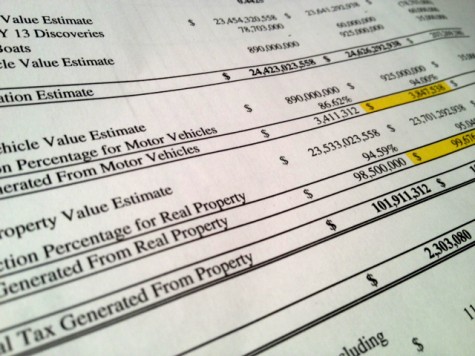
NEW HANOVER COUNTY — State lawmakers are reviewing whether there’s room for improvement in how property taxes are levied across the state; some legislators and local leaders are wary of the state overstepping in territory that should be, in their opinions, reserved for local governments.
“A one-size-fits-all cap set in Raleigh could make it harder for fast-growing communities like Wilmington to keep up with population growth, rising service costs, and major capital needs,” Wilmington City Council member Salette Andrews said.
READ MORE: Wilmington council discuss multi-cent tax increase to accomplish wage, capital project goals
The House Select Committee on Property Tax Reduction and Reform held on Feb. 18 its third meeting since House Speaker Destin Hall created the body in December. The committee is designed to study ways the state can “reduce the property tax burden” on taxpayers, with a recommendation from the committee expected before the North Carolina General Assembly reconvenes on April 21.
There has been a 50% rise in property values nationwide since 2020 though New Hanover County, in particular, experienced a 67% rise in average from 2021 to 2025. With the rise in values often comes higher property tax bills for homeowners, already experiencing increases in other costs, such as groceries and energy bills.
At last week’s meeting, the House’s property tax reform committee received a recommendation on how to implement property tax reform from senior policy analyst Abir Mandal from the Tax Foundation, a nonprofit think tank based out of Washington, D.C. While the foundation advertises itself as nonpartisan, it often espouses conservative viewpoints, such as lower taxes on corporations and high-income earners.
Mandal explained the best route to implement limits on property tax levies statewide would be a cap on how much revenue a municipality could collect from the tax each year. In other states where this is done — including New York and Massachusetts — a municipality’s property tax revenue can only increase by so much compared to its last budget.
For example, the state of New York has a cap of 2% or the rate of inflation, whichever is less. Let’s say a municipality brings in $100,000 in property tax revenue this fiscal year; when it goes to approve a budget for next year, its property tax revenue cannot exceed $102,000, or 2% higher than the previous year. Its tax rate must be adjusted to stay under that number, even if that means lowering the rate.
There are some caveats, which Mandal recommended as well; the cap would only apply to existing properties. New construction and the property taxes generated from it would not count toward the cap in order to scale revenue with growth.
Additionally, local governments could override the cap upon resident approval. This would require the municipality’s request to be placed on a ballot and win the votes needed for passage; in New York, the measure must get 60% voter approval.
“If they make the case that they absolutely need to spend extra money on a particular project, then they can take it to the voters,” Mandal said to the committee.
If passed in North Carolina, lawmakers may need to reexamine its referendum law, however.
The state only allows voter referendums on scheduled election days — a March primary or November general election. Plus, every resident in the municipality must be eligible to cast a vote on the referendum — meaning a county-wide referendum cannot be placed on the ballot for a municipal election. Doing so would only capture the votes of those within the municipality.
Thus, if New Hanover County wanted to send a budget override to the voters, it would need to be on a March primary ballot or November general election ballot. It would also need to take place in an even-numbered year — county commissioners don’t have seats up every year.
If the referendum law remained the same, New Hanover County and other municipalities would potentially need to reexamine their budget approval schedule, as budgets are typically approved in June. To meet a November or March ballot deadline for an override, however, municipalities would need to start budget talks much earlier.
However, some local elected leaders didn’t find the idea of a state-imposed levy limit very appetizing.
“While voter-approved overrides may sound like a safeguard, in practice they can create uncertainty in budgeting and shift long-term planning toward short election cycles rather than stable service delivery,” Andrews said.
Her colleague, council member David Joyner, also disliked the idea, especially after the General Assembly’s failure to pass a 2025 budget of its own.
“How ironic that the House has a select committee exploring ways to knee cap us from being able to solve locally for the problems their failure to act continues to create statewide,” Joyner wrote in an email to Port City Daily.
Andrews — who is running as Democratic candidate in the 2026 New Hanover County commissioner race — said she was, in general, cautious about state-imposed levy limits, pointing out property tax decisions are one of the primary levers to fund local services.
If a levy limit was passed, Andrews wrote she would imagine the city would likely need to rely more heavily on fees to fund city services. The city currently relies on fees to fund its stormwater and trash operations. Andrews said capital projects would also need to be phased or delayed, slowing the city’s ability to address infrastructure needs as it grows.
“We could technically operate within those parameters, but it would make budgeting more reactive and could constrain the strategic, forward-looking planning that Wilmington has been working toward,” Andrews wrote.
Wilmington City Council budget conversations are underway, with the city manager already bringing forth several budget priorities pointing to that would require a tax-rate increase. Upping employee pay to a “livable wage” and catching up on longstanding capital projects are projected to add in the range of 4 cents to the tax rate. The additional 4 cents would generate about $14 million more in revenue for the city — a 17.61% increase over this fiscal year’s estimated property tax revenue of $79.5 million.
If a 2% revenue cap was enacted at the state level, this increase would no longer be possible without a voter-approved override.
The New Hanover County commissioners have yet to hold their first public budget session for the upcoming fiscal year — beginning July 1 — but this year’s budget is projected to bring in nearly $241 million in property tax revenue, an increase of 3.34% from fiscal year 2024-2025. The commissioners adopted a revenue neutral rate, but it resulted in a $36-million operating reduction and dozens of position cuts.
Commissioner Dane Scalise — a Republican candidate running for the District 20 North Carolina House of Representatives seat to be vacated by Rep. Ted Davis this year — told Port City Daily he was “not going to speculate” on legislation that has not been written.
“What matters is that local, state, and federal governments be good stewards of taxpayer dollars,” he wrote. “That has always been my priority.”
The House committee does not include any members representing Pender, Brunswick or New Hanover counties, though Port City Daily reached out to both House members and the local area state senators for comment.
Rep. Deb Butler, a Democrat representing Wilmingtonians, referred to the levy limit idea as a “bullying tactic.”
“I think we elect people locally to use their best judgment and I feel like local officials know the needs of their communities best,” she said. “It’s funny to me that the GOP leadership can’t even produce a budget for our State because of their infighting, but are willing to foist their judgment onto local electeds as though they know better. That is arrogance pure and simple. If the citizens of a particular community don’t like the decisions of their local electeds, they have a remedy at the ballot box.”
Rep. Frank Iler, a Republican running for reelection this year to represent District 17 in Brunswick County, told Port City Daily he was cautious of a levy limit, despite having voted to lower state income and business taxes. He said he also foresees a levy limit causing unequal hardship to the 19 municipalities within his district.
“One size doesn’t fit all down here,” Iler said, adding he would have to research the levy limit further.
The 23 members of the House select committee were equally skeptical on both sides of the aisle.
Rep. Larry Potts, a Republican from Davidson County and who spent 21 years as a county commissioner, questioned Mandal on how counties would raise the revenue for large capital expenses, such as schools or stormwater projects. Mandal said the county should make the case before the voters.
Rep. Maria Cervania, a Democrat from Wake County, said it’s a challenge even for the state to communicate with constituents and posited what if a much-needed project failed to capture votes.
Rep. Brian Turner, a Democrat from Buncombe County, suggested it was hypocritical of the state to impose an override requirement of its municipalities.
“At the state level, we don’t take it to the people, the budget, necessarily,” he said. “Every two years we have elections, sure, but we’re not taking the budget to the people. And so I think we need to look at our elected officials that we’ve elected for the role that they are to fulfill, and not micromanage.”
Potts also warned his fellow committee members of the signals it was sending to the federal government about its budgetary capabilities.
“If we’re not careful, the guys above us may look at our budget and say, ‘Well, you know, I don’t really think you need $2 billion in savings for a hurricane. I think you need to allocate that to one of your programs or pave some roads with it,’” he said.
The committee won’t meet again until March, and though an agenda hasn’t been released, it’s possible it could receive another recommendation on how to reduce property tax burdens.
Other states have imposed limits not on property tax revenue, but on the tax rate directly or property assessments. Alabama, for example, caps tax assessments at 7%, meaning homeowners will not see their values increase by more than 7% in one revaluation cycle.
However, Mandal called this method and others targeting anything but revenue as “not great” because they don’t get to the root of the problem, which in his opinion is government spending. They can also come with some negative consequences, such as creating market distortions and discouraging property improvements. Tax relief programs — such as exclusions for elderly, disabled or veterans — Mandal also said was piecemeal and inefficient.
Despite its challenges, Mandal did not advocate for the elimination of property taxes altogether. He noted it is one of the only “self-reinforcing” taxes, meaning residents can see where the money is being spent on a granular level and vote elected leaders out if they don’t like what they see. Comparatively, sales tax is another major income pool for municipalities, but the rate is capped by the state and the revenue generated is largely out of a local government’s direct control.
The Center on Budget and Policy Priorities, another major nonprofit, left-leaning think-tank — opposite the Tax Foundation — has written against levy limits. A 2018 report noted the limits have led to municipalities relying more on fees and sales tax and shifted savings to those able to afford a home from those that cannot. It advocates for more targeted relief, including circuit breakers (which provide refunds to households whose property taxes are deemed too high) and homestead exemptions (which exempt a flat amount of home value from the tax).
The report also advocates for states and municipalities to diversify their revenue streams to reduce pressure on the property tax. Its listed possibilities include raising income taxes for high-income residents “who have gained the most from rising inequality, adopt or expand state inheritance and estate taxes, and close any corporate tax loopholes.”
Reach journalist Brenna Flanagan at brenna@localdailymedia.com.
At Port City Daily, we aim to keep locals informed on top-of-mind news facing the tri-county region. To support our work and help us reach more people in 2026, please, consider helping one of two ways: Subscribe here or make a one-time contribution here.
We appreciate your ongoing support.
