


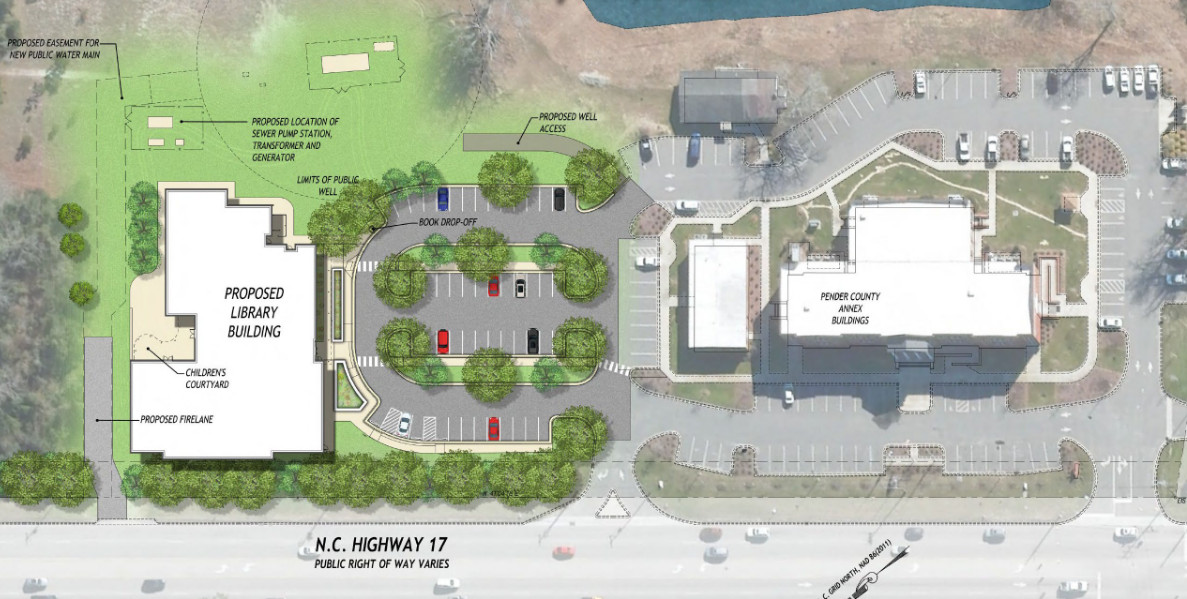
PENDER COUNTY — After being in the works for more than a decade, Hampstead will finally see the construction of a new branch library next year. Though the project is coming in under estimated costs, some commissioners are worried the construction contract left the county exposed to costly delays and unexpected expenses.
The Pender County Board of Commissioners greenlit the Hampstead Library Replacement project on Feb. 17 by approving its $10.8 million budget. They also took up a budget ordinance amendment to allocate an additional $6.9 million from the general fund and a $7.9 million construction contract with Daniels & Daniels Construction Co., Inc. The measure passed 4-1, Commissioner Brent Springer opposed, arguing the construction contract doesn’t do enough to protect county taxpayers.
READ MORE: Voting redistricting resolution tabled as Pender weighs timing, necessity
ALSO: Pender schools to look at policies following booster club arrest
Springer pointed to Central Pender Park, originally budgeted at $3.5 million and slated for completion in September 2025, but as of February 2026, it remains unfinished and over budget.
“The park cost us a lot of money outside the budget and this could have been prevented with a good contract that would protect the county,” Springer said. “If we go and prematurely approve this, what’s it going to cost when something didn’t get caught or something is missed?”
While Springer cast the lone dissenting vote, Commissioner Jimmy Tate agreed with some of the concerns during the board conversation.
“Going forward, I do want to make sure that we stay on top of these projects and we really manage them correctly, because if you don’t, you’re costing taxpayers a lot of money for these change orders and so forth,” Tate said.
The approval marks a notable shift in the project’s financial outlook since its inception. In 2024, early estimates placed the library’s cost at $15.3 million. However, after receiving seven competitive bids, the lowest came in at $7.9 million for the physical build. When factoring in architecture — completed by Sawyer Sherwood & Associates — engineering and site work, the new total budget will come with a $4.5-million savings from the original estimate.
The library project’s budget will be mostly covered by the county’s general fund contribution of approximately $7.87 million. While the $7.9 million construction contract covers building the library, the remaining $2.9 million in the budget will go towards turning the building into a functioning library.
Extra costs are supplemented by a $1 million private donation and $500,000 raised by the Friends of the Library for furniture, books, and technology. The remaining $1.4 million stems from county reserve funds previously set aside for architecture fees, engineering, and site preparation.
If the project were to go over budget, any added expense greater than $30,000 would have to be signed off by the board.
Springer pressed concerns about the American Institute of Architects (AIA) construction contract at this week’s meeting.
“This contract is not to protect the people that donated the money to get this library built,” Springer said. “When you have a change order that’s astronomical because the architect didn’t catch it, guess what? We’re stuck and they’re stuck because we didn’t have a contract that says the architect’s at fault.”
The AIA contract is a nationally used template and common starting point for major building projects. It sets the ground rules between an owner and builder — in this case, the county and Daniels & Daniels — detailing how payments are made, disputes are settled, and changes to the building plan are priced.
Commissioner Springer argued since the templates are created by the architects’ association, they are naturally designed “to protect the architect” rather than the county.
In a standard AIA setup, the architect acts as the administrator between the county and the builder. Springer expressed concern it would create a conflict of interest: if an architect makes a mistake in the blueprints, the contract makes it easy for the builder to demand more money through a change order, while the architect signs off on it to cover the original design error.
Springer linked the library’s contract to the ongoing headaches about Central Pender Park, warning a similar deal could leave the county vulnerable to oversights. The primary reason for the park’s delay is the site’s soil. Originally designed for a septic system, once construction began on the park in 2025, the dirt was found to be unsuitable. Poor soil quality required a transition to a force main sewer system instead, adding an estimated $150,000 to the budget.
Because the park build-out operated under a standard construction agreement that did not require contractors to verify ground conditions prior to excavation, the county absorbed the cost of removing wet soil. To date, the project has generated $289,000 in change orders.
Last month, commissioners allocated an additional $41,000 in leftover renovation funds from the Pender County Courthouse and the Burgaw Probation and Parole building to help cover the overages.
Expressing caution with the library, Springer pushed for a construction contract written from scratch by county legal staff instead of moving forward with the AIA agreement.
Springer clarified he favored approving the budget ordinance and amendment, while withholding the construction contract until legal counsel could bring back a custom version for commissioner review. However, deputy county manager Meg Blue explained the board would likely have to approve the entire package or nothing at all, as the current construction bids would expire if the contract was not signed. Because the bids were publicly opened on Dec. 18, the county had a 60-day window to officially award the contract and lock in the $7.9-million price of construction.
Tate questioned how the library agreement would differ from the park project’s, specifically asking staff attorney Quinton Morgan why a standard AIA contract was recommended over one produced by county legal counsel.
Morgan explained while AIA templates often contain “problematic” terms for a municipality, he “painstakingly” reviewed the document to ensure it complied with state law and county interests. Using the AIA framework as a base, it was modified with a custom addendum and Morgan thought it was the most efficient way to protect the county while securing project bids before they expire. Specifically, the addendum safeguards taxpayers by keeping legal authority in local courts instead of private arbitration and holds the builder fully responsible for any mistakes or negligence.
When asked by Vice Chair Brad George if the county was in better shape with this specific contract than it currently is with the Central Pender Park situation, Morgan responded: “Absolutely.”
“These folks have waited long enough,” Tate said, emphasizing while caution is necessary, the community deserves the new facility.
The push for a new facility in Hampstead began in 2014, when the current library was deemed insufficient to serve the growing population, which has increased from about 4,000 residents in 2010 to over 7,000 by 2020. For more than 10 years, the project remained in the planning phase as the county navigated shifting budget priorities.
The new 15,000-square-foot branch will be more than triple the size of the existing building and located at 15060 US Highway 17. Beyond housing books, the facility is slated to serve as a community hub, featuring expanded children’s areas, dedicated study rooms, and public meeting spaces — amenities the current building lacks.
The construction timeline is estimated at 14 to 18 months. If groundbreaking starts as scheduled in March 2026, Hampstead residents can expect a grand opening in the summer of 2027.
(Ed. Note: This article was updated to include more information regarding the project’s budget, specifically clarifying the $1.4 million in allocated county reserves used for architectural and site engineering costs.)
Have tips or suggestions for Charlie Fossen? Email [email protected]
At Port City Daily, we aim to keep locals informed on top-of-mind news facing the tri-county region. To support our work and help us reach more people in 2026, please, consider helping one of two ways: Subscribe here or make a one-time contribution here.
We appreciate your ongoing support.
