


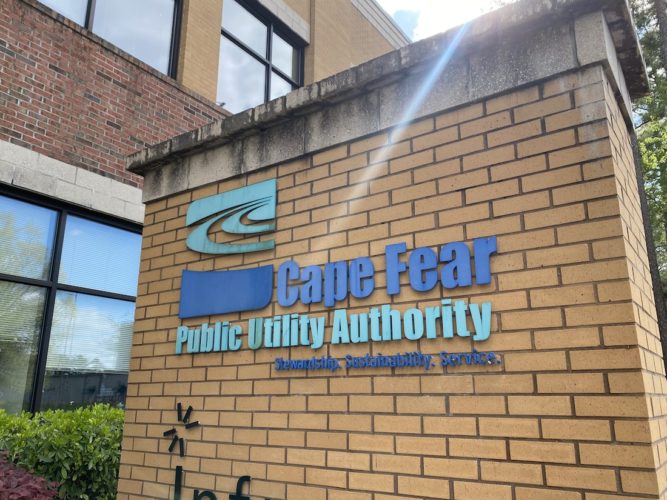
WILMINGTON — The billing apparatus at Cape Fear Public Utility Authority has come into question after one board member highlighted how struggling city customers may be at a disadvantage when it comes to keeping their water turned on.
In 2025, CFPUA had an average of 550 disconnections per month (excluding December), which CFPUA says is average or below its peer authorities. While the majority of disconnected customers were reconnected after one day — and disconnections are only made after several attempts to obtain payment from the customer — CFPUA board member Jessica Cannon thinks the authority can reduce the amount of disconnections by changing what CFPUA bills for.
READ MORE: Wilmington council discuss multi-cent tax increase to accomplish wage, capital project goals
In a Jan. 6 email, Cannon explained the situation to Wilmington council members and CFPUA board members David Joyner and Chakema Clinton-Quintana, both of whom were appointed to CFPUA in December.
A key driver of the disconnect rate is CFPUA’s billing structure put in place in 2008, when the City of Wilmington and New Hanover County merged their utilities into CFPUA. Instead of the city then getting rid of its utility employees, who also handled the city’s trash and stormwater payments, these staff members were transferred to CFPUA, along with the responsibility for billing for both trash and stormwater. The city still runs these operations in-house, but the billing for the services goes through CFPUA.
Customers see this as one sum, inclusive of CFPUA’s water charges, monthly. For city residents, the bill is normally $40 higher due to stormwater and trash; it typically is $8.68 for residential stormwater and $31.12 for a 95-gallon trash cart.
Cannon thinks removing the city’s fees will make CFPUA’s bills more affordable and, thus, reduce disconnections, as people are more able to pay a lower bill. Additionally, if a customer can only buy a partial amount, the city’s charges are covered first by CFPUA, per the interlocal agreement between the two entities.
“This means a customer can pay an amount equal to or greater than their actual water charges because the payment was automatically diverted to the City’s stormwater/solid waste line items,” Cannon wrote in her email. “This structure disproportionately affects lower-income households and renters, exactly the customers least able to navigate penalties or shutoffs.”
Cannon’s theory isn’t just a hunch.
CFPUA recently conducted an analysis of residential customers both inside and outside the city who had at least 12 months of continuous billing between December 1, 2022, and December 31, 2024. The analysis concluded customers whose bills included city charges were, on average, 28.5% more likely to experience a disconnection than customers whose bills did not include the charges. This is true even after accounting for factors such as income, whether a customer rents or owns their home, and enrollment in automatic payment.
Port City Daily obtained Clinton-Quintana’s response to Cannon’s email, where the council member wrote the unintended consequences of the billing structure were “deeply concerning” and “warrants closer review.”
According to Vaughn Hagerty, spokesperson for CFPUA, the issue has come up informally at CFPUA’s board meetings. To change the billing structure, all parties to the interlocal agreement — CFPUA, the City of Wilmington and New Hanover County — would need to agree.
Additionally, the city would need to create a platform to bill for its stormwater and trash services — and also deal with nonpayments when they happen. Hagerty said CFPUA incurs some incremental costs for handling trash and stormwater, but there’s been no study to quantify these costs. He added they are most likely less than the funding the city voluntarily provides for customer assistance programs annually.
Port City Daily asked the city if additional resources would be needed to take over the billing and if the city manager was interested in exploring the prospect to bring to council. No response was received by press.
Port City Daily also asked Joyner and Clinton-Quintana if they would support removing the city’s charges from CFPUA purview.
Clinton-Quintana said, though she is new to the council and CFPUA board, she’s working with the authority and the city manager’s office to fully understand the issue. She wants to explore potential solutions in the best interest of all parties involved, including customers.
“At this stage, no determinations have been made,” she wrote to PCD. “Once that review process is complete and a decision or recommendation is reached, I will be happy to provide an update.”
Joyner said he is awaiting briefings from the city and CFPUA staff on the topic to “better understand the history of this agreement on billing structures.”
Both Cannon’s email and PCD’s inquiry have sparked a pending conversation among the CFPUA board, according to emails obtained by PCD. Kenneth Waldrup, executive director of CFPUA, plans to brief Joyner, Clinton-Quintana, City of Wilmington Chief of Staff Dennis LaCaria, and Deputy City Attorney Mary Vigue at a Feb. 23 meeting.
“It is a complex issue, so we would invite our peers from the city to the table to give them a firsthand understanding of the CFPUA briefing, so they could prepare and give you their perspectives at their convenience,” Waldrup wrote.
Reach journalist Brenna Flanagan at brenna@localdailymedia.com.
At Port City Daily, we aim to keep locals informed on top-of-mind news facing the tri-county region. To support our work and help us reach more people in 2026, please, consider helping one of two ways: Subscribe here or make a one-time contribution here.
We appreciate your ongoing support.
