


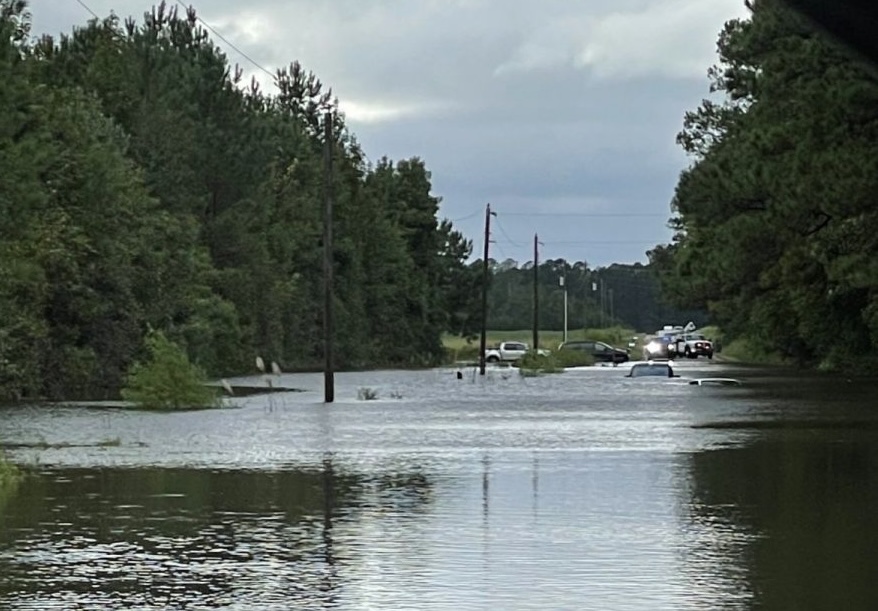
BRUNSWICK COUNTY — New developments in Brunswick County will soon be held to a higher standard of flood protection, as local officials overhaul stormwater rules after repeated flooding issues have surfaced countywide.
In a unanimous vote on Jan. 20, the Board of Commissioners approved updates to the county’s Stormwater Management Manual and Ordinance, raising the county’s stormwater standard from a 25-year to a 100-year storm event. The move followed public pressure in the wake of 2024’s Potential Tropical Cyclone 8, which many residents said indicated previous stormwater regulations were no longer sufficient.
READ MORE: Nudist resort wants to expand to 69 RV sites upon Brunswick County approval
ALSO: One path cleared for Novant Health hospital in 955-acre mixed-use project in Leland
Developers have been required to design stormwater systems capable of managing runoff from storms expected to occur once every 25 years. Under the updated rules, almost all projects must now prove drainage infrastructure can handle storms with a 1% annual probability — commonly known as 100-year events — without increasing runoff beyond pre-development levels.
Precipitation data from the National Oceanic and Atmospheric Administration indicates 100-year events in southeastern North Carolina can dump between 10 to 13 inches of rain over a 24-hour period. By comparison, 25-year storms produce about 7 to 9 inches of rain in the same time period.
NOAA and National Weather Service analyses show heavy precipitation events are increasing in frequency and intensity across North Carolina, with studies projecting extreme rainfall — the heaviest 1% of storms — could become roughly 25% more intense by 2075.
Deputy Engineering Services Director Bridget Flora noted many larger residential subdivision projects are often already meeting the 100-year storm standard voluntarily. However, making the requirement mandatory means all projects — commercial and residential — can no longer bypass the threshold without formal review.
PTC8 was considered a 1,000-year event, bringing extreme rainfall to Brunswick County, with the National Weather Service reporting roughly 12 to 20 inches of rain across parts of the county. The storm caused widespread flooding and an estimated $50 million to $100 million in damages across southeastern North Carolina. Port City Daily asked Brunswick County for an updated estimate of PTC8 related spending. This will be updated upon response.
The new ordinance does include an exemption for smaller project sites unable to physically meet the 100-year standard. For example, a coffee shop planned on a half-acre lot might not have the space to accommodate designing for a 100-year storm, which often requires larger retention ponds and more land devoted to drainage infrastructure. The small amount of land also must account for required parking, setbacks, and other needs.
To qualify for an exemption, developers must demonstrate compliance would make a site undevelopable, while still meeting at least the 25-year storm threshold. Exemptions would first be reviewed by county staff, with appeals coming before commissioners for the final say.
Only one resident spoke during Tuesday’s public hearing — Ernie McLaney, a volunteer spokesperson for Citizens for Better Brunswick. A local non-partisan advocacy group, it focuses on sustainable growth and infrastructure transparency.
While favoring the 100-year timeline, McLaney criticized the new ordinance’s small-site exemptions, arguing it shifts long-term costs from developers to residents.
“If exceptions are allowed, developers save money up front by avoiding full compliance, and then all citizens pay on the back end through stormwater fees, repairs, and damage recovery,” he said.
He also highlighted the economic cost of flooding, citing FEMA research suggesting every $1 spent on mitigation saves approximately $6 in future recovery costs. McLaney argued the cost of failing to mitigate can be higher when factoring in property and infrastructure damage, and business interruption.
Commissioner Randy Thompson echoed McLaney’s concerns and initially moved to mandate the 100-year storm requirement for all projects, regardless of lot size. It received a spattering of applause from members of the public.
On top of being a commissioner, Thompson is the chief executive officer of Thompson Disaster Recovery Associates Inc., which advises government agencies on disaster preparedness, recovery, and emergency management. He also served as Brunswick County’s emergency services director from 2000 to 2009.
“If you’re in and can be impacted by the 100-year, why not build it to that and make sure that you are covered all the way around as far as the buildability of the land,” Thompson said. “I don’t see where the minimum design for the 25-year should even be in place.”
However, county attorney Bryan Batton cautioned Thompson’s motion, explaining removing all exemptions could be considered as “government taking.” Simply stated, “taking” occurs when government regulations are so restrictive they strip a property of all practical or economic use.
If the ordinance provides no path for relief or appeal, the owner could sue the county for the full value of the land.
Multiple commissioners chimed in, asking staff what specifically constitutes a “small site” for exemption. Flora said they are not defined by a specific acreage, but refer to compact commercial lots where meeting the 100-year standard would be difficult due to lot size.
After debate, Thompson ultimately amended his motion to align with staff recommendation, maintaining exemptions for smaller sites unable to meet the standard due to technical constraints.
To prevent retention ponds from consuming excessive buildable land, the updated rules allow developers to use emergency spillways — an outlet to release water from retention ponds during heavy rain. Developers can design ponds to hold the 100-year volume, but they are allowed to use a reinforced spillway to “bleed off” excess water in a controlled manner during extreme events, rather than requiring the pond walls to be built high enough to contain the entire surge.
Although emergency spillways were not previously required under the county’s stormwater rules, they have been commonly included in engineering designs. In practical terms, the change allows developers to meet the 100-year standard without dedicating as much land to retention ponds, while still reducing flood risk.
The regulation change comes as the county is also exploring the possibility of implementing a stormwater utility department, which would be funded through a dedicated fee paid by property owners. The fee would support maintenance and improvements to stormwater infrastructure, including drainage and retention systems.
Stormwater management is currently handled by county engineering and public works departments, with costs covered through the county general fund and state and federal grants. A feasibility study for the utility fund is underway, though a proposal has yet to come before the board.
Have tips or suggestions for Charlie Fossen? Email [email protected]
At Port City Daily, we aim to keep locals informed on top-of-mind news facing the tri-county region. To support our work and help us reach more people in 2026, please, consider helping one of two ways: Subscribe here or make a one-time contribution here.
We appreciate your ongoing support.
