


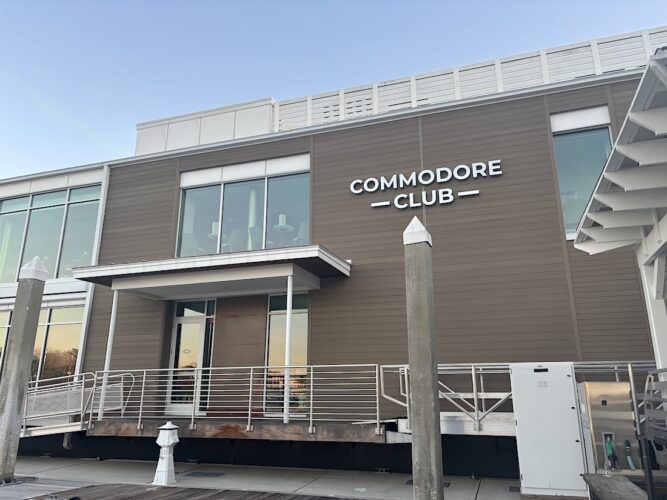
WRIGHTSVILLE BEACH — A private club is at the center of a debate about what is considered “public access” in Wrightsville Beach. Some are questioning whether the Commodore Club is following through on what aldermen approved in its special use permit a few years ago. The town has issued a notice of violation to correct the measures.
Standing more than 28 feet tall in the marina, the Commodore Club’s floating structure was allowed to dock at the Wrightsville Beach Marina in 2020. The town granted the club a special-use permit with a few stipulations, one of which requires the club to grant public access to its first floor.
READ MORE: Lifeguard pay raises, bulkhead repairs: WB aldermen take first votes of the new year
Operating since 2024, the Commodore Club is located at 6 Marina Street, with membership costing $32,500 — not including application fees and annual dues at $2,500. Last reported in 2024, the club had 400 memberships; members are encouraged to dock at the marina before dining at the club.
The club was created to be an added amenity for Wrightsville Beach Yacht Club members and the Wrightsville Beach Marina. The Commodore Club contracted Giorgios Bakatsias from Giorgio’s Lifestyle and Hospitality Group to run its facilities, but a six-member board makes the club’s decisions, including handling strategic planning and finances.
The second floor of the club is restricted to members, while the first floor is open to the public with reservations. However, it will cost nonmembers $100 a person just to step foot into the restaurant.
“That was never the spirit of the deal,” current Mayor Ken Dull told Port City Daily.
Dull was one of the aldermen who voted in favor of the special-use permit six years ago. As part of its nine conditions is public access and the board of aldermen also wanted to ensure the club met the aesthetic of the neighborhood and didn’t infringe upon local business’ and residents’ view of the waterway.
Wrightsville Beach resident and former mayoral candidate Henry Temple takes issue with charging general diners for a reservation because the waters along the Intracoastal Waterway are open to anyone.
According to Wrightsville Beach’s Coastal Area Management Act Land Use Plan, adopted in 2018 and implemented in 2019, public access to waterways, navigational channels, and public view of the waters cannot be blocked off by structures, either by the seaside or on the water. Temple called it a public right and believed the club took that from residents.
“The town got assurance that the public could use certain parts. I thought that was pretty straightforward,” Temple said. “But that’s not the way it is.”
When the Commodore Club application was first submitted in 2019, there was no public access to the restaurant in its plans, as it was going to be exclusive to members only. The planning board denied it, insisting the club had to invite the public in.
While the pier is not public property, as it is owned by the Wrightsville Beach Marina and Yacht Club, its location in the water led to the addition and requirement of the public access condition for Commodore Club to receive permitting.
“What we’re going to propose for the board’s consideration is the first level of the restaurant portion of this marina restaurant would be open to the public, and then the second level would be an amenity for the members of the Wrightsville Yacht Club,” the club’s attorney Matt Nichols said at the July 2020 planning board meeting. “We thought that was a good compromise.”
The planning board held at least three meetings about the Commodore Club before it was approved by the aldermen in July 2020. The board faced concerns over whether the club would be up to code and fit the aesthetic and height of the area. The Commodore Club is the tallest structure in the marina and then-planning board member Thomas Cofer took up for the public’s right to enjoy the waterway without obstruction.
“I think that the public has a right of enjoyment to view,” he said. “When you are talking about building out in the sovereign water, the town does have a responsibility to protect some views.”
The Commodore Club’s permit went to the board of alderman first in June 2020 to vote on a text amendment to allow floating homes and restaurants in the C-3 commercial zoning district, which passed by the planning board 6-1 in recommendation. The following month the club asked for its special use permit.
Planning Director, Tony Wilson, and then-Town Attorney Brian Edes reiterated to the aldermen its public accessibility.
“In the beginning, it was a larger structure with more people. In the very beginning, it was just for the private club,” Wilson said, adding the planning board made changes across three meetings. “[A]nd made some changes to open it up to the public on the first floor and reduce the size of it. So with those changes, staff does support the conditional use permit.”
Fast forward to 2026 and former Alderman Hank Miller and now-Mayor Dull, both of whom voted in favor, have come to a singular conclusion: What the club considers public accesst today — charging for reservations — is not what the five-member board had in mind when it voted unanimously to approve Commodore’s permit.
“It was our job to decide: Is this a benefit to the town? How is this good for the people of our town?” Dull said. “Because if this is just a private club and it benefits only the members — who might mostly not even live at Wrightsville Beach — why would we approve something like that? And the answer is: We wouldn’t.”
Port City Daily reached out to most Commodore Club board members, including Stacy Ankrum, Wesley Wooten, Clayton Gsell, Nathan Singerman, and Ryan Legg; a contact for Francis Shepherd couldn’t be located. PCD asked why the board decided to charge $100 to the public for its reservation fee and if they thought the decision was in line with the permit conditions. No one responded by press.
A background source said the reservation fee was not implemented to be elitist. Rather, it came down to finances and the club’s expenses, though numbers weren’t provided.
The Commodore Club is registered as a 501(c)(7), a tax exempt social club. ProPublica’s Nonprofit Explorer database shows the most recent 990 tax form from the club filed at the end of 2024 has $2,334,181 in revenue, but expenses at $1,413,555, leaving the club with a net income of $920,626. The club’s total assets are listed at $9.25 million.
A permit stipulation was included from the planning board that if the club did not adhere to nine conditions, it could result in a revocation of its permit — as agreed upon by the aldermen.
Bill Blair was the former mayor of Wrightsville Beach when the Commodore Club was granted “public/private entity” status by the town — and he served as WB Board of Adjustment chair until recently. Blair agreed that while not meeting a requirement for a conditional use permit could result in revocation, it could also mean permanent closure of the Commodore Club.
“If they violate the SUP, then the town can bring the SUP back up for renegotiation,” he said. “Or if they violate it, [the town] can actually technically close the Commodore Club. They can pull the SUP.”
The Town of Wrightsville Beach responded after press, due to its closure for the Martin Luther King Jr. holiday, that a notice of violation was issued to the Commodore Club at the end of October. According to the document, the town received several complaints about the facility fee required of the public.
The notice stipulates the following remedies to the violation:
- The club will seize charging a facility fee
- Within 10 business days of receiving the notice, the club will have to send the town written confirmation of its operating routine and how it was maintaining public access
- Also within 10 business days, the club will have to take down any and all mention of a facility fee, including from its website
The language is still on the website, however, as of Jan. 20.
Fines associated with the violation are typically $50 a day, according to Town Planner Wilson. But the club hasn’t paid any fines to date because it is attempting to appeal the violation.
The town informed Port City Daily the Commodore Club was interested in addressing the interpretation of public access in the original agreement before the Board of Adjustment. The town did not answer PCD’s questions about when the club would go before the BOA and its basis of appeal.
According to Mayor Dull, the town’s attorney, Grady Richardson, and the club’s attorney have been discussing the matter privately in recent weeks in hopes of remediation.
Port City Daily reached out to other sitting aldermen for input but did not hear back by press.
Have tips or suggestions for Emily Sawaked? Email [email protected]
At Port City Daily, we aim to keep locals informed on top-of-mind news facing the tri-county region. To support our work and help us reach more people in 2026, please, consider helping one of two ways: Subscribe here or make a one-time contribution here.
We appreciate your ongoing support.
