


SOUTHEASTERN NC — The North Carolina Department of Public Instruction unveiled school performance grades at a meeting on Wednesday, showing student scores are rising slowly but have yet to return to pre-pandemic levels.
READ MORE: School bond projects ranked: Riverlights and NHHS at top, Isaac Bear removed from list
In the tri-county region, Pender County has succeeded in reducing its number of low- performing schools, while New Hanover County increased by four and Brunswick one.
Each September, NCDPI presents data from the prior school year to the State Board of Education, including student performance on state-required tests and academic growth outcomes for all schools. Both metrics are combined (80% test scores and 20% growth) into a school performance grade. From there, schools that earn a D or F grade are considered low performing, unless they exceed growth expectations.
Statewide, the number of schools earning a D or F declined by nearly two percentage points and around 71% of schools met or exceeded growth in 2024-2025. As a result, nearly 50 fewer schools were designated as low performing in 2024-2025 compared to the previous year. There were also 60 fewer schools designated as continually low performing in the same span.
Pender County cut its number in half this year, going from six to three low-performing schools.
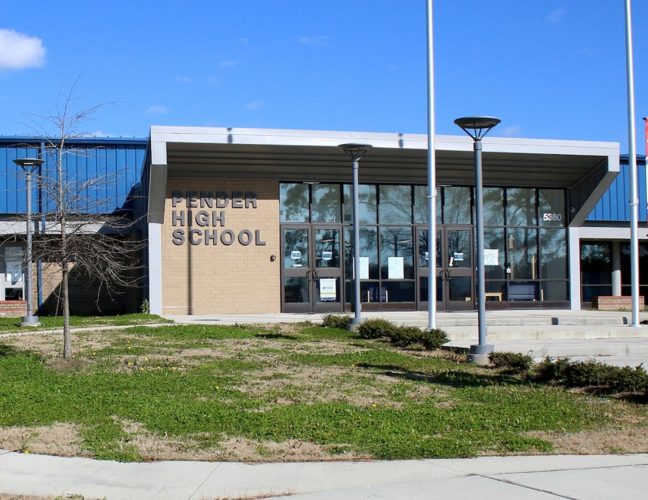
Last year, C.F. Pope Elementary, Malpass Corner Elementary, Penderlea School (K-8), Burgaw Middle School, West Pender Middle School, and Pender High School are all recurring, low-performing schools and achieved D grades.
This year the schools still received D grades, though four exceeded growth metrics and therefore, are not considered low-performing. These schools include Malpass Corner, Burgaw Middle, Cape Fear Elementary and West Pender. Both Penderlea and C.F. Pope improved their numerical score and met growth; Pender High was the only school to lose points and not meet growth.
Cape Fear Elementary also remains a D school, though it exceeded growth both years.
In a press release on Wednesday, PCS boasted other successes including:
- All elementary schools met or exceeded growth in reading
- Middle school scores in reading and math both increased
- PCS students earned 7,400+ CTE credentials with an 88% attainment rate.
- High school students saw a 10% increase in Math III proficiency, along with improved ACT and WorkKeys results.
- The district’s graduation rate remains in the mid-90s, above the state average.
“These results reflect the dedication of our teachers, students, and families,” Superintendent Brad Breedlove said in the release. “We are seeing steady growth across the district, and while we acknowledge there is still work to be done, our focus remains on providing every student with the resources and support they need to succeed in the classroom and beyond.”
As noted by Superintendent Breedlove, the state has implemented new state standards in science, which have contributed to lower results in grades 5 and 8 and in high school biology. These scores also factor into the overall test scores for schools.
Brunswick County added one school to the low-performing list, which includes:
- Bolivia Elementary, 52 (D)
- Cedar Grove Elementary, 50 (D)
- Leland Middle, 47 (D)
- Lincoln Elementary, 52 (D)
- Supple Elementary, 49 (D)
Lincoln Elementary was new to the list after earning a C grade of 59 last year; none of this year’s low-performing schools met growth expectations.
New Hanover County Schools saw more of a backslide in their performance metrics, but mostly due to not exceeding growth metrics, as many schools’ test score composites improved.
New Hanover saw more of its schools returning to a low-performing status. This year’s schools include:
- Rachel Freeman, 27 (F)
- College Park Elementary, 45 (D)
- Alderman Elementary, 42 (D)
- Forest Hills Global Elementary, 51 (D)
- Blair Elementary, 51 (D)
- Career Readiness Academy at Mosely, 49 (D)
- Sunset Park Elementary, 51 (D)
- Snipes Academy, 44 (D)
- Williston Middle, 34 (F)
- Wrightsboro Elementary, 48 (D)
The NCDPI report card has been a sore point for New Hanover County Schools since the Covid-19 pandemic, when the district had 11 schools considered low-performing. In the next school years, the district brought them down to seven and then six in the 2023-2024 year. Last year, though they received Ds, recurring low-performing schools Williston and Snipes exceeded growth.
Williston has now slumped back down to an F after moving up to a D last year. Returning to the list are Sunset Park and Blair elementaries; Blair had a score of 62 (C) last year but dropped 11 points this year to a D. Sunset Park remains at a D, though did improve its score by two points; this year, however, it did not exceed growth expectations.
Port City Daily reached out to NHCS for comment but did not receive a response by press.
The remaining schools are considered recurring low performing, though scores have improved for each, aside from Alderman Elementary. After rising to a D for the first time last year, Forest Hills remained at a D and added seven points to its score, bringing it to 51. Mosley, after enduring the district’s proposal to shut the school down before the 2024-2025 school year, improved its score of 39 (F) last year to 49 (D) this year.
Despite the required school-improvement plans for low-performing schools, NHCS has long struggled with its strategy for pulling its schools into passing territory.
Some board members, current and past, have pointed to the concentration of minority groups and students of lower socioeconomic classes into the low-performing schools, largely a result of NHCS’ neighborhood schools districting. This model insists children attend the school closest to them, intended to help foster community, though Wilmington neighborhoods are a culmination of years of racial segregation.
Demographic breakdowns provided by the state show the current model may not be serving students of color as well as their white counterparts. White student proficiency came in at 76%, while Hispanic students were at 40%, and Black students 30%. College and career readiness proved less bright, with white students at 57%, followed by 24% of Hispanic students, and 14% of Black students.
Commissioner Stephanie Walker, when she was still on the school board, introduced the Turnaround Taskforce to address consistently low scores at 12 schools around the district. Earlier this year it concluded its work after two years with a report on suggestions. Essentially, they came down to redistricting or putting millions of extra dollars into those schools where poverty is concentrated. The taskforce suggested $18 million worth of enhancements to the district to improve target schools, as reported by WHQR.
At the very least, the state requires districts to provide school improvement plans for its low performers, which will be made public.
The full school performance report and data dashboards, which include more detailed breakdowns for each school, can be found here.
Have comments or tips? Email info@portcitydaily.com.
Want to read more from PCD? Subscribe now and then sign up for our newsletter, Wilmington Wire, and get the headlines delivered to your inbox every morning.
