


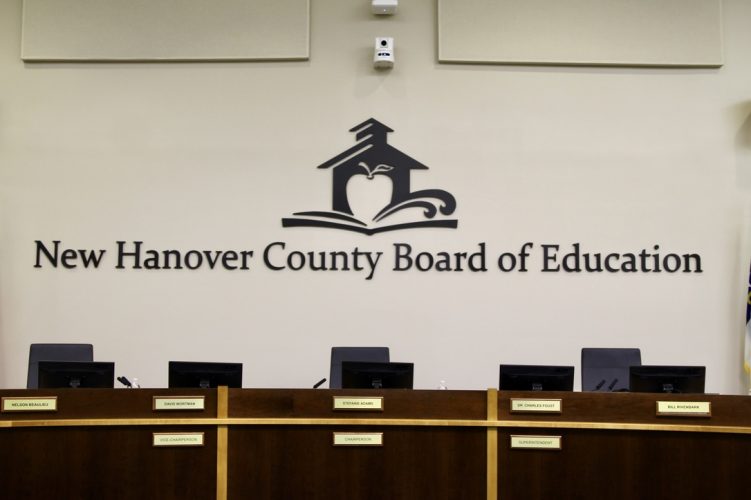
NEW HANOVER COUNTY — Two resolutions aimed at the state government — one advocating for the release of hundreds of millions of dollars in funding and the other supporting law changes to address student vaping — were voted down by the New Hanover County Board of Education Monday.
READ MORE: New Hanover County school board overrules committee decision, bans ‘Stamped’ from curriculum
According to the dissenters, both resolutions were not within the purview of the school district.
“We’re stepping into state stuff that I just don’t think this is our lane, although I’m really torn because I want to support every good thing that comes along,” board member Pat Bradford said, despite saying she could pass out if exposed to smoke from tobacco products. “But I also want to get back to the three goals of our school district — safety, academic performance and communication — and focus our time in these meetings on that.”
Despite multiple board members repeating Monday the need to stay in their lane, resolutions have been passed by the cohort before. In 2023, the board requested the State Bureau of Investigation release its report on the district’s culpability in student sex abuse cases; board members David Perry, Judy Justice and Tim Merrick were not on the board at the time. However, earlier this year, the board supported a letter to the state attorney general urging an investigation into the PowerSchool breach.
Both of Monday’s resolutions were brought forth by Merrick. The vaping resolution affirmed support for Solly’s Law, state legislation that would require tobacco retailers to obtain a permit, sets up a directory of allowable tobacco products and lays out penalties for selling tobacco to those under 21.
Though a 2019 federal law made purchasing tobacco under 21 illegal in each state, this law would affirm that regulation and remain so if the federal law was ever repealed.
The state legislation has bipartisan support, including from Rep. Ted Davis (R-New Hanover), though it remains in the House of Representatives’ rules committee. The bill is being referred to locally as “Solly’s Law” after an NHCS student, Solomon Wynn, died of lung damage attributed to vaping.
Wynn’s stepmother, Charlene Zorn, was present Monday at the board’s agenda review to share more about Solly’s Law.
“There’s over 100 signed resolutions between health departments, school boards, community organizations supporting Solly’s law … if we don’t say we’re helping North Carolina support this, what are we saying to our other students? What are we saying to my son’s friends that are playing football right now in Hanover?” Zorn said to the board.
Still the resolution failed in a 5-2 vote, Merrick and Justice the only ones in favor.
Board member Perry, who said picking up smoking was the “one of the dumbest decisions he ever made,” couldn’t get behind the resolution because of his disagreement with the age requirement. He explained that if an 18-year-old was old enough to vote, serve in the military or law enforcement, they were old enough to purchase tobacco.
For similar reasons to the federal drinking age being 21, research shows reducing smoking in people under 21 can benefit brain development and overall health, and could prevent someone from smoking throughout their life. Data from the Department of Health and Human Services shows three quarters of teen smokers keep up the habit into adulthood, even if they say they intend to quit.
The rise of vaping products has largely reversed the downward trend in tobacco sales. Data from the 2024 National Youth Tobacco Survey showed that 5.9% of middle- and high-school students self-reported using electronic cigarettes in the past 30 days. Almost half of underage users report getting their products from a retail source.
Merrick said he agreed with Perry that 18-year-olds should have certain rights, but their decision-making is hindered by the lack of a fully developed pre-frontal cortex, responsible for planning, decision-making, working memory and regulating behavior. The cortex isn’t typically complete until the mid-to-late 20s.
Board member Josie Barnhart said she didn’t think the resolution adequately addressed minors, meaning those under 18, and that the school district should have other conversations about reducing vaping. She pointed to some schools use of receptacles to collect unwanted vapes and the potential installation of vape detectors in the bathrooms.
“Can we pursue something that actually gives accountability with [enforcement of retailers]?” Barnhart said. “Because I absolutely agree, when I started looking into and having conversations with our sheriff, they can’t, they can’t go after the store owners for that because it’s not their jurisdiction.”
Solly’s Law does create an enforcement apparatus by giving permitting authority to the Alcoholic Beverage Control Commission and enforcement of the law to the Alcoholic Law Enforcement.
As for criminal penalties, the bill would make it a Class 2 misdemeanor to sell tobacco products to someone under 21 and for an underage person to attempt to buy products using a fake I.D.
With its permitting authority, the ABC Commission would have the discretion to grant permits based on:
- The reputation, character, and criminal record of the applicant
- Any other evidence that would tend to show whether the applicant would comply with the tobacco retail sales laws
- Whether the operation of the retail seller permit applicant’s business at that 30 location would be detrimental to the neighborhood, including
- Past revocations, suspensions, and violations of ABC laws within the past 12 months
- Evidence of illegal drug activity on or about the licensed premises Evidence of fighting, disorderly conduct, and other dangerous activities
Permits, application fees being $400, would be good for one year. The ALE would be given the power to investigate premises for alleged violations and issue fines or revoke or suspend permits.
The passage of Solly’s Law would remove North Carolina from the list of 10 states that don’t require retail permits for tobacco sales, either traditional or e-cigarettes.
The Leandro plan
After voting down the Solly’s Law resolution, the board struck down support for releasing Leandro funds.
Leandro refers to the Leandro Comprehensive Remedial Plan that formed out of the 1997 North Carolina Supreme Court case Leandro v. State of North Carolina. Five rural school districts argued they did not have enough money to provide an equal education for their children, a right set out in the state constitution. The court sided with Leandro, though no significant funding change followed.
After a consultant developed recommendations in 2018, the parties involved in the Leandro case came up with a $5.6 billion, eight-year remedial plan. It identifies targeted investments in public education that North Carolina must make in order to ensure all children have access to a sound, basic education.
In 2021, Judge Lee ordered defendants in the Leandro case to take action to implement the remedial plan. This decision was appealed, leading to the 2022 case finding the state was underfunding the plan.
A judge ruled the state is obligated to carry out the remediation, though the court, due to the separation of powers between the two branches, could not order the legislature to do so. When the court’s decision came down later in 2022, the majority opinion said deference to the legislative branch was over, as the court could no longer “wait for the day, year, or decade when the State gets around to acting on its constitutional duty.”
However, the case is now being taken up by the court again under a new Republican majority.
The resolution proposed by Merrick calls for the full full implementation of the Leandro plan and calls upon the General Assembly, Governor Stein, and all state officials to:
- Uphold their constitutional duty to provide every child a sound, basic education
- Ensure that public school funding is not undermined by expanding private school voucher programs
- Release without further delay the funds required to implement the Leandro Plan in accordance with the 2020 Consent Order and the 2022 NC Supreme Court decision.
Perry said, while he thought the board could agree the state needed to increase education funding, the Leandro case wasn’t the right avenue to advocate for it.
“The judges are there to interpret the law and not make the law,” Perry said.
He added he didn’t think NHCS would receive a large sum compared to other, less affluent districts; NHCS was estimated to get $51 million for K–12 education and an additional $5.6 million for early education programs under the plan.
Instead, Perry said he would like for the district to advocate the state change its public school funding model.
Merrick and Justice argued the district could advocate for a different model and Leandro at the same time, noting the benefit more money could bring to the local economy.
“A better educated populace makes a populace that makes a better community because it’s a democratically educated community, it adds to the job base, and then it’ll add, eventually, to the tax base,” Justice said.
She also pointed to the state’s surplus of funds as evidence the General Assembly could do more; the state has predicted a $544 million surplus this year and revenues have exceeded budgeted amounts by 10% in the last three fiscal years.
Bradford said she didn’t see the point in putting energy toward something that’s been tied up in court for 30 years. She also took issue with singling out private school vouchers; the General Assembly voted in 2023 to eliminate income restrictions on obtaining financial assistance to attend private school.
Money is now provided on a sliding scale based on need, though recent data shows the vouchers disproportionately benefit wealthier families, as 87% of 2024-2025 recipients had never attended public school.
“There’s a little line in here that says, ‘ensure that public school funding is not undermined by expanding private school voucher programs,’ so it’s got a little hidden agenda in here,” Bradford said. “I am not in favor of that. I want every kid and every family to have the opportunity to go to whatever school they want and take their money. When New Hanover County schools become excellent — as excellent as they will be — then kids will come back to our schools.”
The idea of better attracting kids that have left public schools for charter and private options was discussed at the board’s August town hall.
Barnhart, referring to the Leandro plan as “outdated,” then made a motion to support the board’s already agreed upon legislative agenda.
The motion was intended as a substitute for Merrick’s to pass the resolution, but Merrick took issue with Barnhart’s request being a “diversion” from his original intent. He questioned if this was allowed, but the board attorneys were unable to provide an answer.
Ultimately, Barnhart’s substitute motion passed 5-1, Merrick and Justice dissenting. Merrick’s motion was not taken up for a vote.
After voting, the attorneys weighed in that the board needed to vote on the validity of a substitute motion before voting on the substance of motion itself, which is not what had occurred. However, instead of going back to redo the process on Merrick’s motion, Chair Melissa Mason said they would move on.
“In the future, that’s the protocol we will take,” Mason said. “But because we have already been and we already got the previous advice from our legal counsel, we’re going to continue.”
Reach journalist Brenna Flanagan at brenna@localdailymedia.com.
Want to read more from PCD? Subscribe now and then sign up for our morning newsletter, Wilmington Wire, and get the headlines delivered to your inbox every morning.
