


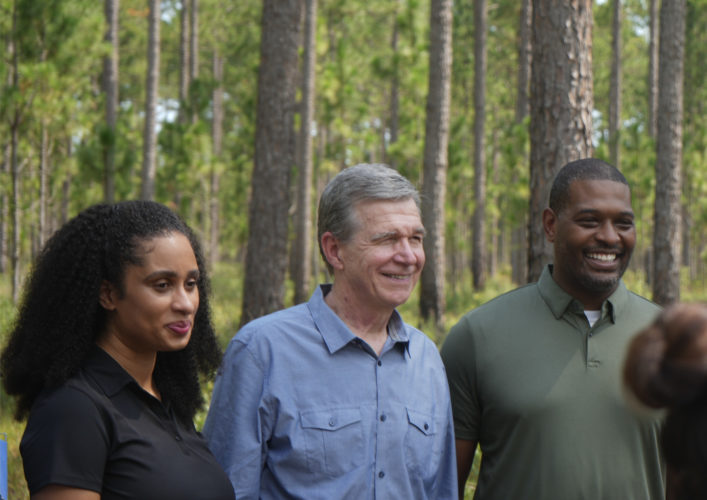
BRUNSWICK COUNTY — Tuesday afternoon, Governor Roy Cooper and Environmental Protection Agency Administrator Michael Regan visited a prominent Brunswick County nature preserve to celebrate new federal grant opportunities for conservation projects in North Carolina.
READ MORE: NC to receive $117.8M for environmental projects
ALSO: No. 4 Most Read Story of 2023: Forest service launches investigation into Green Swamp wildfire
It comes on the heels of last week’s announcement that the state will receive $117.8 million from the EPA’s $421 million Climate Pollution Reduction Grant. The money will boost natural land conservation, restoration projects in coastal habitats, and carbon reduction statewide. Cooper said some of the funds would go toward conserving Brunswick County’s 15,900-acre Green Swamp Preserve.
“Think of what this swamp can do for our environment and for our resilience,” he said. “This swamp and others like it soak up potential flood waters, reduce carbon release into the air, and create a great space for recreation and for families to go.”
Regan — former secretary for N.C. Department of Environmental Quality — noted the preserve contains peatlands, a type of wetland with a high proportion of partially decayed organic matter in its soil that is uniquely capable of retaining carbon.
“The peatlands here in the Green Swamp Preserve have been around for millenia,” Regan said “Remaining natural and undrained, the way a peatland is supposed to be.”
The Atlantic Conservation Coalition, a regional collaboration of organizations focused on natural climate solutions from North Carolina, South Carolina, Maryland and Virginia, is the grant recipient. ACC partners, including the North Carolina Coastal Federation, North Carolina Forest Service, and the N.C. Nature Conservancy, will help determine locations for grant-funded projects over the next five years.
The Nature Conservancy manages Green Swamp preserve and surrounding acreage to ensure it remains undeveloped. It has worked to restore degraded peatlands by installing water control structures to maximize flood resiliency and habitat conservation.
Peatlands occupy around 3% of global land area but retain twice as much carbon as the world’s forests, making them a core focus of natural carbon sequestration efforts. A 2022 Communications Earth & Environment study found peatland drainage and development release 5% to 10% of annual anthropogenic carbon emissions.
“Restored peatlands also have benefits including absorbing floodwaters, which is particularly important on our hurricane-prone coast,” Nature Conservancy executive director Katherine Skinner said. “And, of course, restored peatlands provide habitat for a myriad of animals, which boosts our economy through hunting and wildlife-watching.”
EPA region four administrator Jeanette Gettle told Port City Daily communities in New Hanover, Brunswick, and Pender counties are encouraged to apply for new EPA grant opportunities. Resources will be allocated in a competitive process using criteria including community need and climate pollution reduction.
Department of Natural and Cultural Resources Secretary Reid Wilson said his agency will work closely with ACC to ensure there is extensive community outreach and input for grant-funded projects. A minimum of 40% of total funds will go to historically underserved communities disproportionately impacted by environmental degradation.
Cooper said part of an executive order he issued in February — which set statewide goals, including conserving 1 million acres of natural lands — is mapping environmental justice issues throughout the state to identify community concerns.
“In the next week or so we’re going to have a meeting of leaders from communities who are involved in environmental justice to help us make that map the very best it can be,” he said.
Environmental sociologist La’Meshia Whittington praised Regan, Cooper, and Wilson for emphasizing community engagement in the new grant strategy.
“You can’t remove contaminants if you don’t remove contaminants in the most contaminated areas of our state,” she said.
Whittington — president of Raleigh-based Democracy Green and a member of the Department of Environmental Quality’s Environmental Justice and Equity Board — told Port City Daily her organization prioritized PFAS cleanup efforts in Brunswick County due to its status as one of the most highly contaminated areas in the nation. She described the Green Swamp Preserve’s location in Supply — an unincorporated area in Brunswick County — as a focus of local workshops that have trained over 500 residents.
Whittington cited a 2014 settlement between a Supply-based community group and Brunswick County as an example of the power of local community engagement. The Royal Oak Concerned Citizens Association alleged a pattern of racial discrimination culminating in a lawsuit against the county to stop a rezoning in its community to expand Brunswick’s landfill.
“They won and that reduced the pollutants that go right here to Green Swamp,” she said. “When we talk about communities showing up, we’re just talking about letting them tell their own stories, talk about their own legal wins, and understand that this money is going to actually help us cleanup that PFAS.”
Democracy Green started engaging DEQ on environmental issues after realizing the extent of the state’s water contamination — including PFAS, coal ash, and animal waste — after carrying out rescue efforts during Hurricane Florence in 2018.
“We’ve heard La’Meshia’s impassioned plea,” Cooper said. “I’ve heard it. They are getting power now. These communities are getting power, they are being heard. It’s the right thing to do so that we have a North Carolina that works for everybody.”
Tips or comments? Email [email protected].
Want to read more from PCD? Subscribe now and then sign up for our morning newsletter, Wilmington Wire, and get the headlines delivered to your inbox every morning.
