


WILMINGTON — Most residents have been susceptible to stopping at a red light, wondering if a few dollars will provide temporary relief to an individual patiently standing outside the window holding a handwritten sign, “Anything helps.”
Metropolitan areas throughout the country have implemented efforts to provide resources and reduce panhandling. Locally, the City of Wilmington is encouraging residents to support nonprofits, instead of providing a one-off donation to an individual.
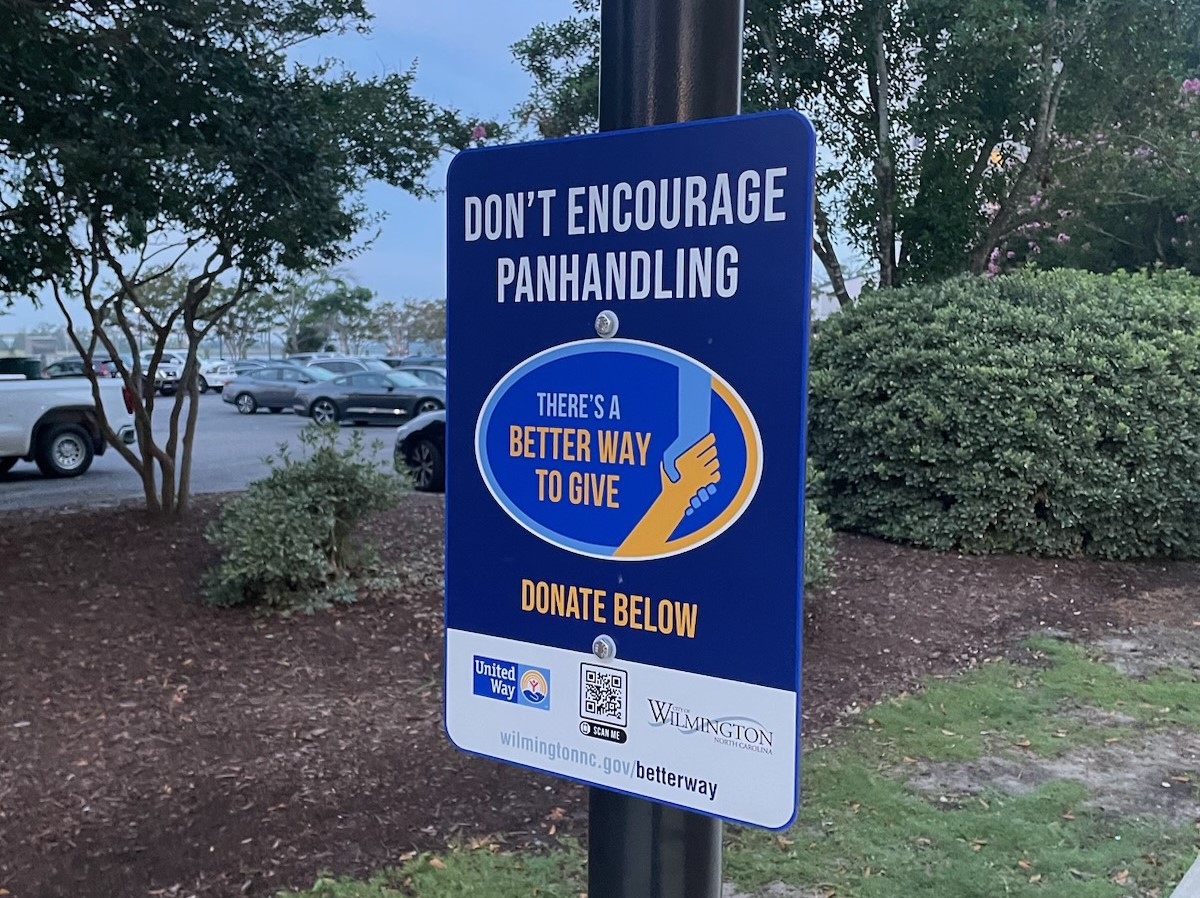
The city’s new campaign, “There’s a Better Way to Give,” launched last month in partnership with United Way. People are encouraged to donate to the nonprofit by scanning a QR code on signage placed downtown. The donations go to United Way, which supports organizations working directly with the most vulnerable populations, including homeless, disabled, and financially burdened.
Whether the initiative, also implemented in various U.S. cities, is successful or not remains unclear. Representatives from towns in South Carolina, Washington and Tennessee have posted signage discouraging panhandling and replacing it with charitable giving to organizations; some said they have not tracked the success.
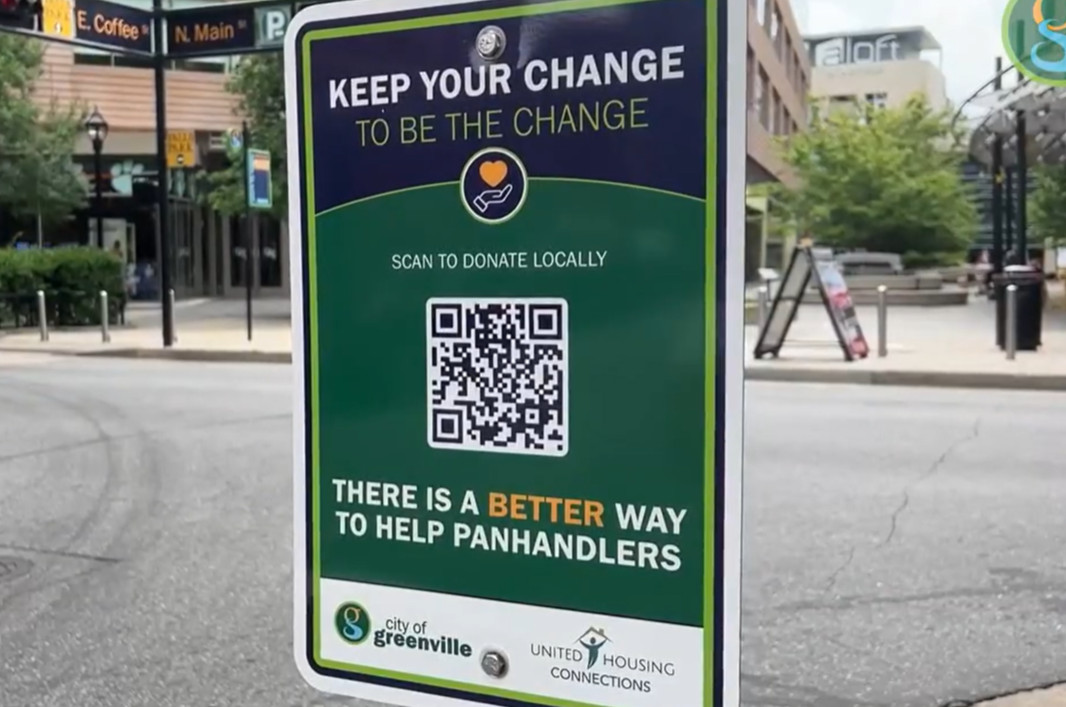
Last summer, when the city began to explore alternative options to giving to panhandlers, deputy city manager Thom Moton said he was in contact with staff in Greenville, S.C., who adopted a similar initiative in 2020. Greenville’s signage directs residents to donate to United Housing Connections, linking people at-risk for or experiencing homelessness with sustainable housing.
Port City Daily reached out to the city of Greenville asking if their efforts have been successful in reducing panhandling. Greenville assistant manager Megan Young did not answer the question.
“While offering money to someone asking for help might feel like the right thing to do in the moment, often it is this kind of support that keeps people on the streets,” she said. “Downtown merchants and restaurants have tabletop information and cards to share with patrons of their businesses that outlines the program and encourages donation.”
Wilmington posted its first 10 “There’s a Better Way to Give” signs downtown throughout the central business district. The city paid $380 for the signs and has launched a webpage, social media, and co-sponsored an op-ed in the Wilmington Business Journal advocating for the initiative.
City officials and United Way CEO and president Tommy Taylor said giving directly to an organization that supports people in need is a better way to address the root problems of why someone might be homeless, hungry, or financially burdened.
Cape Fear Council of Governments director Judy Herring told Port City Daily panhandling is “not synonymous with homelessness.” The COG oversees management of the Cape Fear Continuum of Care, a consortium of nonprofits supporting the homeless population.
“I think it is important to correct the assumption and understand that the goal of the signs is to reduce panhandling,” Herring said.
During last year’s discussion about the program, council member Charlie Rivenbark had a similar thought.
“What do we know about these people?” he asked. “I recognize immediately a lot of people who camp at the library … But I don’t see the same faces at the same intersections. They’re the cause of why we’re having this discussion. They could be getting $200 or $300 a day. I’m not so sure everyone we see on the street corners is homeless or suffering from mental illness.”
Moton agreed and said there would be an outreach component to the campaign identifying exactly what it is someone may be lacking and connecting them to the right resources.
“We can determine which ones are in dire straits and need the assistance,” he said.
“The city and county have efforts to proactively reach out to those on the street and connect them with services to meet a wide breadth of need,” city spokesperson Jerod Patterson told PCD last week. “By shifting patterns of giving, more people can be connected to comprehensive services.”
Specifically, he was referring to the city and county’s joint Getting Home initiative. Launched in December, it pairs up county social workers and Wilmington Police Department officers to engage with those experiencing homelessness and connect them to proper resources.
Also Wilmington Downtown Inc.’s street outreach program has the same mission, geared primarily in downtown.
Herring said the Cape Fear CoC was not consulted in the creation of the panhandling signage initiative, and she “has no expectation” funds collected will go specifically toward homeless services.
“Since this program is not specific to homelessness, the public should not see this as a replacement for specific community activities related to reducing homelessness nor as a replacement for community funding necessary to reducing homelessness in the City of Wilmington,” Herring added.
Taylor said the nonprofit has launched a separate account to collect funds from the “There’s a Better Way to Give” campaign. It will ensure any donations received are compiled for the specific purpose of investing in homeless services.
The goal is to analyze what funding and services are already in place and find a way to tailor the investment to fill needed resource gaps, Taylor explained. Therefore, exactly to whom the money will go has not yet been decided.
“Should the city or United Way reach out to us for assistance or for consultation in regards to the program, we will do our best to help,” Herring said.
Some community stakeholders who work directly with the impoverished and unhoused populations don’t think the initiative is “practical.” Among them is Rev. Randy Evans, founder of Walking Tall, a ministry for the homeless which shut down in 2020, and Feast Gathering ministries. The latter provides services, such as meals, fellowship, showers and a clothes closet, for the homeless population or those experiencing poverty.
“Where do you know to go to be able to benefit from someone hitting that QR code?” Evans asked.
He’s been talking about panhandling for years, he said, and believes the city, instead of trying to stop it, should encourage ways to do it safely.
Evans suggested having residents “register” with the city to receive fluorescent vests to be allowed to panhandle. This way law enforcement can document those involved and find a way to track concerns.
“We’re not ever going to get rid of it,” he said. “The issue is how can we be a part of making it safer and an easier thing for people to do.”
It’s not an off-the-wall idea; Wake County requires people to obtain a free permit to panhandle and renew it every six months. The county passed the ordinance requiring a permit in 2011, the same year there were 372 charges for begging without a permit in Raleigh limits, according to a WRAL report.
Wake County spokesperson Arevik Badalyan-Drewek said there are 177 active panhandling permits right now. The environmental services department, where permits are obtained, does not handle enforcement of panhandling. Staff was unable to gauge whether panhandling has increased or decreased as a result or the impact it’s had on the homeless population.
The City of Wilmington’s goal is to dedicate financial resources to a bigger cause to help vulnerable populations on a larger scale.
“The community can contribute to the whole support structure and persons soliciting money on the street or sidewalk can be connected with a more sustainable pathway to move from crisis to stability,” Patterson said.
Evans, who opposes the QR codes, said leading people to a sign to donate is not realistic. People who give to panhandlers usually make a spontaneous decision to do so, he said, with fewer likely to seek out an avenue to donate alternatively.
“If you’re already giving, you probably have an organization that’s near and dear to your heart,” he said. “In my opinion, random people are not going to seek out the time to do it. “
He also believes in everyone “minding their own business.”
“I think in some ways you’re telling people what they can and can’t do,” Evans said. “It’s my right. If I wanna hand someone a dollar outside my window, and I don’t question what they’re doing with it, it’s my right, my money. … What if someone came to you and said, ‘What do you spend your money on?’ You’d probably get offended.”
According to the National Homelessness Law Center, most people handed cash tend to use it on food and necessities, debunking the myth that funds are often used for drugs or alcohol.
No longer legal to ban panhandling
Last summer, city officials began to consider alternative approaches to panhandling, following some pushback from residents about the number of people staked out at intersections and on roadways.
The subject was broached specifically by former city attorney John Joye, who explained the city needed to alter its ordinance against panhandling in September. PCD asked for details on what the revisions entailed; this article will be updated upon response.
A 2015 U.S. Court of Appeals case Reynolds v. Middleton deemed it unconstitutional for governments to ban panhandling outright. The ruling said roads and sidewalks are public places and panhandling is protected under the First Amendment of the U.S. Constitution.
In April 2022, the U.S. Supreme Court case, Austin v. Reagan expanded the burden of local governments. It ruled ordinances would have to be very specific and provide adequate data to show the need to put any ban in place. It also requires government officials to try alternative methods first and prove they did not work before implementing any restrictions to panhandling.
Law enforcement cannot issue citations for anyone posting up unless their actions become aggressive. Wilmington Police Department Lt. Greg Willett said since panhandling is not a criminal offense, the agency does not track instances to confirm if numbers have increased or decreased in the last year.
“We do receive calls about [panhandling] from time to time, and those are prioritized and handlined just like all calls for service,” Willett confirmed. “As far as aggressive panhandlers, we would certainly respond to that as a call for service. Oftentimes, people’s definition of ‘aggressive’ can vary.”
Willett said officers will respond if someone has been threatened or exhibits violent behavior, as in all situations.
Officers can also ticket individuals for littering or dumping, but would have to witness the act firsthand, as well as for impeding traffic or loitering.
What are other cities doing?
While anti-panhandling ordinances are no longer constitutional, the D.C.-based National Homelessness Law Center reported 27% of cities across the country still have regulations in place, a 43% increase since 2006.
The nonprofit law center is leading the charge to “humanize those who need to ask for help while advocating for their constitutional right to do so.”
Its research called out specific towns using alternative programs to assist those in need. For example, in Syracuse, New York — with a population of about 20,000 more than Wilmington — officials launched the Hire Ground initiative in 2019, where panhandlers are offered lunch and $50 at the end of the day, in exchange for day labor. Jobs include cleaning up streets and picking up trash in local parks; workers also receive lunch.
The joint city and county initiative was launched with a $200,000 investment. Based on data from In my Father’s Kitchen, the nonprofit overseeing the Syracuse program, more than 450 individuals have been hired for a five-hour work day and receive meals and transportation to participate.
In Philadelphia, city staff implemented the “same-day pay” program, designed to hire individuals looking for work to assist with mural painting and receive compensation.
Other cities that have implemented measures to deter panhandling but still encourage people to give include Lakewood, Washington; Aurora, Colorado; Nashville, Tennessee; Anchorage, Alaska; Scottsdale, Arizona; Holyoke, Massachusetts, and Newport Beach, California.
The City of Lakewood communications manager Brynn Grimley told Port City Daily it does not track the amount of money contributed to nonprofits or the numbers of panhandlers.
“Anecdotally, our police officers said they saw the number of people standing at our busiest intersections go down after the signs were posted,” Grimley wrote in an email. “We don’t have too large of an issue with people panhandling in our city, but we felt placement of the signs helped drivers think twice before giving money and instead consider supporting a local organization that is actively working in our region to help people in need.”
Locally, the new signs have been installed from the Cape Fear River over to Fifth Avenue and from Nun Street up to the Isabel Holmes Bridge downtown. More will be placed throughout town in the coming months, funded by the city.
In 2019, panhandling was the top concern for residents in the Central Business District, according to a law enforcement survey. More than 60% saw it as the number one problem area, according to past PCD reporting.
The City of Wilmington doled out $10,000 in seed money to kick off the current campaign. It also means all collected money will go toward services; there is no administrative overhead fee.
“We’re hoping to double or triple that before the first investment,” Taylor said. “I’m optimistic we’ll be able to do something significant with the funding once we get a little bit of traction and figure out, depending on the amount, what would have the most impact we could do that’s not already happening.”
An additional nominal amount has come in thus far — less than $100, Taylor said.
He said how individuals choose to react to solicitations is a personal decision.
“Some people may be panhandling because they want food, often there may be that immediate need,” Taylor said. “When I’m approached, if someone says they want food, I try to connect them to the food services out there. Personally, I want to connect them with services I know work. Sometimes that appeals to them, sometimes it does not.”
He often suggests United Way’s 211 hotline as a go-to resource, manned 24 hours a day, seven days a week with multilingual representatives. They link people with housing assistance, mental health services, childcare, transportation, food, and more.
In New Hanover County, 46% of 211 calls are people seeking housing assistance, according to United Way’s data, with the majority of those looking for space in a shelter. Also requested is utility assistance, making up 25% of calls.
From June 2022 to present, 3,159 calls came in to 211 from New Hanover County.
“I like to see people in crisis taking the steps to get to stability and hopefully prosperity,” Taylor said.
Only time will tell how effective the city’s campaign might be, but Taylor’s confident the nonprofit can use money raised for the good.
“There are a lot of tactics to use depending on where other funding strings land to see where the biggest need will be,” he said.
Tips or comments? Email amy@localdailymedia.com.
Want to read more from PCD? Subscribe now and then sign up for our morning newsletter, Wilmington Wire, and get the headlines delivered to your inbox every morning.
