


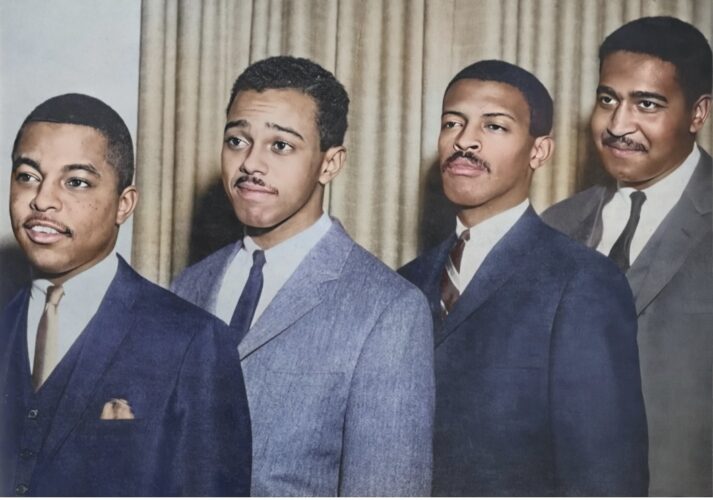
WILMINGTON — Integral to the civil rights movement of the early 1960s, Joseph McNeil has passed away.
READ MORE: Wilmington considers naming street after civil rights activist but also moratorium on renaming city streets
McNeil, a Wilmington native who graduated from Williston High School in 1959, died Thursday, his family announced.
The 83-year-old was a retired U.S. Air Force Major General and graduated from A&T State University in Greensboro. His time at the university and involvement in the Greensboro Four inspired more people to protest and hosts sit-ins for equal rights in North Carolina and beyond.
The Greensboro Four — consisting of McNeil, Jibreel Khazan (née Ezell Blair Jr.), Franklin and David Richmond — sat at the “white’s only” lunch counter in F.W. Woolworth’s department store on Feb. 1, 1960. Despite management and law enforcement prompting them to leave, they refused to do so.
“Their courage sparked a national movement for civil rights and human dignity, inspiring generations to challenge injustice with determination and nonviolence,” New Hanover County NAACP leader LeRon Montgomery wrote to Port City Daily, while sending condolences to the McNeil family. “As a native of Wilmington, Mr. McNeil’s legacy is deeply rooted in our community. We honor his unwavering commitment to justice, his example of moral leadership, and his enduring impact on the struggle for equality. His life reminds us that ordinary people can do extraordinary things when they stand up for what is right.”
An oral history of McNeil notes while living in Wilmington his Williston educators often empowered students to hold their ground, understand their rights, and take pride in their education at the school.
Williston’s history dates back to 1866, denoted as the first accredited North Carolina high school for Black students in 1923. It endured a fire and relaunched as Williston Industrial in 1937 before Williston High opened next door in 1954. The school closed in 1968, with students integrating into New Hanover and Hoggard high schools — 14 years after Brown v. Board of Education passed and the U.S. Supreme Court ruled segregation in schools “unconstitutional.”
In the oral history, McNeil noted Williston teachers would tell students: “They can take your house, your car, all your physical belongings, but they can’t take what you have up here.”
McNeil has returned to Wilmington throughout the years for high school reunions, to speak at UNCW, as well as when Third Street was dedicated in his honor. The City of Wilmington recognized his legacy in 2019 by voting to rename a north portion of Third Street, from Market to Davis streets, as Maj. Gen. Joseph McNeil Way.
There is also an historical marker about McNeil wrested near Thalian Hall, formerly home to city hall as well.
“We are proud to have honored him in his lifetime, and his legacy will continue to inspire future generations in Wilmington and beyond,” council member Salette Andrews wrote to PCD following his death, noting his membership in the Greensboro Four was fundamental in reshaping “the course of American history.”
When he was 17, McNeil’s family moved to New York after his Williston high-school graduation, but the college freshman moved back down South after receiving a full scholarship to attend North Carolina Agricultural and Technical State University from 1959 to 1963. He earned his bachelor’s degree in engineering physics before joining the Air Force, flying in Vietnam combat missions. He retired from service in 2000 and went to work as the deputy director for the Federal Aviation Administration until 2002, wherein he then entered into the private sector as an employee for IBM, Bankers Trust and E.F. Hutton.
Married with five children, McNeil received four honorary doctorate degrees throughout his lifetime, including in philosophy from his alma mater, two in law from St. John’s University and Molloy College, and a doctorate of humanities from UNCW.
In an email to PCD, UNCW Chancellor Aswany K. Volety memorialized the civil rights pioneer as well on Friday: “Joseph McNeil taught us that courage and conviction, when united, can inspire profound and lasting change. The UNCW community honors his life of sacrifice and legacy of leadership and service.”
In a release on Thursday, A&T University noted in spite of McNeil’s health challenges he attended a 65th anniversary breakfast in February this year to honor the Greensboro Four’s impact. He received a standing ovation.
“Joseph McNeil and his fellow North Carolina A&T classmates inspired a nation with their courageous, peaceful protest, powerfully embodying the idea that young people could change the world,” Chancellor James R. Martin II said in a release.
McNeil was one of the last two remaining survivors of the Greensboro Four, along with Khazan. McCain passed away 11 years ago and Richmond died in 1990.
McNeil has said in pervious interviews that treatment of Black people in the South differed from what he saw up North. When he arrived at A&T via bus, he attempted to grab a bite to eat in the terminal but was denied service and became fed up.
“For me that was the final blow of humiliation,” he told WUNC FM in 2014. “I had had enough. And I made up my mind that I had to do something.””
He learned his fellow students were also exhausted by enduring racism and decided to take action. McNeil, utilizing his discipline and training as a Reserve Officer Training Corps at A&T, approached the protest without violence and with guidance from an NAACP member at the time, Ralph Johns, who suggested they embark on a sit-in.
The group of students decided to conduct one at Woolworth’s and when the four men attempted to order from the counter, staff refused to serve them. But they didn’t budge, despite police intimidation tactics, and remained seated until closing time. They then returned the next day and the day after that and thereafter for six months, with growing community support each day.
It also inspired other sit-ins across the state and eventually led McNeil to help form the Student Executive Committee for Justice, a joint effort with women at nearby Bennett College. They would picket segregated businesses in Greensboro.
Before long, similar movements were popping up in other Southern cities, from Durham to Asheville, Richmond to Nashville.
Back in Greensboro, it wasn’t until July 25, 1960 that Woolworth’s changed its policies across its stores. Four years later, the Civil Rights Act passed and in 1965 the Voting Rights Act. The student demonstrations throughout the states — and inspired by the Greensboro Four — are often credited for helping mark the changes.
Today, a 15-foot bronze and marble sculpture, the February One Monument, depicts the Greensboro Four’s walk to Woolworth’s. The Woolworth’s location is now an International Civil Rights Center and Museum and a part of the counter is located in D.C. at the Smithsonian.
North Carolina Governor Josh Stein released a statement Thursday, also sharing condolences and gratitude for McNeil’s impact: “May his memory be a blessing.”
Want to read more from PCD? Subscribe now and then sign up for our morning newsletter, Wilmington Wire, and get the headlines delivered to your inbox every morning.
