


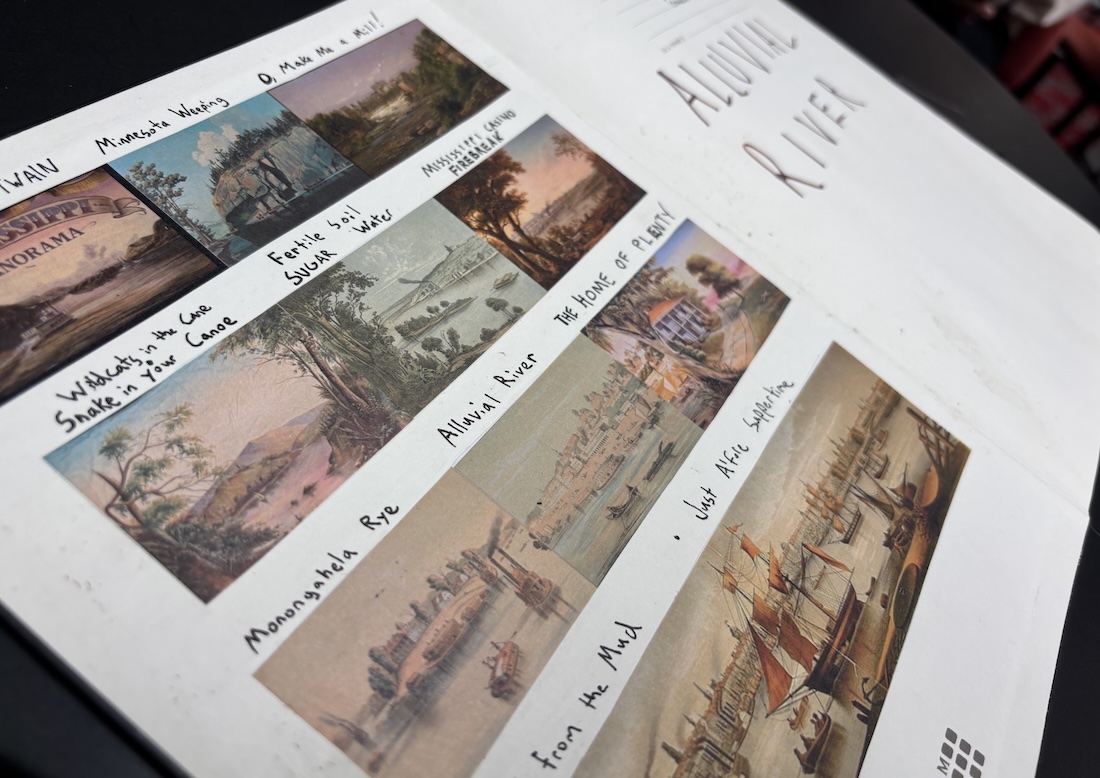
SOUTHEASTERN N.C. — More than a century ago, audiences once gathered in Wilmington’s Thalian Hall to watch painted canvases follow winding rivers and distant landscapes in an artform that predated film: the panorama scroll. This weekend it will return to Wilmington’s historic theater, with a 109-foot panorama show, “Alluvial River,” accompanied by an original score that traces the Mississippi River’s beauty, danger and complicated history.
Local musician Justin Lacy was commissioned to create the music and write the show to accompany Thalian Hall’s Downriver Ramble Panorama debut. For six months, he’s been immersed in books about the Mississippi River, watched documentaries about entertainment and commerce along the river during the 19th century, and learned about cities tucked away along the riverbanks from the north down to New Orleans.
“In this age with all this AI content and digital screens, I think this live performance score is something that’s really special,” Lacy said of blending music and skits with an old-age artform. “I want to do this more, given all the AI creation in the world — just lean into doing things in real life, making music for people, with people in a place.”
READ MORE: Comedian Tig Nataro coming to Wilson Center
Though Lacy hasn’t seen the scroll yet in person, all the moving pieces — the dozen or so people making up the showboat orchestra and cast bringing the story to life — were all interpreted from paintings the scroll was based on.
The panorama was created in the 1980s, devised by artists C. Lance Brockman and Janet Ryger and based on mid-1800’s landscape sketches and other artwork of the Mississippi River. It was restored by theater historian, scenic artist, author, and stage scenery preservation specialist Wendy Waszut-Barrett, an expert of panoramas and theatre history.
On Wednesday, Waszut-Barrett delivered the scroll to Wilmington from Minnesota where it was created for the University of Minnesota Centennial Showboat. She donated it to Thalian Hall, an arrival that’s been 10 years in the making, according to Thalian Hall staff, Seth Hoyle and Linnai Budusky. The historic theater is a place where panorama scrolls were shown beginning in the 1850s.
“We believe they were on this stage all the way up through 1897 when the first film was screened here,” Hoyle said. “The ones shown here ranged between 100 to 300 feet.”
To scale the large piece of art, an apparatus had to be built to move the scroll’s rolling pictures. It was created by Thalian Hall’s technical director Hannah Funderburke and Terry Collins, a scenic designer for theater in Wilmington. It will be tested for the first time this week.
Budusky explained how the moving panoramas were “the 19th century’s version of immersive reality.”
“So this is how you would see a travel film today,” she explained. “At the time, it was performed with an accompanying band with folk music or songs specifically depicted in the panorama.”
Thalian staff reached out to Lacy, after seeing his work merge with theater in the last year. Lacy has been known in the local music scene for upward of 15 years, having created numerous albums and stop-motion music videos. He’s also scored films and continues to book private events as a working musician, whether concerts, weddings or doing live yoga scoring.
Since last fall, he’s immersed himself into scoring multiple theater productions, including Opera House’s “To Kill a Mockingbird,” Shakespeare on the Green’s “Hamlet” and Big Dawg Productions’ “Men on Boats.”
For the first time this week, his six months of research and music-writing comes to life as the band and performers will all be on stage with their maestro to see moving parts coalesce in “Alluvial River.” The show is expected to run around 45 minutes or so.
“There’s this innate trust in him to tell this story, to create this beautiful music,” stage manager and “Alluvial” performer Morganna Bridgers said. “And it’s been so cool to watch the enthusiasm, with which everybody comes to rehearsal and wants to help and wants to be a part of it.”
The show is set up with roughly a dozen songs, each moving forward the story’s plot, centering on a steamboat showboat that travels up and down the Mississippi River. The audience in Thalian Hall will act as the showboat audience for whom Lacy and his crewmembers are performing to the panorama experience.
“It’s very Muppets-y,” Lacy said, “basically a show within a show.”
The showboat idea actually came from Bridgers’ familial lineage, as read about in her great, great, great grandfather, Noah Ludlow’s book “Dramatic Life as I Found It.” The book was mentioned in Waszut-Barrett’s doc about the scroll Thalian is obtaining, unbeknownst to Bridgers.
“It’s a connective thread for me,” she said, having acted since her youth. “Noah basically started a company of actors on a flat boat with minimal sets and costumes from New York down to the Mississippi and would stop wherever there was a potential town and made it all the way to New Orleans and came back to St. Louis from the 1820s through the 1830s.”
In Lacy’s show, the crew members arrive in Vicksburg, Mississippi, situated near an alluvial plain — with silt and sediment clogging the river’s main channel. As Mark Twain described in his book, “Life on the Mississippi,” Vicksburg was once a river town but is now a “country town” because the changing river channel.
“That became a focal point of the piece,” Lacy said, without giving away much more of the plot.
But in the show, he plays a showboat leader and sings along with a variety of people: a roustabout, a group of sisters, gamblin’ men and women, and even people stuck in Antebellum Southern towns. Lacy also acts as an orator to transition into each song.
“I tried to weave a narrative in the towns and represent all the different cultures,” Lacy said.
One song performed is “Snake in Your Canoe,” inspired by a canoe trip Bridgers and Lacy took along the Black River earlier this spring.
The eight- or nine-hour swamp paddle came with its own set of concerns that led them down the dangers of the river.
“There was a moment trying to get into the swamp, where he looked out of the peripheral, saw something drop into the water, and as Justin looked over, there were like three snakes on this branch,” Bridgers remembered. “I remembered that my brother, who is a woodsman, told me snakes do fall from trees, so we’re going into the swamp, just thinking about, like — well, precipitation of a serpentine sword.”
Lacy said the melody of the tune was inspired by The Roches, a 1970s band featuring three sisters singing 1920s harmonies and inserting odd and weird comedic intervals.
“It’s a little moment of levity and the song is so fun,” Bridgers said, noting she sings it with Addison Hamlet and Annie Jewell, who also is the violinist, and are known in the show as the Moccasin sisters.
Lacy studied Rinker Buck’s book, “Life on the Mississippi: An Epic American Adventure,” to learn about the flat boats that traveled with goods and wares from New York to sell in New Orleans. These boats, held together from wooden logs without side barriers, and a hodgepodge wind sail and shack built on them, would go from the Monongahela or Allegheny rivers to the Ohio then Mississippi River.
“The commerce they brought was varied,” Lacy said, “and once they got to New Orleans, they would scrap the wood and walk back. … They were just using the river as a highway because that was the easiest way to move. But they’re losing their logs and facing unnavigable obstacles with trees in the river. There were several pirates on the river, who would stop and rob you and there were brothel boats and bar boats.
“We get all our dangers into one song,” Lacy quipped.
He included folk sounds of the day, but also leaned into Cajun music to represent New Orleans. Lacy captures the French voyagers that would travel from the Great Lakes region in Crooked Lake, Minnesota, to explore the Mississippi River.
“And they were known to sing French folk songs while they were traveling,” he said.
In addition to his lyrics absorbing some of the language and dialect of the 19th century, he has one song in French, with the melody based on “A la Claire Fontaine” a popular French-Canadian nursery rhyme.
Lacy also leaned into suggestions from the show’s performers, including Kim Pacheco Beatty, who suggested spirituals be included. Gospel influence is in three songs, and Lacy said he also asked some of the Black performers for input when tackling a tough topic of the Antebellum South: slavery.
It appears in a song when the showboat arrives at a plantation house.
“I don’t think one person should tell this story — and definitely not one white man,” he said. “It’s a complex story to tell, going into the Antebellum South from a modern perspective.”
He decided to take it on satirically via Natchez, Mississippi, a place Lacy learned about through the PBS Independent Lens documentary series, “Natchez.” He called it fascinating, in that it was home to a slave market, Forks in the Road — the second-largest domestic slave market in the Deep South. However, some of the wealthy Natchez land and property owners were initially torn about slavery and Union-leaning, and during the Civil War, Union soldiers set up in the town.
They have a mansion district, and according to Lacy, were European, with French and Indian influences, “but then had plantations kind of out of sight, out of mind.”
The Mississippi became a pretty remarkable corridor of slave ships to the Natchez market.
Today, tour guides, homeowners, and activists have competing histories about the town and the PBS doc captures the tension between preservation and truth.
“Now they have a mansion tour called pilgrimage every spring and fall where they have women in hoop skirts and they find ways to talk around it: ‘We didn’t have slaves, we had servants. We’re all family here,’” Lacy explained.
He tackles the topic in “Alluvial River” through the lens of a guest in a plantation house asking: What is going on here, how does the wealth work, exactly?
Lacy said he likened it to the same homes in Wilmington with their grandiose architecture seducing passersby. In his song, the house becomes a siren to bewitch guests with its veranda views, madeira wine and magnolia trees, the charm outweighing an underbelly of the dark past.
“It’s like a plantation house ‘Hotel California’ thing,” he referenced of The Eagles’ famed track.
Every song has its own composition for each instrument — violin, cello, viola, guitar, percussion, piano, maybe even a dulcimer for special effects. However, Lacy said this week’s rehearsals will welcome areas where the musicians can improvise.
The band will be on the stage and the pit will be raised, with the performers coming in and out of skits as the panorama’s artwork scrolls. The scroll will be positioned far forward onstage as well.
“It’s always a mad dash to the end,” Lacy said, comparing the varied coordination of parts to creating music videos. “No matter how much prep work you do, the day of there are always adjustments. But it’s exciting to see.”
The team, both Thalian Hall staff and the performers, anticipates the next 48 hours to be hectic, getting the scroll up and running, situating performers, props, the band, and then dress rehearsal is Thursday. “Alluvial River” will come to life on the mainstage at Thalian Hall at 7:30 p.m. on Friday for one night only, with tickets affordable to everyone for $10.
The project was funded by Herbert and Ronna Zimmer, which is allowing for a weekend of educational events surrounding the scroll’s debut and show. It’s what Thalian Hall is dubbing “Panorama Palooza.”
Wendy Waszut-Barrett is teaching a full day of watercolor and gouache masterclass, from 9 a.m. to 5 p.m. all day Thursday at Thalian Hall and beginner to intermediate watercolor and color theory class Saturday at Thalian Hall, 9 a.m. to 12 p.m. Folks can learn more here.
After Friday’s show will come Saturday’s Community Day, noon to 3 p.m., featuring 10-minute mini versions of “Alluvial River,” at 12:30 p.m., 1 p.m., and 1:30 p.m. It also will incorporate Thalian’s Thunder Roll — a 19th century analog technique used to create thunderous sounds in theater — and the history of Thalian Hall’s historic stage curtains. Waszut-Barrett is going to be giving a lecture on the restoration or the replica of the historic stage curtain on Saturday at 2 p.m.
On Sunday, there will be one final color theory and line art class for children, ages 6 to 12, at the Hannah Block Community Center and USO.
“I’ve been struck personally by this project taking place, tying back to the 19th century roots of the building,” Hoyle said of Thalian Hall, which was built in 1858. “All the former city hall side is walled off and being turned into one of the most technologically advanced and capable arts buildings in the American South. So having the dichotomy of both the historic significance of the building, and also the technologically capable future happenings at the same time, I think, is really cool. It would be really hard to find another place like that in the country.”
At Port City Daily, we aim to keep locals informed on top-of-mind news facing the tri-county region. To support our work and help us reach more people in 2026, please, consider helping one of two ways: Subscribe here or make a one-time contribution here.
We appreciate your ongoing support.
