


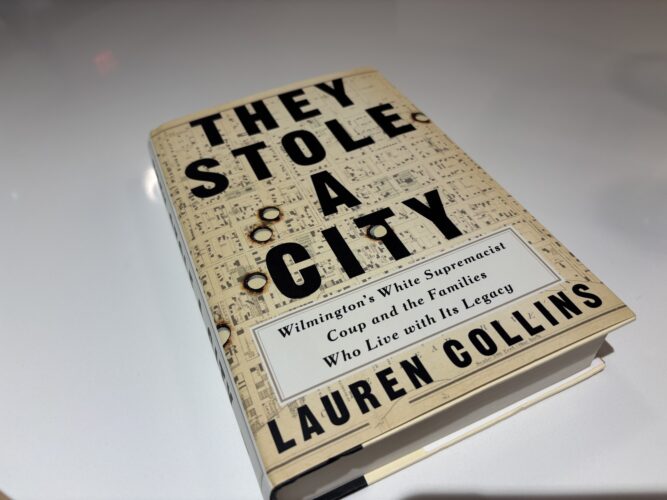
SOUTHEASTERN N.C. — Journalist, author, and Wilmington native Lauren Collins has written a new book, “They Stole a City: Wilmington’s White Supremacist Coup and the Families Who Live with Its Legacy.” She appeared on CBS Sunday Morning: on July 12 to discuss the book, which explores the lasting legacy of the 1898 coup in Wilmington.
The only successful coup in American history took place on Nov. 10, 1898, when white supremacists and Southern Democrats forced elected members of Wilmington’s fusionist government — consisting of both Black and white leaders from the Republican and Populist parties — to resign and leave the city. The white supremacists killed anywhere from a dozen to hundreds of Black residents, according to historians who, to this day, don’t have an exact count. An official state report from 2006 has documented 60 deaths, all Black people. However, the coup also drove out countless others.
At the time of the coup, Wilmington was 56% black, while today the percentage sits at 14.5% according to the North Carolina Census Bureau.
The North Carolina Department of Natural Culture and Resources reports around 500 white supremacists at first assembled, but grew to 2,000, to burn down the town’s Black-owned newspaper, The Daily Record, after its editor, Alexander Manly, ran a controversial editorial. Manly was one of the men who fled the city.
A picture from Cape Fear Museum of History & Science implies ten men had affixed a cart with rapid-fire artillery, like a machine gun, and drove it through central Wilmington. The violence was concentrated in downtown neighborhoods like the area around Fourth and Harnett streets. The museum sources found do not give a street by street account for where the cart itself went.
Following the massacre, white Democratic publications characterised the event as a “race riot” that white Democrats had to protect themselves against, crediting Manly as inflaming racial tension with his editorial. It was referred to as a “race riot” for years until the narrative began to reflect a more balanced truth of events, as published in H. Leon Prather Sr.’s “We Have Taken a City: Wilmington Racial Massacre and Coup of 1898” came out in 1984.
Collins’ approach to the fairly well-documented historical event was to trace the intertwined histories of four families, both perpetrators and survivors of the violence on the day of the massacre: the Halseys and the Howes, both Black, and the Moores and the Bellamy/MacRaes, both white. Collins chose these families because when asked about her choice to write “They Stole the City” through the families’ stories, Collins called them “a critical vehicle for the transmission of history.” In Collins’ view, these families — and how they either prospered or suffered after the coup — demonstrate how the events of 1898 formed an inheritance that gets passed down from one generation to the next.
A victim in the coup, Joshua Halsey became a target after filing a lawsuit against the city when his wife tripped and injured herself while walking on a poorly maintained bridge. According to Brown, Halsey was shot on Nov. 10, 1898, 14 times as his wife, Sallie watched. He was laid to rest in an unmarked grave until 2021.
Phillip Junior Brown, the son of Cynthia Brown who is discussed later in this interview, are the descendants of Athalia Howe Whitfield, a teenager when the coup happened. She witnessed a white man kill a black man in the streets.
In contrast, the MacRae, Bellamy and Moore families were well-revered in the decades following the coup, despite their involvement as perpetrators.
Hugh MacRae was a wealthy business man who was recognised as the leader of the coup. MacRae was part of a group that penned ‘The Democratic Handbook’ which outlined the white-supremacist campaign to overthrow Wilmington’s elected government. He, along with Alfred Moore Waddell lead the mob of white supremacits on the fateful day. Long Leaf Park was known as Hugh MacRae Park until 2020.
Alfred Moore Waddell became mayor of Wilmington after the coup. Independent of the family patriarch, the Moore family has received little public attention. Collins’ research brings them into the story as representatives of “families who contributed to the violence and its afterlife.”
“I wanted to examine how this story came down within the families of both survivors and perpetrators,” she continued, “I also wanted to look at memory and dismemory, and I thought families provided a powerful and pertinent lens for looking at the transmission of history.”
Collins spoke with Port City Daily about “They Stole a City” ahead of a conversation that’s taking place at Brooklyn Arts Center on Friday, July 17, 2026, at 6 p.m. LeRhonda Manigault-Bryant, the director of the Sonja Haynes Stone for black culture and history at the University of North Carolina at Chapel Hill, will moderate the event.
Below is a transcript of the conversation between PCD and Collins, and was edited only for clarity.
Port City Daily: What compelled you to write this book?
Lauren Collins: I grew up in Wilmington. I was born there in 1980, and I don’t know if you’ve seen Christopher Everett’s documentary “Wilmington on Fire.” I saw it in 2016 and I thought it was fantastic. I also thought more people needed to know the story of 1898. So I wrote a short piece about it for The New Yorker. As part of that, Chris and I met and went to the 1898 memorial downtown. While we were there, I was reading the plaque at the memorial. It presents this neat, official history. It explains what happened, but it’s all tied up in a neat bow.
Then I turned and saw that somebody else had put up another sign. It was this kind of homemade, guerrilla effort — a piece of plywood that somebody had climbed up or used a ladder to nail high on a telephone pole. It says: “1898 war crimes.”
In that moment, I realized this was still a live wire — that this wasn’t over. The events of 1898, and especially their long-term repercussions, still carried high stakes and mattered deeply to people who are alive today.
I didn’t start writing the book that day, but as I began thinking about it and researching it, I felt there was a need for a book that examined not only what happened on November 10, 1898, but also what led up to it and what followed. I wanted to assess the compounding, cumulative damage of 1898, and trace its impact all the way to the present day.
PCD: There’s a lot of scholarship, history and documentaries about this massacre. What does your book bring that other accounts do not?
LC: First of all, I want to give credit to and acknowledge all the work that’s come before, beginning with Helen Edmonds’ groundbreaking study in 1951, which was one of the first books to call the Wilmington massacre and coup a massacre and coup instead of a riot. Then there’s Leon Prather’s 1984 book, “We Have Taken a City.” My title is kind of a tribute to his groundbreaking work. Philip Gerard’s “Cape Fear Rising” in the mid-1990s, Christopher Everett’s documentary, David Zucchino’s “Wilmington’s Lie” — there’s been a lot of excellent work on this.
I feel like the way I’m moving the ball forward, or what I wanted to contribute, is something a little different. I think this is the work of many hands, and my book is one set. It’s a multigenerational family saga that tells the story of 1898 across more than two centuries. I was really interested in family and in telling this story through families because I think they’re one of the most powerful ways history is transmitted — but also, in many cases, distorted or warped.
PCD: That leads me to another question. You tell this story through four families and write that “families are both the incubators and the life support machines of memory.” How did the younger generations of these four families talk about their family histories?
LC: P.J. Brown, who is Cynthia Brown’s son, comes in at the end of the book, and he’s committed to carrying on his mother’s work of talking about 1898, pushing for education and keeping the memory alive. As she handed him the torch — she died in 2023 — she told P.J.: “You have to find your own way to do this work.” I think that’s exactly what he’s doing now. He’s a photographer, whereas Cynthia gave a lot of interviews. P.J. is finding his voice through images.
PCD: In an interview with CBS News, you said: “I also feel that it’s incumbent upon white people like me to know this history, to grapple with it, and to shoulder the full truth of it, even when it’s uncomfortable.” I’m interested in how that obligation shaped your reporting. What questions did you feel responsible for asking as a white person?
LC: That question informed all of my reporting. I realized that one of the questions I was really interested in answering was one Toni Morrison posed: “What is the impact of racism on the people who perpetrate it?” That was the question I was interested in answering when I was examining the white family.
PCD: What can Americans, writ large, take away from a book that is so localized?
LC: I disagree with the premise. I don’t think it’s localized at all. What I’m trying to do with this book is demonstrate that the origins of our current crisis are rooted in our own violent past. Wilmington is a case study in the vulnerability of democracy and the challenge — and the magnitude — of repairing it once it’s been breached.
When 1898 occurred, this was front-page news. People all across the country knew about it. It was on the front page of The New York Times, and it appeared in newspapers around the world. Which is to say, this story has always had an impact beyond Wilmington.
PCD: Can you describe the ideal reader of this book? Who did you have in mind when you were writing it?
LC: I don’t have an ideal reader, but I hope the people who pick it up and do me the honor of spending time with it are hungry for the truth about Wilmington’s history and, as you said, America’s history more broadly.
PCD: Your book starts in the late 1800s and ends in 2020. What are some of the consistent themes that arise across those years?
LC: The most consistent theme is that on the other side of every era of expanded rights, someone is waiting to claw those rights back. You pursue Reconstruction, and you get Jim Crow. You desegregate and you’re met with massive resistance. You elect a Black president, endure a white nationalist president who denies that his predecessor was even a citizen. I came to see this pattern as a window opening, with white supremacists feeling like too much democracy had gotten in and doing everything they could to slam it shut.
PCD: This isn’t really a question — more of an observation — but as you were talking, it struck me that one of the first things white supremacists did was burn down a Black newspaper, The Daily Record. Then there was disinformation about the massacre and we’re still dealing with disinformation today.
LC: Absolutely. That’s one of the reasons I wanted to follow this story over many decades. If you continue the timeline, you’ll see that The Wilmington Journal, the Black newspaper that eventually replaced The Daily Record, was blown up again in 1973 [ed. note: it was bombed.] That attempt to destroy the newspaper was also an attempt to destroy the idea of a community and its history. There’s the very concrete fact that, over and over again in Wilmington, the voice of the Black community — in the form of its newspapers — was physically attacked.
PCD: Just continuing on that thread, it struck me that you’re a journalist telling a story in which journalism was targeted over and over again. I’m curious: As a journalist, what do you make of that?
LC: Journalism in the white Democratic newspapers of 1898 was journalism at its worst — pernicious and deeply damaging. You essentially had a mass media campaign of rampant disinformation. The white Democratic media was really in cahoots. I thought a lot about the ways that political parties, government, the church, the military, and business and the press conspired. I think there are very palpable parallels to today.
But you’re right: in the stories of The Daily Record and The Wilmington Journal, we can also see the ways strikes on the press are strikes on the truth.
At Port City Daily, we aim to keep locals informed on top-of-mind news facing the tri-county region. To support our work and help us reach more people in 2026, please, consider helping one of two ways: Subscribe here or make a one-time contribution here.
We appreciate your ongoing support.
