


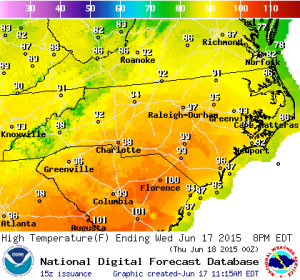
The National Weather Service has issued a heat advisory for Southeastern North Carolina for Friday. This follows days of warnings and advisories about the heat index. But do you know the difference between an outlook and a watch? And when does a warning become an advisory.
The NWS issues four heat warnings, based on not only atmospheric conditions, but geographic location. “For instance, residents of Florida are much more prepared for 90°F+ weather than residents in Alaska,” the NWS website states.
They are also based on the agency’s heat index, which factors in relative humidity to determine how hot it feels for your body, not just the thermometer.
Here is the breakdown of the National Weather Service’s heat lingo:
Excessive Heat Outlook
Translation: There’s a chance it’s going to get really hot by the end of the week.
Excessive Heat Outlooks are issued when the potential exists for excessive heat in the next three to seven days. An Outlook provides information to those who need considerable lead-time to prepare for the event.
Excessive Heat Watch
Translation: There’s a good possibility a heatwave is coming, and soon.
A watch is a general “be prepared” alert. A watch is issued when conditions are favorable for there be excessive heat in the next 24 to 72 hours, however, the time or even the event itself are still uncertain .
Heat Advisory
Translation: The heat is here.
The National Weather Service website refers to a “heat advisory” as a “Take Action!” point. People are urged to take precautions to avoid heat-cased illnesses, potentially leading to serious injury or death.
A Heat Advisory is issued within 12 hours of the onset of extremely dangerous heat conditions. Typically, heat advisories are issued when the maximum heat index temperature is expected to be 100 degrees or higher for at least two days, and night time air temperatures will not drop below 75 degrees.
The factors considered when the National Weather Service issues a heat advisory also depend on location, “especially for areas that are not used to dangerous heat conditions,” the website states.
Excessive Heat Warning
Like the heat advisory, this is “Take Action!” warning. This issued for the same reasons as a heat advisory, but when temperatures are expected to reach at least 105 degrees during the day and to not drop below 75 degrees at night for two days.
READ MORE:
Here are the signs of heat-related illnesses. Can you tell them apart?
Tips for dealing with excessive heat
Like us on Facebook to keep up with what’s going on in the community.
