


[Ed. note: City council designated the building an historic landmark at its Nov. 18 meeting.]
WILMINGTON — A local warehouse filled with oddities, movie props and memorabilia, local lore and more may become the next local historic landmark in Wilmington.
READ MORE: City’s historic commission adds NHHS for landmark study
Thursday, the Historic Preservation Commission agreed with the importance of preserving 201. S. Water Street, currently home to the Museum of the Bizarre. The HPC unanimously voted to put the 5,400-square-foot brick warehouse at the corner of Orange and Water streets on the study list on July 10 and on Sept. 11 they voted again unanimously to formalize the application.
If the application passes muster at city council, the landmark will be suited for 50% deferral of property taxes as long as its historic significance is upkept. The HPC reviews any changes made to the property that would alter its exterior.
The designation also adds a layer of protection, should an owner attempt to demolish the building. The HPC would be allowed to execute a year’s stay, in hopes the building owner would have a change of heart. But if not, the property owner would have to come back to receive a permit from the HPC for demolition.
Justin LaNasa — who has run for mayor, the House of Representatives and Senate, and is also the proprietor of Hardwire Tattoo and Piercing and Port City Vapor — currently owns the property. He has no plans to raze the warehouse, but said he has worried about its future and the day he no longer owns it.
“To protect it from development, preservation would be the main goal having it as a local landmark,” LaNasa told PCD. “Having been here 34 years and my father being a native of Durham, NC, I feel inclined to want to save historical buildings such as this one. We have lost so much of Wilmington’s history due to development that was not expected.”
Wilmington native and local real estate broker Clayton Hamerski, who has a love for historic structures as well, remembers chatter of its potential redevelopment back in the early aughts.
“It’s just such a cool, unique building worth recognizing,” he said.
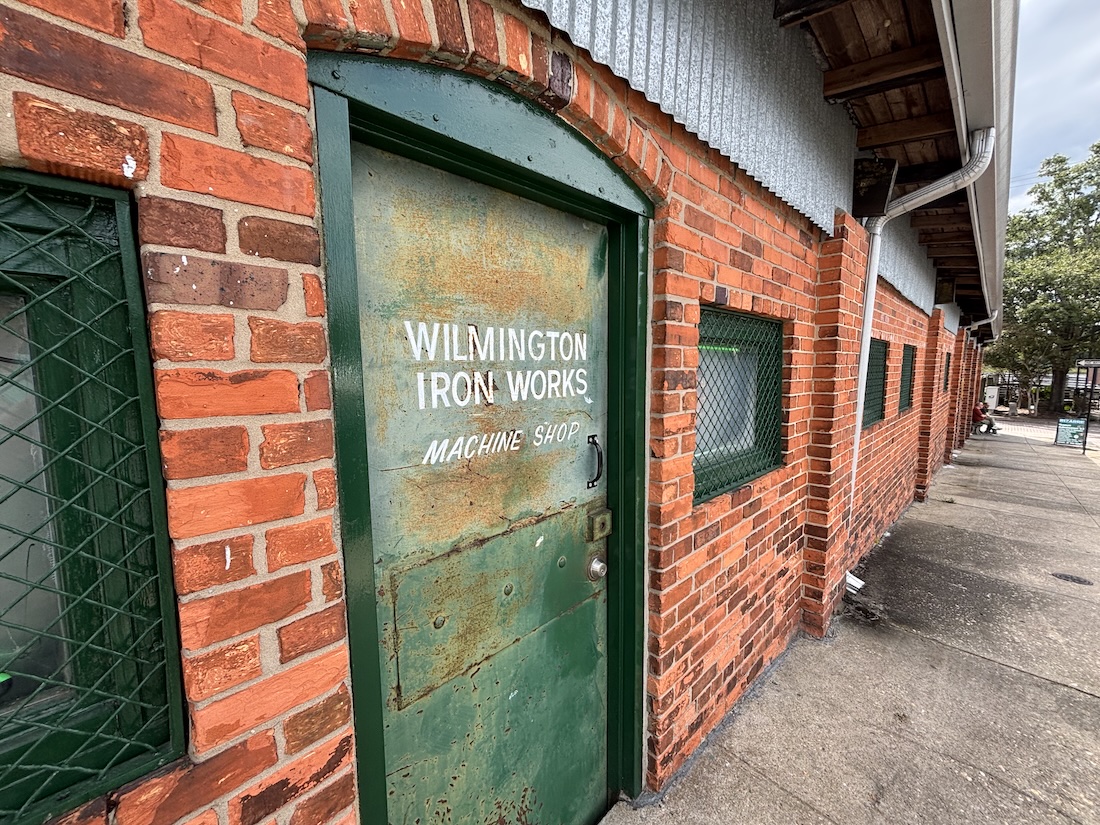
Dubbed the Wilmington Iron Works Building, a metal manufacturer and machine shop existed there for 71 years and was issued an historic plaque by the nonprofit Historic Wilmington Foundation recently. Hamerski, a member of HWF, helped LaNasa throughout the plaque process, which kickstarted the historic landmark discussion as well.
“And I thought it would be a slam dunk,” Hamerski said.
History indicates 201 S. Water St. was likely constructed in 1869 and was reconstructed in brick in 1925, though it’s anticipated the original framework was salvaged and reused in the early 20th century rebuild done by Wilmington Iron Works. The company installed a corrugated metal sliding door and a metal frame door with its name on it, both of which are still intact at the museum today.
The building is located on a slope along Orange Street, with windows changing from vertical to horizontal installations due to its incline up the Orange Street slope. Inside, iron support columns are believed to still be evident from its former machinery workshop.
“You can find these really cool, like stamped iron pieces that have Wilmington Iron Works embossed on them throughout the city,” Hamerski said.
Though it’s unclear how much of an economic impact the company made across Wilmington, its services were used in the building of various infrastructure. Hamerski told the commission Thursday he has seen Iron Works embossed on stormwater grates and even a metal door installed at downtown’s City Club, dubbed the DeRossett House. The logo can be found on gutters, cast iron balconies, street furniture, and iron fittings, including in Oakdale Cemetery.
“I’ve noticed this now as I walk around town,” Commissioner Stephen Sulkey confirmed to Hamerski at the meeting. “I never paid attention before.”
One of the building’s previous owners removed all the equipment from the warehouse in the early 2000s, Hamerski told PCD, and donated Wilmington Iron Works’ records to East Carolina University. Hamerski drove to the library to research the documents while putting together the application with LaNasa.
“They have blueprints, pictures, invoices, and corporate meeting minutes,” Hamerski told PCD. “So we were able to get this full picture of a company that really responded to different waves of industry in the world.”
For instance, Wilmington Iron Works cranked out farm equipment and fertilizer containers in the early part of the 20th century, as well as created steamboilers for the Atlantic Coast Line Railroad. During World Wars one and two, it worked with the military, creating engines and more.
Even before it was Wilmington Iron Works, the business existed as far back as 1838 and in 1840 was known as Tin and Sheet Iron Ware Manufactory, before partnerships in the business shifted and it underwent other names, such as Hart and Bailey and Burr and Bailey.
Some of those companies provided turpentine stills, cannonballs and cannon shot to the Confederate Army during the Civil War.
“It’s believed to have started as a naval store,” Hamerski said, meaning the S. Water Street warehouse may be the last remaining structure of its sort connected to that part of Wilmington’s history.
Built as a naval shed investment property, the building was transferred to Peter B. Ruffin from Hillsborough, North Carolina, according to its historic plaque. During the 19th century, North Carolina produced 96% of the naval stores in the country, due to the state’s proximity to railroad and waterway.
The Water Street warehouse was purchased in 1887 by D.L. Gore, who leased it out, with Wilmington Iron Works coming in around 1908.
“What I found interesting about this is we don’t talk about industrial and manufacturing a lot [on the commission], but it was so key to our city,” Commissioner Beth Rutledge said, calling it a “no-brainer” for the property to be recognized as an historic landmark.
The City of Wilmington’s landmark program is meant to preserve history but also educate and provide cultural enrichment to the community-at-large when it comes to conserving area structures. A property must by at least 50 years old, though a younger structure threatened by demolition may be considered. There are also other varied criteria.
For example, a property will be considered if it’s made an impact socially, economically, educationally, or culturally, marked a specific turning point in history, contributed to a specific heritage, or offers an important architectural, aesthetic or building type.
Ben Riggle, planning manager with the city, told the commission on Thursday the building stands as a testament to economic prosperity in Wilmington and continues to serve the town’s tourism industry. LaNasa said 30,000 people come through the Museum of the Bizarre annually to peruse items like the Annabelle doll, created for the locally filmed “The Conjuring” by local movie effects artist Tony Rosen. There are also serial killer exhibits that captivate a lot of audiences, including Jeffrey Dahmer knives or hand drawn art by John Wayne Gacy.
“For exhibits, I love things with a marvelous history,” LaNasa said.
The building was once owned by Dean Ripa — who was killed by his wife in 2017. Ripa also owned the former Cape Fear Serpentarium, located next door to the museum.
“He told me I should open a bizarre museum here because he knew I had a lot of stuff I collected over the years,” LaNasa said, remembering back to 2015 when he and Ripa were standing in the space. One month later, the museum was open to the public.
Since occupying the space, LaNasa said he has learned a good deal about the building, which he purchased for $395,000 in September 2015. It was among the top five oldest buildings that operated in the state, he said. Like Hamerski and Sulkey, LaNasa also has been surprised by the amount of Iron Works stamps located citywide.
“I’ve seen them on manhole covers,” he said. “Just has to make the mind wonder in amazement of what else was made at the Wilmington Iron Works. Might be a good scavenger hunt event we could have along with the Cape Fear Museum one day.”
If the Iron Works Building passes the council vote — yet to be scheduled, according to city staff — it could join nine other historic landmarks recognized in Wilmington:
- Cazaux-Williams-Crow House, 7413 and 7417 Masonboro Sound Road
- Lazarus-Hill-Divine House, 314 Grace Street
- Fire Station No. 5, 1702 Wrightsville Avenue
- Chestnut Street Presbyterian Church, 712 Chestnut Street
- Greenfield Lake Park and Gardens, 1701 & 1739 Burnett Boulevard
- North 6th Street Truss Bridge / Harry Forden Bridge, Between Brunswick and Campbell Streets
- Dr. Hubert Eaton House, 1406 Orange Street
- Giblem Lodge, 19 N 8th Street
Want to read more from PCD? Subscribe now and then sign up for our morning newsletter, Wilmington Wire, and get the headlines delivered to your inbox every morning.
