


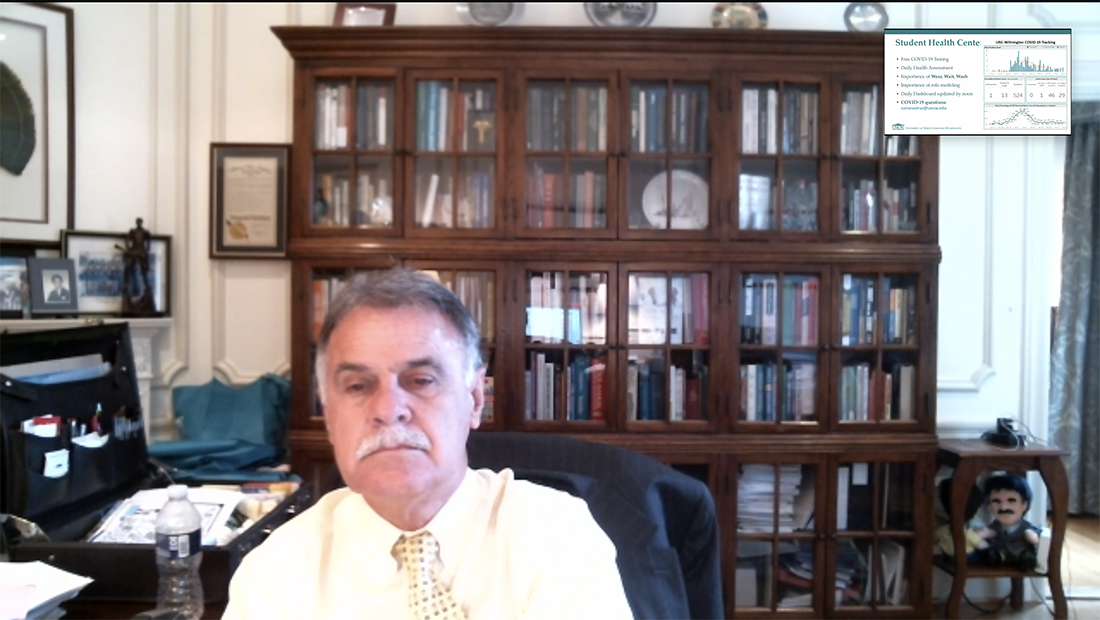
WILMINGTON — University of North Carolina at Wilmington Chancellor Jose Sartarelli addressed the university in a statement released to faculty and students Wednesday, in which he referenced ongoing discussions playing out on UNCW’s campus. In doing so, he said he hoped his actions haven’t increased campus tension, but “If they have, I apologize,” he wrote.
Last week, Chancellor Sartarelli joined a Zoom call with faculty to defend his administration’s handling of a recent policy that some students and faculty say was designed to target the removal of Black Lives Matter displays from campus.
Multiple faculty members who were present on the Zoom call said Sartarelli’s presence served to foment additional discontent among faculty, who questioned why the policy — which restricts the display of banners and signs on campus, in-line with existing UNC System policies — was constructed and announced without significant input from faculty voices. Faculty also said Sartarelli put the blame on faculty for a lack of minority representation among university professors and administrators.
On Wednesday, eight days following the Zoom call and five days after a separate meeting held between Sartarelli and UNCW’s Renewal and Change Accountability Committee, the chancellor sent a statement to the university community to apologize.
“I hope that, in leading through these difficult times, my focus and determination have not inadvertently increased tensions or despair for any members of our community,” he wrote in the statement. “If they have, I apologize. Irrespective of my leadership style, I want the campus community to understand that I am willing to listen, learn, change and accept good ideas and real solutions from wherever they come.”
Tension between Sartarelli and Black student leaders reached a precipice this summer, when he reportedly told a group of students and other community members that he would not embrace the Black Lives Matter stance.
Earlier in the fall semester, professors at the university questioned why they weren’t consulted before UNCW announced on Sept. 8 that all double occupancy freshmen dorms would be converted to singles — with the students asked to decide internally how to handle the request that one of them relocate for the remainder of the fall semester.
“Ideally, we would have lots of time to engage a lot of different stakeholder groups. We still try to do that, but sometimes decisions have to be made fast,” UNCW Provost James Winebrake said in an interview last month, referring to the announcement.
After the “de-densification” policy was released, Nathan Grove, president of the UNCW Faculty Senate, told Port City Daily that to his knowledge, no professors were given advance notice that UNCW would be making significant alterations to its residence life operations.
“I’m hopeful that should something like this be necessary in the future that it will be handled differently,” Grove said at the time.
Weeks later, however, when UNCW announced the policy restricting banner display on campus, faculty returned with the same concerns. Some said that in a similar manner to the new dorm policy, the banner policy was created and implemented from behind closed doors, without the consultation of UNCW’s professors.
After publication, a UNCW spokesperson took issue with the characterization that stakeholders were not consulted as the university developed the banner policy. Representatives from the Faculty Senate, Staff Senate and the Student Government Association were consulted during the policy’s development, she said.
Grove, the Faculty Senate president, confirmed members of the senate’s steering committee put eyes on the policy over the summer, and he added the banner rule, when announced publicly, “likely took the vast majority of faculty by surprise.”
“We were clear that the administration had to be careful with how this was handled as it could easily come off as being against the Black Lives Matter movement,” Grove added.
The UNCW Student Government Association released a resolution following the policy rollout, in which it referenced “the frustration felt by the student body in response to the lack of collaboration and communication with relevant stakeholders.”
In his message released by the chancellor’s office, Sartarelli sought to make clear his stance on recent pleas from faculty and students, who have urged UNCW to become more outwardly involved in promoting diversity initiatives and increasing minority representation within the faculty and staff.
“At both meetings, I was asked to communicate more clearly my commitment to diversity, equity and inclusion. To clarify where I stand, let me state again, Black lives matter to me, both as a person and as Chancellor of this great university,” he wrote. “I fully understand this fundamental human rights issue must be acknowledged as we grapple with our complex history and present reality as a nation and a city.”
Woody White, a Republican on the New Hanover County Board of Commissioners and a member of the university’s Board of Trustees, said he considers the ire some faculty and students feel toward the chancellor to be misdirected, and that the chancellor has well-served the university community.
“This chancellor lived for years under a military dictatorship that punished free speech. He knows the importance of all voices, including his own,” he said in a text. “He’s doing an incredible job in so many ways but unless he conforms 100% to the purity tests pushed by liberals, they want to get him.”
Sartarelli is from Brazil, and prior to his entrance into academia he was a power-player in the pharmaceutical industry. “From 2001 to 2010, Chancellor Sartarelli worked for Johnson & Johnson as pharmaceutical group chairman for Asia-Pacific, Japan and Latin America,” according to UNCW’s website. “In that role, he oversaw a business with $3 billion in annual sales and more than 9,000 employees throughout more than 50 countries.”
UNCW has previously announced a list of measures the university is taking in the realm of promoting diversity, which include increased funding for disadvantaged and low-income student-recruitment efforts, increased funding for diversity scholarships, supporting staffing for three different cultural centers, and expanding university curricula by adding a new Africana Studies major, and other courses.
Donyell Roseboro, UNCW’s interim chief diversity officer, said in a statement, “We are committed to creating an inclusive campus where diverse voices are valued. To do so, we need to listen. The Chancellor’s message reinforces our commitment to listen, learn, and act.”
Send tips and comments to Preston Lennon at [email protected]
