


NORTH CAROLINA — A new bill introduced to the U.S. House of Representatives last week would shine a light on secretive cases of sexual harassment by congressmen. The bi-partisan bill would not only out perpetrators, it would force them to pay back, with interest, taxpayers for the public money spent on settlements.
H.R. 4494, known as the “Congressional Accountability and Hush Fund Elimination Act,” would update legislation on accountability for Congressional Representatives in several ways, including prohibiting the use of money intended to fund the operation of a Congressional office for private legal settlements
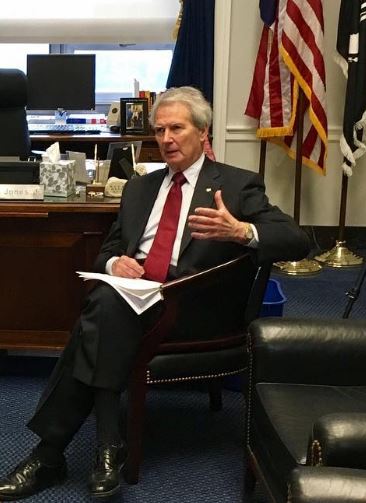
North Carolina Congressman Walter Jones is one of several dozen bipartisan sponsors of the bill, created by Representative Marsha Blackburn, of Tennessee’s 7th District.
“As soon as this office – namely me – found out about the legislation we contacted Ms. Blackburn’s office to say put me on this as a cosponsor,” Jones said.
“It’s another example of there not being enough sunshine around this place in Washington. This was a surprise to the majority of us that there were these office accounts, they call them MRAs (Members Representational Allowance), that a representative could take this money and use it to pay off an employee,” Jones said.
Jones said MRA office funds have been used by “congressional representatives and high ranking officials” to pay for at least $15 million dollars in sexual harassment settlements since 1995.
According to Jones, he first learned about the practice through the story of Texas Representative Blake Farenthold, who used $84,000 of his taxpayer funded account to settle with his former communications director, Lauren Greene.
Farenthold has denied wrongdoing. He has also offered to repay taxpayers, something H.R. 4494 would require of anyone who used an MRA for a settlement, dating back to 1995.
“Paid back with interest,” Jones noted.
“If you’re the victim, I understand their reluctance (to have their name published), but if you are the predator, so be it. You’re the predator, you created the situation, therefore your name – and in most cases there will be a member of congress or a high ranking member of staff – so there’s no reason their name would not be made public.”
But as Jones pointed out, many other cases of taxpayer-funded settlements are not publicly known. H.R. 4494 would change that. In addition to required repayment, it would make public the names of Congressional representatives and their staff who had used MRAs to settle harassment cases since 1995, while protecting the anonymity of their accusers.
“If you’re the victim, I understand their reluctance (to have their name published), but if you are the predator, so be it. You’re the predator, you created the situation, therefore your name – and in most cases there will be a member of congress or a high ranking member of staff – so there’s no reason their name would not be made public,” Jones said.
H.R. 4494 would prevent future “abuse of taxpayer money,” as Jones described it, but it is also aimed a larger social issue – “a national issue,” Jones called it – including case of Roy Moore, the Alabama senatorial candidate facing numerous sexual harassment and assault cases.
Jones didn’t weigh in directly on the Moore case, but said that after listening to the women’s accusation, “you’ve to give them some credibility.” Jones said it was part of national problem.
“It’s kind of like there’s a sickness, where men who reached a certain level of power, or who have money — not all, but some — they feel like they can do with an employee who is a female whatever they want to do. It’s just wrong,”
Jones said he expects the bill to pass quickly.
“I truly do not expect (anyone to vote against H.R. 4494),” Jones said. “I think must members of Congress, male and female, feel the same way about this as you and I do.”
Send comments and tips to Benjamin Schachtman at [email protected], @pcdben on Twitter, and (910) 538-2001.
