


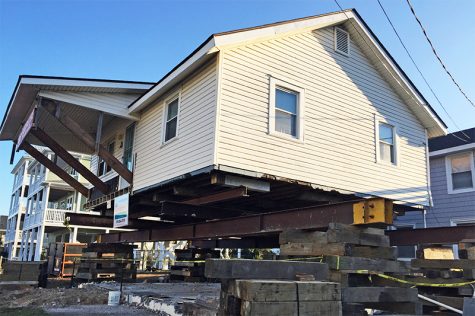
CAROLINA BEACH — Elevation is underway for three flood-prone Carolina Beach homes.
Awarded relief from FEMA after a lengthy, two-year application process, the homeowners were granted about 90 percent of the total cost to salvage their existing homes. Owners will cover the remaining 10 percent of the cost.
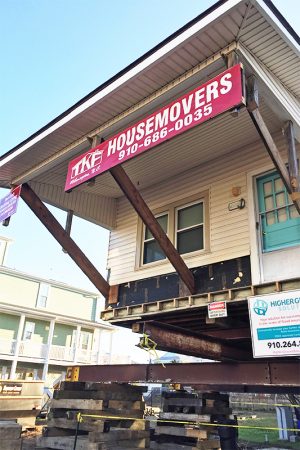
General contractor John Buechele, owner of Buechele Building Group, has teamed up with the town of Carolina Beach, Higher Ground Solutions, FEMA, and TKF movers to protect vulnerable homes from future flooding.
89-years-old, 24-feet high
Raising an older home in the air is no small feat.
“There’s a lot of variables and a lot of factors that could go wrong,” Buechele said. “That would go for a real bad day.”
On 700 Canal Drive, the plan is to raise the beach cottage, built in 1928, 24 feet into the air.
“It’s kind of a crazy project,” Buechele said.
Raising an older home that high is not the typical assignment, but for this couple, Buechele says it was the most cost-efficient option.
“This was their little beach house they’ve lived in for 40 years, it’s got beautiful pine walls,” he said. “They’re older. It’s nice for them to keep their main part intact.”
Instead of demolishing older homes in flood-prone areas with increasing flood insurance rates, Buechele and his team come up with creative options to save homeowners in the long run.
“They’re going to raise it, fix it,” he said. “It actually saves the taxpayers and everybody a lot of money by doing this.”
Now in the first phase of demolition, the house will eventually be supported by a two-story structure to be used as a downstairs apartment.
Flood reform
Since the 1960s, homeowners in coastal and flood-prone areas across the nation have been buffered by federal subsidies. That was halted by 2014 when FEMA gradually delayed its National Flood Insurance Program after incurring substantial debt from disastrous hurricanes like Katrina and Sandy with the Homeowner Flood Insurance Affordability Act.
This meant that people living in homes located in vulnerable areas of the flood map started to feel the actual cost of insurance, Buechele says.
Despite the federal changes, FEMA has selectively assisted vulnerable homes for updating, according to current flood maps.
In 2016, FEMA awarded three homes in Carolina Beach a total of $483,536 as part of its Flood Mitigation Assistance Grant program.
This year, the cost to protect the three vulnerable homes is an estimated $610,000, of which 90 percent is federally funded.
“No town funds will be utilized for the Grant,” the town’s bid proposal states.
The home at 700 Canal Drive will cost $255,000, for 206 South 3rd Street ,$155,000 is required, and 314 Wilson Ave will cost $200,000, according to final bid tabulations presented to the town council.
Updates like this are not necessarily required in all waterfront communities – often a simple flood bank will suffice.
“Some of them you could just raise them a couple feet to get them out of the flood zone,” Buechele said. “Sometimes it’s just putting in flood banks.”
On Tuesday, North Carolina Congressman David Rouzer voted for the 21st Century Flood Reform Act, which would extend the National Flood Insurance Program until 2022 and cap flood insurance premiums at $10,000 for homeowners, among other changes. The bill passed in the U.S. House Tuesday, Nov. 13 and still needs to pass through the U.S. Senate and the president’s pen before becoming a law.
The capital strain drain
While plenty of homeowners would like to be awarded federal relief to update their vulnerable homes, Buechele says that FEMA only steps in for cases of repetitive loss.
“I would consider these the ones that were in the highest need and were going to be of the most value to the community and the taxpayers to help,” he said.
FEMA looks at a variety of factors to mitigate the greatest capital risk.
“How many times has the house been flooded and what is the payout?” Buechele asked.
FEMA studies “the biggest capital strain on the system” and prioritizes bringing those structures up to date.
“The next criteria they look at is the owner’s financial situation,” he said. “Are they able to take care of themselves or are they at a greater need for assistance?”
Oftentimes, individuals that are retired or past a working ability are granted relief over those that are still able, in consideration of the strain the home’s damages pose on a multitude of forces, Buechele says.
The three projects are expected to wrap up by spring 2018, with the house on Canal Sreet expected to be raised to a height of 24-feet in the coming weeks.
Johanna Ferebee can be reached at johanna@localvoicemedia.com or @j__ferebee on Twitter
