


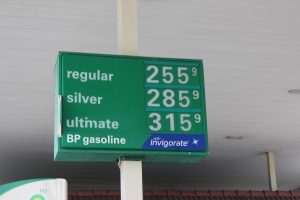
WILMINGTON — Gas prices have jumped across the Cape Fear region, reaching more than $2.50 per gallon for regular unleaded gasoline.
The American Automobile Association (AAA) attributes the increase in gas prices throughout the country to Hurricane Harvey; on Monday, the national average for a gallon of gas was four cents higher. Reporters for Port City Daily have seen gas prices rise as much as 10 cents since early Thursday morning.
A major supplier of petroleum products to the southeastern United States, Colonial Pipeline Company has officially announced the shutdown of a diesel and aviation fuel pipeline, as well as the potential shutdown of two commercial automotive gasoline pipelines, both of which terminate in Greensboro, NC.
Related story: The pipeline leak last September which caused gas shortages in the state was also a Colonial Pipeline Company pipe.
Colonial Pipeline Company, an Atlanta-based company with more than 5,500 miles of pipeline, supplies more than 100 million gallons of gasoline and other petroleum products every day. The company has announced the suspension of operations for its Line 2 as of yesterday evening, according to a press statement from Colonial. Line 2 transports mostly diesel and aviation fuels.
The statement also announced the company’s expectation to suspend services today to Colonial’s Line 1, which transports mostly gasoline.
“Due to supply constraints caused by storm-related refinery shut-downs and the impact to Colonial’s facilities west of Lake Charles, Colonial’s Line 2, which transports primarily diesel and aviation fuels, will suspend service this evening. For the same reasons, we expect that Line 1, which transports gasoline and is currently operating at reduced rates, will suspend service tomorrow (Thursday),” according to the press statement.
According to David David McGowan, III, executive director of the North Carolina Petroleum Council, “(a)lmost 75% of the refined products NC receives comes through either the Colonial Pipeline or the Plantation Pipeline,” with a much smaller amount arriving by truck or through the Port of Wilmington.
The federal government has stepped in to try and mitigate the effect of the hurricane on fuel supply through emergency fuel waivers for 12 states (including North Carolina), and the District of Columbia.
“At this moment, diesel seems to be in shorter supply than gasoline. Unbranded prices are rising as a result of this short supply. Carriers report that lines at terminals are lengthening and delivery times are being pushed out to 48 hours or more.”
The emergency waivers remove “requirements for reformulated gasoline and low volatility gasoline,” according to the EPA.
“As a result of the continuing impacts on Gulf Coast-area refineries and disruption to the fuel distribution system caused by Hurricane Harvey, EPA Administrator Scott Pruitt today exercised EPA’s emergency fuel waiver authority to help ensure an adequate supply of fuel throughout the South, Southeast and the Mid-Atlantic,” according to an EPA press release.
Wilmington-based Go Energies, a company that specializes in fuel management software, hardware and consulting for commercial, government and emergency management agencies, released a statement to its customers Thursday morning updating the status of current supply.
According to the email, “Reports coming in Wednesday afternoon indicate that multiple refineries along the Gulf Coast are closed as a precaution against high water. This has caused a cessation of product injection to the Colonial Pipeline. As expected branded product allocations along the Colonial are tightening. At this moment, diesel seems to be in shorter supply than gasoline. Unbranded prices are rising as a result of this short supply. Carriers report that lines at terminals are lengthening and delivery times are being pushed out to 48 hours or more.
“It would be unwise for us not inform you that the supply situation is going to get worse before it gets better. We will continue to serve you in the best manner we can, but rest assured, we will keep this communication line open and update you as much as possible until things are restored to normal operational status,” according to the customer update.
Michael Praats can be reached via email at [email protected]
