


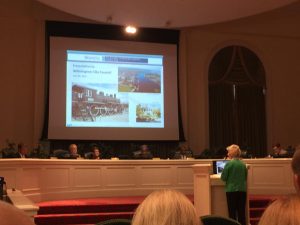
WILMINGTON — The City of Wilmington could be closer to seeing a major rail realignment project after Tuesday night’s City Council meeting. The Mayor’s Task Force on Rail Realignment presented the council with the results of its initial feasibility report on the ambitious project.
The proposed project was first introduced in 2015 to consider and consists of two separate projects – the first would relocate the current freight rail line to allow for a more direct route, while the other half of the project consists of plans for a trolley system in Downtown Wilmington.
The project could cost upwards of $1 billion, according to Laura Padgett, chairwoman of the task force.
Want more background? Read this: This ambitious railway plan could reshape Wilmington. It could also cost a billion dollars
The City of Wilmington, the North Carolina Department of Transportation and the Wilmington Urban Area Metropolitan Planning Organization all helped provide the funding for the feasibility project.
“The purpose of the study was to consider relocation of the current freight usage from the heart of the city to the west side of the Cape Fear River and up the industrial highway 421 corridor,” Padgett said.
Currently, freight moving along the railroad in Wilmington takes a roundabout journey in a V shape through the city – the realignment could help cut the time as well as improve quality of life for residents, she said.
Wayne Hyatt, project manager of the feasibility study helped present the findings of the report to the mayor and City Council.
“The study is intended to look at several aspects – the main purpose is to find what could potentially go wrong if the project is pursued,” Hyatt said.
The report analyzed the different aspects of the proposed plan, including: goals and objectives, infrastructure, jurisdiction, and confirming the corridors. Although there are two separate plans for the proposed project, there are several overlapping areas which could lead to collaboration in the future, Hyatt said.
For such a potentially massive project, both in size and financially, the task force was unable to find a “fatal flaw” at this level of the study, he said.
One of the bigger aspects the report looked at was the impact the proposed plans would have on the environment. There is an environmental conservation easement on the north-west region of the proposed realignment. Hyatt presented the council with three different potential options and their benefits and impacts of the conservation easement.
“There are alternatives that would avoid, minimize, and there are some that would impact that conservation easement, that is all part of the future engineering,” Hyatt said.
The group also made sure to avoid other areas to minimize the impact on the U.S.S. North Carolina, the turning basin for the port ships, and other infrastructure in the city, according to Hyatt.
The proposed realignment would run from Yadkin Junction in the north, to the Port of Wilmington in the south.
Funding for the projects could come from several different locations including federal, state, and local money, Hyatt said. For the project to move forward, the city would have to gain approval from CSX – the company that owns and operates the railroad. Without its support, the project would not be feasible, he said.
While the study did outline several benefits, the proposed realignment would have on the city, it did not take quality of life benefits into account.
The City Council did not take any action on the realignment plans during the presentation. Port City Daily will continue following the plans and provide updated information when it becomes available.
