


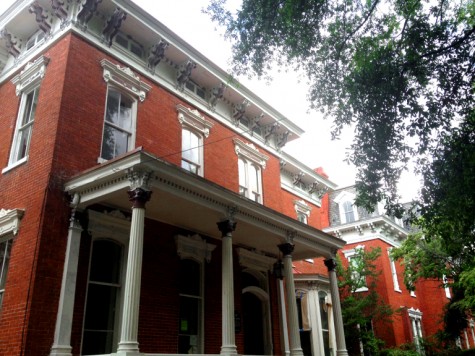
Neighbors on and around historic South Third Street in Wilmington are split on a proposal that would return one of the 130-year-old homes there to apartment use, potentially adding more than a dozen tenant cars to an area some say is already cramped for parking.
Adding to it is a worry that allowing originally single-family homes to become multifamily runs against an economically powerful charm of downtown’s old, residential corridors.
The 1880s-era subject property at 208 S. Third St., on a busy destination area lined with parallel vehicle spots, is slated for seven apartments whose occupants under the proposal would not have off-street parking.
“As it is right now … I rarely see an open space,” said Margi Erickson, who owns property two blocks down South Third Street. “And the homeowners who live on that block cannot regularly park in front of their own homes.”
Her comments, and numerous others like them, fed into a lengthy public hearing that reached no conclusion at Tuesday night’s Wilmington City Council meeting, where a special-use permit to allow the multifamily arrangement at 208 S. Third St. was up for consideration.
The city’s planning commission had recommended approval of it after noting the property had multifamily usage in its past and already consists of seven units; as such, the density wouldn’t increase if the property resumes that use. Representatives for the applicant, Red Tiger Development LLC, asserted the proposal would not harm neighboring property values and ultimately met all criteria.
The main, two-story brick building–known to historians as the Edward Latimer House, a contributing structure on the National Register of Historic Places–is 3,463 square feet with a detached 650-square-foot carriage house that are both currently vacant and vying for new life.
Blair Brown, who said she lived in the property’s carriage house from late 2009 to early 2011, called the new multifamily plan one of great spirit and that the planning commission saw it “as a really wonderful opportunity for improving downtown.”
“It would mean that there would be more people and more cars,” Brown acknowledged, “but right now this house is sitting and falling apart…. It has sat empty for months.”
Red Tiger Development, managed by Sean R. Frelke, bought the property in late 2012 as “a serious financial commitment to downtown Wilmington in the midst of a depressed real estate market,” said family friend Bill Batuyios, a real estate appraiser who cited 19 years’ experience in southeastern North Carolina.
Batuyios told the city council Tuesday he investigated the property and Red Tiger’s plan and determined it harmonious with the surrounding neighborhood. But his observation that parking on South Third Street wasn’t a problem got quick attention from a councilman.
“I guess everybody can have their opinion, but I find it astounding that you can come to that conclusion,” said Councilman Kevin O’Grady, who noted he resides in that neighborhood. “I know that on Third you can rarely find a parking space.”
Batuyios said he’d visited the vicinity five different days at five different hours and saw parking adequate. He said he figured downtown’s residents and workers sort of trade those spaces at transitional times daily.
“I noticed no parking problems whatsoever,” he said.
Michael Smith, who lives on the 200 block of South Second Street in a home abutting the Edward Latimer House’s land, disagreed. He called it fortunate that historic downtown draws so many visitors, but said it’s created a parking shortage to the detriment of residents.
Opening seven residential units in the Edward Latimer House wouldn’t help, Smith opined, nor would it flow with the direction of the neighborhood. Noting he’s lived there for more than 30 years, he said he’s enjoyed seeing former multifamily houses being taken under new ownership and reverted to their original, single-family set-ups. “This after a long dormant period from the ’40s or ’50s into the ’60s, when apartments existed in all of the large homes.”
He said allowing this property to move forward as apartments “is an insult to that block and to that neighborhood.”
His neighbor, Curt Stiles, said he was watching the night’s public hearing unfold live on television and he dashed to City Hall to add his voice. Stiles, an associate professor at UNCW’s Cameron School of Business, declared that “the whole thrust of development here in this community, since I’ve been here, has been on restoring [residences] that were cut up into multifamily usage in years past and restoring them to their original purposes, which was single-family homes. So this would be a major step backward.”
Erickson, the South Third Street property owner who spoke earlier in the hearing, agreed. “During the years that I have lived in Wilmington, several multifamily homes have reverted back to single-family residential,” she said, noting she’d been downtown 18 years. “I feel this is the direction historic residential Wilmington should be going.”
The property’s prior use as apartments, with the seven units already there, figured into an exemption the planning commission recommended with regard to parking. Typically, a property converted to multifamily would, per city rules, have to provide adequate parking–11 spaces in this case–and the Edward Latimer House, because it went unused for a period, became subject to the special permit review. All the same, it won favor from the planning commission, which recommended council award Red Tiger the special-use permit with a parking exemption.
“Our rules are getting in the way of these properties being utilized,” Planning Commissioner Dan Dawson reasoned at a June 5 meeting on the request. “They’re sitting empty and they’re becoming in disrepair.”
After spending nearly an hour and a half on the topic Tuesday night, the applicant asked that the matter be continued to Aug. 6, which council okayed unanimously.
Ben Brown is a news reporter at Port City Daily. Reach him at ben.b@hometownwilmington.com or (910) 772-6335. On Twitter: @benbrownmedia
