

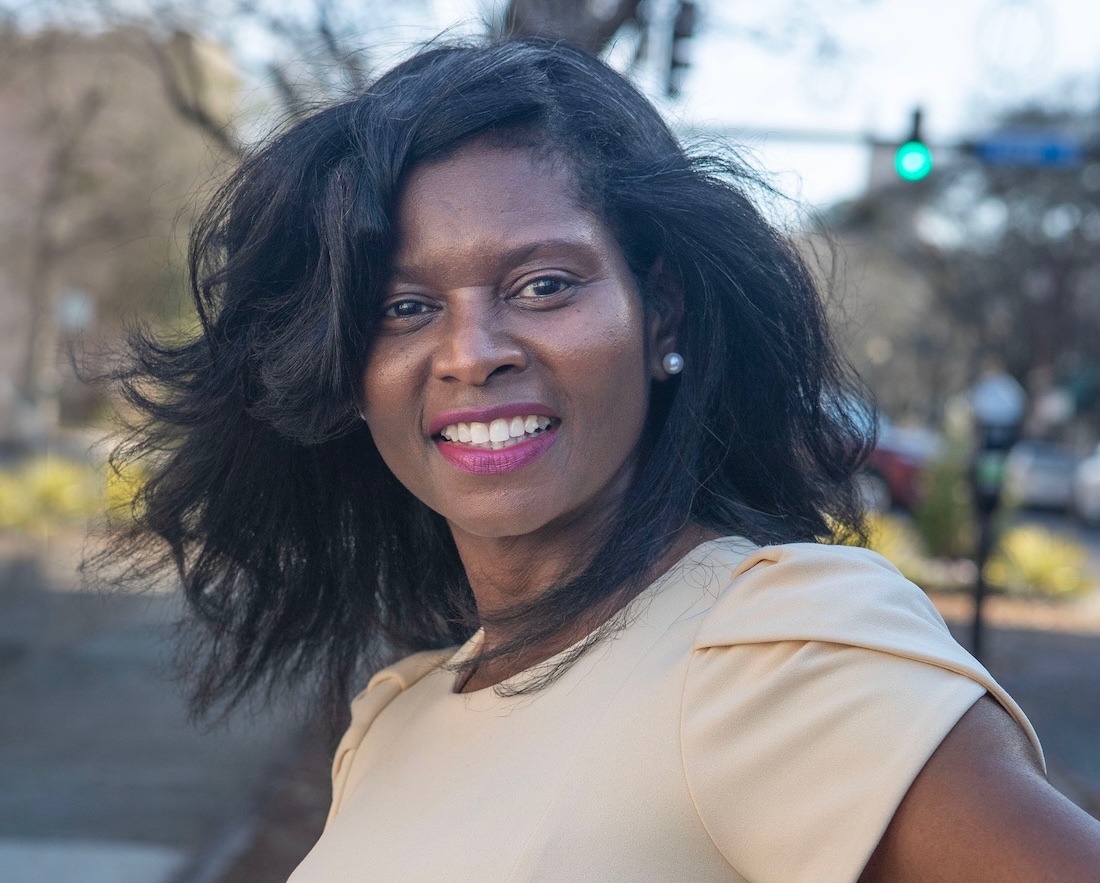
Latisha Grady, Republican challenger
NC House District 18
Career: Business Operations Specialist; Secretary of Jones County GOP (2021-2023)
Education: Bachelor of Science University Studies, East Carolina University
Q: What qualifies you to serve in the North Carolina legislature?
A: Traditional political résumés haven’t exactly insulated voters from waste, fraud, and mismanagement. If anything, the pattern suggests we need a different kind of experience in Raleigh, not more of the same. Mine is in operational problem-solving — spotting a problem and designing a customized process to solve or improve it.
From fraud analysis at Bank of America to vendor onboarding and contract governance at Ripple Labs, to sales and accounting support in the commercial real estate industry, I’ve spent 15-plus years catching where the money and the paperwork don’t match, in regulated industries where getting it wrong has real consequences. That’s the instinct I’d bring to something like the Cape Fear Memorial Bridge tolling question — reading the fine print and asking who actually ends up paying rather than accepting the official framing.
I’m running because I live with the outcomes of these decisions like everyone else in this district. But what qualifies me is that oversight is the work I’ve actually done — and it aligns with the core duties of a state legislator.
Q. What is a bill you would like to sponsor or co-sponsor and what is a bill you want to repeal — or even amend? Why?
A: There are a few. Senate Bill 754 and House Bill 121 address the School Restricted Calendar issue educators and parents have been complaining about, as it creates learning gaps and conflict with CFCC calendar for dual enrollment students. Also, having the same calendar for coastal school districts and mountain districts presents geographical conflicts unnecessarily, as beach economies benefit from later school start dates than do mountain school districts.
So, I’d support H.B. 121 to repeal the law to give authority to school boards to determine calendars that best fit their unique geography and constituents. However, as a compromise, I’d support S.B. 754, if the House version failed.
I’d also like to address the veteran teacher and retired state employee pay raise plateaus that were nominally addressed in the recent budget approved in July.
Q: What will you do to hold industry accountable for pollution of toxic chemicals, such as PFAS or 1,4 dioxane, in the water or air? Will you support enforcing additional maximum contaminant levels of PFAS compounds, aside from PFOA or PFOS; how, if so?
A: The state’s $600-million Chemours/DuPont settlement (September 2026) is real progress — New Hanover County alone will receive $22.8 million over 10 years, and it strengthens DEQ’s 2019 consent order. But it’s not the finish line: the separate CFPUA lawsuit over Wilmington’s own treatment costs remains open and untouched by this deal.
The bigger gap is regulatory, not just financial. Current state rules only require polluters to monitor and report PFAS and 1,4-dioxane — there are no enforceable numeric limits, deadlines, or penalties. Even Rep. Ted Davis’s polluter-liability law only triggers accountability once the EPA sets a federal maximum contaminant level, which today covers just PFOA and PFOS. I’d support setting state-level enforceable MCLs for additional PFAS compounds and 1,4-dioxane, independent of waiting on federal action — North Carolina already has precedent for stricter-than-federal standards.
I’d also push to direct a share of settlement funds toward independent contaminant testing and standard-setting, not just treatment infrastructure, and keep pressure on the still-open CFPUA case so utility ratepayers aren’t left covering costs polluters should bear.
Q: Is the public school allotment formula sufficient or does the legislature need to change it? Explain what your plan is for this issue.
A: No, it’s not sufficient. And, yes, there are a few ways the allotment formula should be changed.
First, I’ve learned a leading educational need is instruction for exceptional children (EC). Due to a 13% EC funding cap, there is a huge gap between what’s allotted and what’s required to educate a child with EC. One possible solution could be to remove this cap and redirect some of the state surplus funds to address the gap with more specialized support staff.
Second, G.S. 115C-105.25 counts kids on a couple of snapshot days and locks that number in for a full year. If a kid leaves for private school or homeschool and returns mid-year, the public school isn’t funded for them until the next budget cycle. I’d reattempt the adjustment Governor Stein proposed, working across the aisle to get it into the next state budget — because getting the count right shouldn’t be a partisan issue.
Q: State law allows law enforcement agencies, including the State Bureau of Investigation, to store data captured by license plate reading cameras (Flock cameras) for up to 90 days. Since the CEO of Flock cameras has now recommended agencies reduce the time camera data is stored down to seven days, would you make it a priority to change state law to follow this recommendation?
A: I am interested in a state law that incentivizes 1970’s style police detective work to find criminals without all the intrusive warrantless surveillance. We have plenty of internet, cell phone, private business, home, and state DOT cameras to help police solve crimes. I am uncomfortable with automated license plate readers and networked surveillance systems continuously tracking vehicle movements with data available across state lines, agencies, and potential bad actors within.
Q: Do you support how the film grant program currently operates? Do you think the $31-million annual cap on award disbursements should be lifted? Do you think the General Assembly should allocate more money to the program?
A: In general, I enthusiastically support the film grant program because it’s an industry that adds quality opportunities to the local arts community and contributes to our local economy. I was happy to see the funds re-appropriated in the recent budget. To attract higher quality productions, I would be in favor of increasing the annual cap but would make future awards contingent upon annual audits to prevent the current over-commitment deficit.
Q: Would you support rolling back the sales and use tax exemption for data centers to build in North Carolina? Explain.
A: No. The electricity portion of the data center sales tax exemption was repealed in this year’s budget, effective July 2026. What’s still on the table is the exemption on equipment and construction materials, and I don’t support rolling that back either.
I think a lot of the fear and hype around data centers — from both sides — is exaggerated and increasingly partisan. What’s real? This is a genuine national security issue. AI and blockchain infrastructure need to stay in the hands of the U.S. and allied companies, not China, Iran, or Russia. North Carolina should be competing to host that infrastructure, not driving it away.
But “innovation” doesn’t mean a blank check. If elected, I’d sponsor or co-sponsor legislation requiring closed-loop cooling and on-site power generation as the standard for new data centers built here — building on what’s already moving through the legislature. I’d go further than current proposals and explore requiring existing facilities to retrofit and meet the same standard — not just new ones — in order to protect public health, ratepayers, and the environment.
As for my district, our county commissioners recently determined New Hanover County is not equipped for a data center site, so there will be no data center in NHC.
Q: The current gas-tax funding system for the NCDOT no longer seems to efficiently support necessary projects – including the Cape Fear Memorial Bridge replacement. Is tolling the answer; what other funding mechanisms would you support? Would you vote on legislation to allow the Turnpike Authority to toll the Cape Fear Memorial Bridge if it comes before you?
A: I would vote against a toll. If elected, I would explore a tiered sales tax where tier one sunsets at the end of the bridge’s completion, triggering the tier two sales tax (a permanent smaller percentage) to fund ongoing maintenance.
Q: Would you vote to implement an independent commission to draw legislative and congressional lines? Why or why not?
A: No, I would not because Republicans won the majority in North Carolina in 2010 using map lines drawn by Democrats. Democratic majorities have been redrawing lines based on race to favor them for over five decades and Republicans took it on the chin and still managed to win.
Yet, congressional lines only become a problem when election outcomes start trending toward favoring Republicans. The facts are, people who live in the same geographical neighborhoods tend to have the same values — hence why they can live, safely, next to each other and how a Black candidate can live in a majority white district and win a House seat and vice versa.
For example, neighborhoods in downtown Wilmington tend to vote more Democratic than neighborhoods in Porters Neck. Skin color propaganda no longer guarantees a Democratic vote; it’s people who share the same values who determine election outcomes these days. So, I think the system we have — with lines drawn based on value geography — works just fine. When legislators offer common sense values, govern well, and do right by taxpayers, informed voters reward them.
Q: In terms of economic development, North Carolina gets high marks for business, but middling and lower marks for worker satisfaction and quality of life. What would you do to improve these metrics for state residents?
A: We are a victim of our fiscal success as a state. Wilmington’s large share of retirees (living on fixed income, not wages) and UNCW students (working part-time around class) gives employers a labor pool that doesn’t need full market wages, so pay stays lower here, even though full-time working residents still face high costs of living and why UNCW students leave after graduating.
First, I would recruit higher wage industries and increase workforce development training pathways to prepare local workers for those industries.
Next, I would address both the demand and supply side of this equation with zoning reforms and developer incentives for more workforce housing. Employers are incentivized to pay workers more when their operating costs are low or manageable. Consumers can afford more, when they keep more of their biggest wealth building tool–their income via lowering income taxes.
At Port City Daily, we aim to keep locals informed on top-of-mind news facing the tri-county region. To support our work and help us reach more people in 2026, please, consider helping one of two ways: Subscribe here or make a one-time contribution here.