


BRUNSWICK COUNTY — Another 400 homes are on the way to Bolivia after the planning board approved a planned development Monday night.
With Howard Stocks recused from the meeting due to being a surveyor for Cape Fear Engineering, which is part of the development team, the planning board agreed 3-0 for 417 single family homes to be built on 122 acres near Old Ocean Highway. Bud Needham, Travis Cruse, and Bill Bittenbender all voted in favor. Chair Clif Cheek doesn’t vote unless a tie-breaker, and Celia Herman and Ron Medlin were not in attendance on Aug. 10.
The Amber Glen Development will be located near COAST School and Brunswick Community College. The land was previously owned by a timber company and the project is being built by Realstar Acquisitions LLC and Cape Fear Engineering. Attorney Clint Cogburn of Ward and Smith represented the applicants, noting the project exceeds requirements in the unified development ordinance and meets the land use plan.
However, a handful of residents spoke out, most of whom expressed issues with traffic, flooding and school capacity as problematic already in the area and not prepared for additional homes.
READ MORE: Brunswick fire chiefs draw line on developers using emergency water tankers for protection
ALSO: Brunswick County Schools hit at or above benchmark scores for the 2025-2026 school year
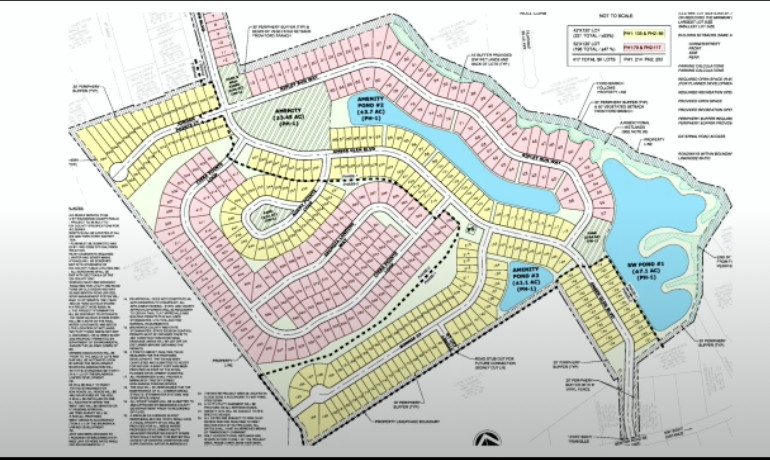
The 122 acres makes up five parcels, with 117 on uplands and 5 acres of wetlands. Cogburn said lots are not in a flood zone area but have been clustered.
“Clustering in uplands will reduce the impact of erosion and minimize land disturbance,” he said, noting the project team is also under the maximum unit capacity allowed.
The project is mostly in the commercial low density zoning, except for a portion in medium density residential to allow for access to the Benton Road tract. Its proposed density is 3.42 dwelling units per acre, about 25% of the 13.6 dwelling units per acre allowed in the CLD and below the 5.8 dwelling units per acre permitted under the R-7500 Density Maximum designation.
“It’s intentional,” Cogburn added. “We have more buffer, recreational and open space — increases offered in order to gain flexibility in other areas.”
The county is requiring 15% of open space to be usable recreational area, with the development providing 118%, Cogburn noted. That amounts to 5.6 acres instead of 4.6 and 32.47 acres of dedicated open space, over the county’s mandate of 30.5 acres.
One flexible design element the group requested was a slight increase of the 6,000-square-foot minimum lot size allowed. It proposes smaller and larger lot designs, between 5,000 and 6,200 square feet.
“It adds a cost effective option for smaller lot design,” Cogburn said, noting there also may be an intermediate lot design that hasn’t been decided upon.
He requested another option in minor design flexibility: slightly reduced setback from the front of the homes.
While the plans meet all setback requirements for corner, side and rear, the group is asking to go from 25 to 20 feet.
“That allows for greater clustering, greater large open space areas, greater conservation, and the ability to have the requisite and adequate buffering with adjacent lots,” the attorney said.
Buffering will include 30-foot or 20-foot perimeters, with a 6-foot fence and a 0.6-opacity area using existing vegetation supplemented with additional landscaping where needed. The fencing will be at the entrances.
As well, lots adjacent to wetlands will include an additional 10-foot buffer, as proposed by the developers.
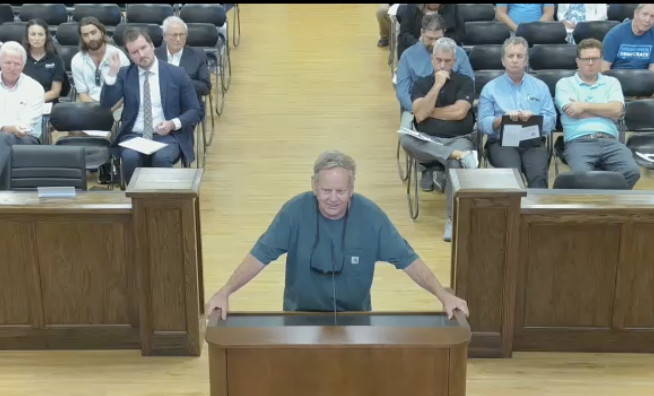
Regardless of the exceptional design elements proposed and the reduction of density by more than half, nearby residents still weren’t sold. Rose McKeithan, who lives on Benton Road near the project, put it simply.
“On paper, it looks great, but the reality of what’s going to happen if this gets built along with all the other ones that are going to be built in our area, the reality is not going to be good,” she said. “You need to think about what the impact is on the people.”
She pointed to a piece of her property located near one of the stormwater ponds on the plan.
“And it scares me that it’s going to flood,” McKeithan said. “Everybody sees the storms getting worse and worse.”
George Harris, also a Benton Road resident, shared similar concerns, noting ditches near the school always flood and Potential Tropical Cyclone #8 in 2024 brought water within 4 to 5 feet of his home’s front steps.
“Benton Road was completely underwater,” Harris said. “Where is this water going to go from the development?”
Brunswick County Planning Board Chair Clif Cheek noted the unexpected tropical storm was a one-and-1,000-year storm event, meaning it has a 0.1% chance of happening in any given year.
This was echoed by stormwater engineer Jackson Starling of Cape Fear Engineering.
“It’s beyond anything I’ve seen in my lifetime and hopefully won’t again,” he said, adding the 1,000-year storms are something “that can’t truly be designed for.”
Starling, whose office is in Leland, noted PTC8 flooded many roads in Brunswick County, not just Benton. However, he explained the stormwater ponds the team is designing release water slowly in a controlled measure, into pipes under Benton Road and out to a flood zone.
Before storms, the ponds will be drained down, which are designed to a 25-year storm event. That means there is a 4% chance of heavy rainfall or precipitation from a storm happening in any given year.
“And traffic is going to be horrendous,” resident Harris added, calling the congestion nearby already “a mess.” “It’s not uncommon to wait 20 minutes to get out on Midway Road to get anywhere. There are lots of developments in that area — a lot of very unhappy people out that way.”
A traffic impact analysis was conducted and approved by North Carolina Department of Transportation and county planning staff, noting the development will bring 3,712 weekday vehicle trips.
The TIA assessed three intersections and two access points and recommended two turn lanes, left and right, being installed on Old Ocean Highway into the site. Nothing was required at the Benton Road access, with low volumes being the reason, according to Ramey Kemp of RFK Engineering.
A main road through the development will be public, Cogburn said, in order to promote connectivity; so no gate will be installed to prevent access from motorists.
Chair Cheek said it allows people another route to get to the area schools.
Southport resident Shirley Sullivan brought up school capacity during her public comment. Sullivan has become a frequent speaker during the planning board public hearings, vocal against overdevelopment. She opposed Amber Glen and questioned how planning staff could reason the schools’ impact would be moderate.
“All of these schools are currently over 82%,” Sullivan said. “How do schools calculate the growth? Is there a specific calculation that can be published? Can’t we just apply the growth rate of 4%?”
Cogburn added the team has worked for months with planning staff to present the best design. The development will be built in two phases, consisting of 214 homes first and then 203 in phase two.
He added they listened to feedback from the late-July community meeting as well. This included adjusting sight lines and access points, also delineating wetland areas along the northeastern boundary line.
“We also had an adjacent property owner ask units to be flipped to the other side of the entrance, away from his property, and it was done to create more buffer,” Cogburn said.
One person from the public spoke in favor of the development Monday. Alton Swann, who also lived on Benton Road, called it “responsible” and “well-planned.”
“I think it shows a commitment to the community by not maximizing homes and providing more open space,” he said. “I respectfully ask you to support the project.”
The planning board did.
At Port City Daily, we aim to keep locals informed on top-of-mind news facing the tri-county region. To support our work and help us reach more people in 2026, please, consider helping one of two ways: Subscribe hereor make a one-time contribution here.
We appreciate your ongoing support.
