


NEW HANOVER COUNTY — New Hanover County leaders agreed on its top five bond projects to continue exploring for voter approval next year, though one item was removed from the list.
READ MORE: UNCW provides acre of land to construct Isaac Bear building, a project in the works for 3 years
The projects that made the cut, in order of rankings made by the New Hanover County Schools Capital, Bond and Finance Committee, include a new Riverlights Elementary School (estimated at $43.34 million), New Hanover High School renovations, the replacement of Pine Valley Elementary ($43.95 million), a new building at Trask Middle School ($77.86 million) and a Porters Neck Elementary addition ($5.8 million).
Made up of elected officials, school district and county staff, and business leaders, the committee also chose to forge ahead with the $233-million hybrid option for upfitting New Hanover High School, moving aside the $137-million renovation-only option and the $280 million rebuild.
Committee chair and school board member Pat Bradford noted the projects and their details are subject to change. Once finalized, the bond amount would be set and placed on the 2026 ballot for voter approval. Based on an anonymous committee poll, 56% of voting members said the bond should be $300 million; 31% voted for $400 million.
The next two projects ranked on the list include Bellamy Elementary Additions and renovations ($24.42 million) and Sunset Park additions and renovations ($18.35 million) the full list can be viewed at the bottom of this article.
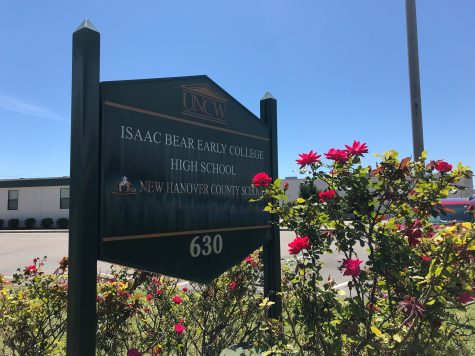
The committee has already removed a project from its top-ranking spot due to complications — a permanent facility for Isaac Bear Early College. The school currently operates out of trailers on UNCW’s campus, though the school board’s goal has been to identify funding for a permanent building since its opening in 2006.
In 2022, the UNCW Board of Trustees approved plans to construct a two-story building for the selective-enrollment early college. The university provided 1 acre of land and used $1 million in state funding for planning purposes. The memorandum of association stated NHCS would be responsible for the funding, construction, renovation, maintenance and operation of the building.
“Obviously, the question is: Where do we get that money?” Assistant Superintendent of Operations Rob Morgan said. “I don’t speak, obviously, for the county. I don’t know what their appetite is for moving forward with that, but I know part of the conversation with them, do we need to look at some sort of public, private partnership in order to move forward? And that’s really where we’re at.”
The matter is further complicated by ownership, as UNCW would own the land the school is built on, but the county would own the building.
Commissioner Rob Zapple, who serves on the committee, said that based on the complications alone and the need to set projects for the upcoming bond, removing Isaac Bear from its spot at number 5 makes way for the Porters Neck addition. Built in 2017 YEAR, it’s already over capacity.
Though it wasn’t mentioned in the meeting, County Manager Chris Coudriet offered his analysis of Isaac Bear’s inclusion on the list prior to Wednesday’s meeting.
“I have expressed to a commissioner and county staff that a priority for school capital, funded by the county for Isaac Bear, does not seem appropriate or in alignment with the facilities obligations for early college programs,” he wrote in an email obtained by Port City Daily. “Those facility costs are intended to be borne by the host institution, so in this case UNCW. It would be unusual for the county to pay for a facility on a 4 year college campus.”
Morgan confirmed Wednesday the funding onus is still on NHCS, as UNCW has not indicated it would step in. In her response to Coudriet’s email, Commissioner Stephanie Walker, also on the finance committee, said she wasn’t aware of any state initiative to further the project along, though thought it should fall on the General Assembly’s dime. Sen. Michael Lee (R-New Hanover) did advocate for the state to provide the $1 million planning money, but Walker noted no one at the state level is championing the project.
“The current Isaac Bear is located in trailers that are at the end of their lifespan,” she wrote to Coudriet. “Those students, in a highly successful program, have been in trailers for almost 20 years.”
Walker also questioned at the meeting the MOA’s deadline for NHCS to put up the money for the building. The MOA stated the agreement would sunset after five years of no action, though Morgan said he didn’t get the impression, from his conversations with UNCW staff, the deal would be nixed.
John Hinnant, business owner and NHC Republican Party chair also sits on the committee and noted the College Road parcel on which the now defunct K-Mart sits could soon come up for a redevelopment opportunity.
“When that happens, it’d be smart to try and cooperate, absolutely, with the developer,” Hinnant said.
Ultimately, Zapple’s motion to pull the Isaac Bear building from the list passed, only school board member Josie Barnhart disagreeing.
It was then Zapple’s turn to be the sole dissenting voice. When the discussion of New Hanover High School came around, it largely focused on whether the district should fund the $137-million renovation-only option to keep costs down versus some combination of the $233-million hybrid option’s four-phase approach, to be completed over a decade. Zapple was the only one to choose the former.
“I think the lower we keep the New Hanover High School number — in other words, scenario number one, $137 [million] — gives us more capacity to put those other projects in so that we don’t break overall debt capacity,” Zapple said.
He then suggested a different consultant — LS3P was hired to put the three NHHS scenarios together — could come up with cheaper prices. The idea didn’t gain traction among the committee and Bradford noted she didn’t think the 2026 bond timeline would allow for another study.
Based on projections from NHC Chief Finance Officer Eric Credle, any school bond amount above $300 million (setting aside $455 million for the county’s other capital needs) would require the county to raise its debt capacity at some point in the next decade. The county has the ability to do so, though Credle has stated he remains most comfortable at the current $2,200 per capita.
With the NHHS hybrid solution at $233 million, it would take up a major portion of the bond amount. Some members of the committee questioned if that was smart.
“I fondly remember the days when I was idealistic, but if this bond doesn’t have something for everybody, it will be voted down,” Superintendent Chris Barnes said.
The committee noted the top five projects were spread across the county. Still, Zapple worried if NHHS took up too much of the money, people wouldn’t vote for it.
Barnhart said she also wouldn’t suggest putting the entire hybrid solution on the bond, though that was her preferred NHHS option.
“I would like to see a joint effort with our county commissioners to talk about funding phase one and making a plan for that in the budget because that’s what needs to happen, as well as maybe look at phase two, three and four, including it in a bond,” Barnhart said.
Barnes agreed that not every phase would have to be funded on the bond, or even in the next 10 years, noting phases 3 and 4, for example, could be done over the next 20 years. The first two phases come in at $135 million, just under the renovation-only option.
“We may have to eat this elephant in more than one bite,” he said. “New Hanover took 100 years to get to where it is. It may take us more than 10 to get back to where we want.”
As affirmed by the NHHS study consultants, each phase was designed to standalone in that the school could function as intended without continuing to other phases.
While the committee agreed to move forward with the hybrid model, no one wanted to decide yet on what phases would come first and how many would be included on the bond. That decision, along with a discussion on marketing the bond to the community, will be left for the next meeting on Sept. 18.
Reach journalist Brenna Flanagan at brenna@localdailymedia.com.
Want to read more from PCD? Subscribe now and then sign up for our morning newsletter, Wilmington Wire, and get the headlines delivered to your inbox every morning.
