


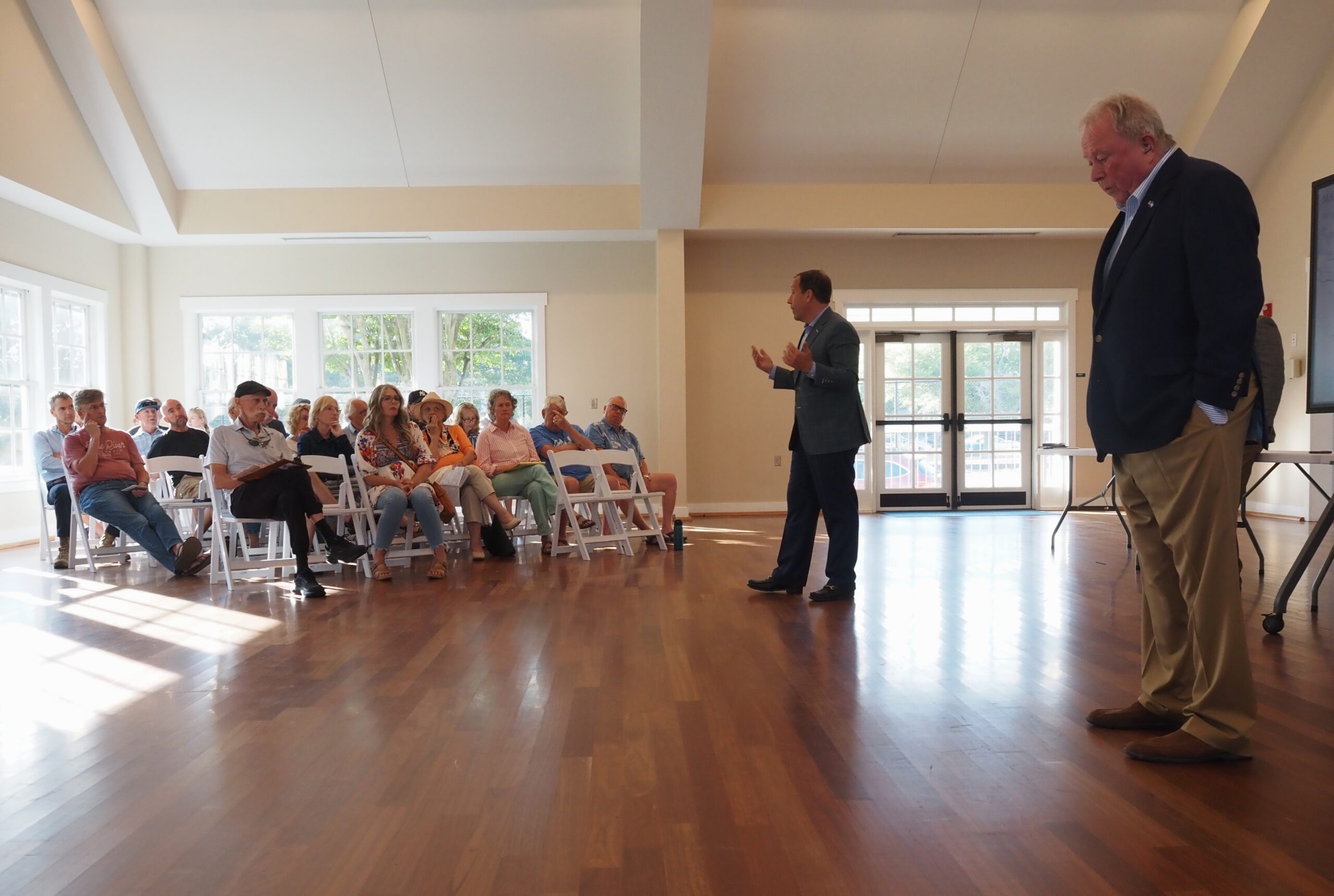
SOUTHPORT — Southport residents gathered earlier this week raising concerns about the proposed Waterway development’s potential impact on local traffic, the environment, and daily life. Their input comes before a vote by the Southport Board of Aldermen on both a conditional zoning text amendment and the project’s specific conditional zoning request and annexation.
READ MORE: Southport community meeting planned for Waterway, conditional zoning amendment back on table
ALSO: Project Indigo back with new name, potentially less units, approved by county
About 70 residents were in attendance at the May 28 meeting, held at the Southport Community Center.
“I was surprised, there were more people here than I thought there would be tonight,” Chad Paul, CEO of developers Bald Head Island Limited, said. “There’s always going to be people who don’t want any development.”
Waterway, formerly known as Project Indigo, is a proposed residential community in Southport from developers Bald Head Island Limited and East West Partners. The full 327-acre project is slated for an area off Robert Ruark Drive, West Ninth Street, and Indigo Plantation Drive. Approximately 47 acres of the project area is located within Southport city limits, comprising 19 parcels.
Of that 47 acres, Waterway’s master plan includes three residential areas: a marina village spanning approximately 4.2 acres with mixed uses, a waterfront village covering about 4.5 acres of multifamily units, and a 21-acre residential village offering 199 townhomes, duplexes and single-family homes.
The initial proposal of Project Indigo was rejected by the Southport Planning Board in 2022, with concerns the residential community was too large, too dense, and did not fit into the long-term vision for the city. The developers withdrew their application before an aldermen vote, to give more time to adjust development plans.
The outlook for the project shifted in 2024 with the removal of Southport’s extraterritorial jurisdiction under House Bill 911. This legislative change placed 75% of the project land under Brunswick County’s zoning authority. As a result, developers successfully secured the county’s approval for 1,190 residential units in December.
The other 25% is in Southport and so the developers have asked for a conditional zoning text amendment to be added to the city’s unified development ordinance — it’s already used in Southport for commercial properties — and changing the current zoning of the 47-acres portion from R-10 to conditional zoning.
Also included is a business agreement to annex the full 300-plus acres back into Southport, but it is only to move forward if the conditional zoning text amendment and the developers’ rezoning request are accepted. Annexing the property into Southport would generate an estimated $2.5 million in annual property tax revenue for the city, according to the development team.
“The last thing I’m going to do is build this project, have it sit right on the edge of Southport and not pay into the city’s coffers,” Paul stated. “That would be irresponsible development, irresponsible for the land, and irresponsible for everyone.”
The community meeting was held specifically for the portion of the Waterway community falling under Southport jurisdiction. Paul highlighted his deep, multi-generational connection to Southport, noting his father developed Indigo Plantation in the 1980s — a project Paul also helped build from the ground-up by digging roadside ditches. He emphasized this family legacy positions him as more than just a developer.
“We ended up having taken everybody’s input over the last four-and-a-half years and made it part of this development,” Paul said. “I’m going to be here all the time and so I’m going to have to see you at Food Lion, I’d have to see you at the coffee shop and I’m not gonna look at my shoes.”
This specific area is currently zoned for R-10 residential, meaning it already allows for a maximum of 4.35 dwelling units per acre for single and two-family residences. While the project’s proposed average density of 4.2 units per acre for this 47-acre portion falls within that range, the conditional zoning request seeks greater flexibility in design and housing types.
Traffic
The hottest topic at the meeting was the impact of the development on traffic in the immediate vicinity. Residents wanted clarification on where the developers planned on altering roads and how it would affect adjacent thoroughfares, like Robert Ruark Drive and Indigo Plantation Drive.
According to a North Carolina Department of Transportation traffic impact analysis from 2024, the full project is expected to generate up to 11,522 vehicle trips on an average weekday. To accommodate additional traffic, NCDOT called for several road improvements, including dual left-hand turn lanes at the Robert Ruark Drive and Highway 211 intersection.
“We did the traffic study, the state wanted us to do it in the summer … and we extended it into the fall because we wanted to make sure we got the impact for the elementary school,” Paul said.
Southport resident John Galowski, who entered the meeting concerned about traffic congestion, found his questions about the issue largely unaddressed. In addition to how the development would affect traffic on Ruark, he also questioned the developers about the demographics of future residents they hoped to attract and how that might impact traffic patterns.
“Depending upon what your market is on houses, who’s going to move in?” Galowski said. “There aren’t enough jobs, I don’t believe, for people to stay in Southport. They’re going to have to go outside of Southport to their jobs, so they’ve got to come in and out.”
According to 2023 data from the U.S. Census Bureau, approximately 1,619 of Southport’s 4,143 residents (aged 16 and older) are employed. With the average commute time for Southport residents being about 22 minutes, this suggests many frequently travel outside the city for jobs.
In response, Roger Perry, founder and president of East West Partners, stated Waterway’s primary clientele would be retirees and pre-retirees, suggesting the demographic would minimize traffic impact during peak business hours.
Regarding construction traffic, developers presented their plan for mitigating its impact. Indigo Plantation Drive, located on the southern side of the property, would serve as the primary road for construction vehicle access. In response to a question about how project construction would affect the health of Indigo Plantation Drive, McKay Siege — partner with East West Partners — said any potential damage from heavy construction vehicles would be repaired by the developers.
Environment
Beyond the physical health of the roads, the project raised questions about the environmental health of the land itself. The development team spoke to the project’s environmental impact, promising to avoid clear-cutting trees and filling wetlands, and to meet all CAMA and state environmental regulations.
“The environmental concern for us mostly means wetlands and wetlands protections,” Siegel said. “We’re not going to be impacting wetlands on the site, we are able to work around those just fine. There’s no reason we need to go in there and take anything out, especially as it pertains to the city properties.”
With more than 13 acres dedicated to open space, Waterway’s master plan proposes 40% open space, well above the planning board’s recommended 20% requirement. Residents offered a mixed view on the projects’ proposed 40% of open space with some calling for more recreational open space and others more focused on preserving existing natural habitats.
Speaking on habitat preservation, Siegel stated the plan includes creating paths up to 100 feet wide to connect preserved areas, allowing wildlife safe and easy passage between them.
Perry said recreational amenities in the open space will consist of multiple parks, playgrounds, and walking trails, all of which will be available for public use, not just Waterway residents. This includes the community’s pool, which Perry suggested would be available to the public through membership or daily rates, depending on demand for access.
Background
The current text amendment and the developer’s rezoning application, comes back before the Southport Board of Aldermen on June 12; it is scheduled for a public hearing, with an official vote to be taken at a later date
Notably, the aldermen have already cast a vote, 4-2, against a conditional zoning text amendment in February 2024. Only Aldermen Robert Carroll and Karen Mosteller supported the motion.
“Without this text amendment update, we do not have a potentially collaborative, transparent, up-front community engagement residential zoning process,” Mosteller said at the time. “I do think that it’s a mistake to kick the can down the road.”
Aldermen Lowe Davis, Marc Spencer, Rebecca Kelley, and Frank Lai voted against it but without providing comment. Southport residents who spoke at aldermen meetings leading up to the 2024 vote cited concerns the text amendment was a “slippery slope” to allow developers to push overly dense projects, altering the city’s character.
Fast-forward two years, and the developers’ request to add a conditional zoning text amendment and CZ rezoning for its development landed before the Southport Planning Board in April. One board member, Larry Ashley, said it appeared before them like a “midnight package” with little explanation as to what changed the aldermen’s minds — aside from legislative restrictions preventing Southport from maintaining zoning authority over the majority of the project.
Despite multiple requests for comment on the upcoming public hearing and vote, no aldermen responded to Port City Daily by press.
The planning board, however, on May 15 recommended approval to the aldermen on the text amendment and the development’s master plan.
The planning board proposed several recommendations for the conditional zoning text amendment: mandating a pre-application meeting, a technical review committee meeting, and 20% open space for all developments. They added any major modifications to a master development plan after public input would require further planning board review before going to the aldermen for a public hearing.
At a May 2 meeting discussing the conditional zoning text amendment and request, some planning board members questioned whether an environmental impact study had been completed for wildlife living in the area.
“There’s not,” Planning Services Director Maureen Meehan said. “An environmental study like that is not something we have asked for.”
The planning board stressed the importance of explaining conditional zoning to residents, detailing its necessity for the development and its potential benefits to the city.
“This obviously is a big deal,” Planning Board Chair Sue Hodgin said at an April 17 meeting. “Voicing the concerns is important.”
Have tips or suggestions for Charlie Fossen? Email charlie@localdailymedia.com
Want to read more from PCD? Subscribe now and then sign up for our morning newsletter, Wilmington Wire, and get the headlines delivered to your inbox every morning.
