


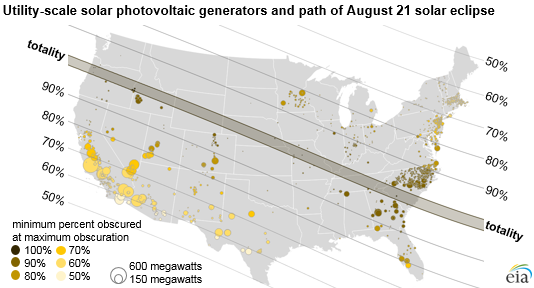
North Carolina’s burgeoning solar power industry will yawn Monday afternoon as the solar eclipse passes to the south and the moon blocks more than 90 percent of the Tar Heel State’s sunshine.
Solar energy production will dramatically decrease as demand for lighting increases in North Carolina while the sun hides behind the moon from about 1 to 3 p.m., Duke Energy said.
Since relatively little solar PV capacity lies in the path of totality—where the sun will be completely obscured by the moon—the North American Electric Reliability Corporation does not anticipate the eclipse will create reliability issues for the power system — nationwide or in the Carolinas.
This is normally a peak time for solar energy production, which made up 3.1 percent of the state’s electricity generation in August 2016, the Energy Information Administration noted in an early August look at the eclipse’s impact.
The eclipse will obscure the sunlight needed to generate electricity at some 1,900 utility-scale solar photovoltaic (PV) power plants in the United States, the EIA said. These are solar generators with at least one megawatt of capacity, like the one built at Duke’s Sutton Plant north of Wilmington nine years ago.
Since relatively little solar PV capacity lies in the path of totality—where the sun will be completely obscured by the moon—the North American Electric Reliability Corporation does not anticipate the eclipse will create reliability issues for the power system — nationwide or in the Carolinas.
Solar-powered generators centered in the path of totality will be affected the most, as the moon will block all direct sunlight for up to three minutes, the EIA explained. These generators will also be affected to a lesser extent throughout the entire eclipse event, which will last for up to three hours, measured from the onset to the ending of any blockage of direct sunlight.
The path of totality spans the United States, starting in Oregon and moving eastward to South Carolina over the course of about 90 minutes. The path of totality only affects 17 utility-scale solar PV generators, mostly in eastern Oregon, the EIA said.
Hundreds of plants totaling about 4.0 gigawatts (GW) of capacity—mostly in North Carolina and Georgia—will be at least 90% obscured.
North Carolina has the greatest amount of installed PV capacity in the band that will be at least 90% obscured. As of May, the state totaled 2.8 gigawatts (GW) of utility-scale PV installations, the EIA said. These facilities, along with distributed solar – mostly rooftop panels, supply about 3.1 percent of the state’s generation capacity.
Duke Energy estimates solar energy output across its North State systems will drop from about 2.5 GW to 0.2 GW at the height of the eclipse.
Spokesman Randy Wheeless said there’s another 52 megawatts (.052 GW) of rooftop solar capacity on Duke’s NC system operated by Duke Energy Carolina and Duke Energy Progress.
Submitted by Jim Brumm
 This content was provided by a community member via Local Shout, a new initiative at Port City Daily. Port City Daily cannot guarantee the accuracy of information presented in this story. If you have additional information or would like to submit a story, please contact [email protected].
