



WILMINGTON — The last two weeks have been a whirlwind of escalating case numbers, increased government restrictions, and economic devastation, especially for the region’s small businesses. It’s been hard to keep on top of the stories — harder still to stomach some of the bad news. But there’s been some positive notes, too.
What follows is a snapshot that, at least for the time being, covers some of the major moving parts of the Covid-19 situation: testing and results, restrictions and ‘states of emergency’ (and questions about enforcement and authority), plans for government assistance (from federal aid to local initiatives), and changes in how local governments do business.
If you’re looking for resources, you can find some useful ones here: Covid-19 resource roundup: Wilmington-area small businesses, childcare, health, info [Free read]
If you’re looking for local businesses that are still operating, or information on how to get your business listed, you can find info here.
The human side of the story
A lot of the coverage of Covid-19 has been facts and figures: tests, cases, hospital bed and PPE capacity, and so on. These are all important data points — but if you’re looking for the human side of the last two weeks’ news cycle, check out these photo essays and articles:
- A pastor, rabbi, and monk share their reflections on the coronavirus [Free read]
- For two weeks, the school system offered pick-up only meals. A network of volunteers delivered thousands. [Free read]
- Through the window: Parents juggle homeschooling, full-time jobs, and feeding the family [Free read]
- In Pictures: Stay-at-home order takes effect in Wilmington, Carolina Beach [Free read]
- ‘On the precipice’: Wilmington homeless shelters urge city, county to help prevent potential mass infection [Free read]
- ‘When we get through this’: Voices from Wilmington’s restaurant industry [Free read]
Of course, it’s hard to recap the whole fortnight, so you can find all of Port City Daily’s free reporting on Covid-19 here. We also encourage you to send comments, questions, and concerns to [email protected].
Cases, casualties, and the ‘curve’
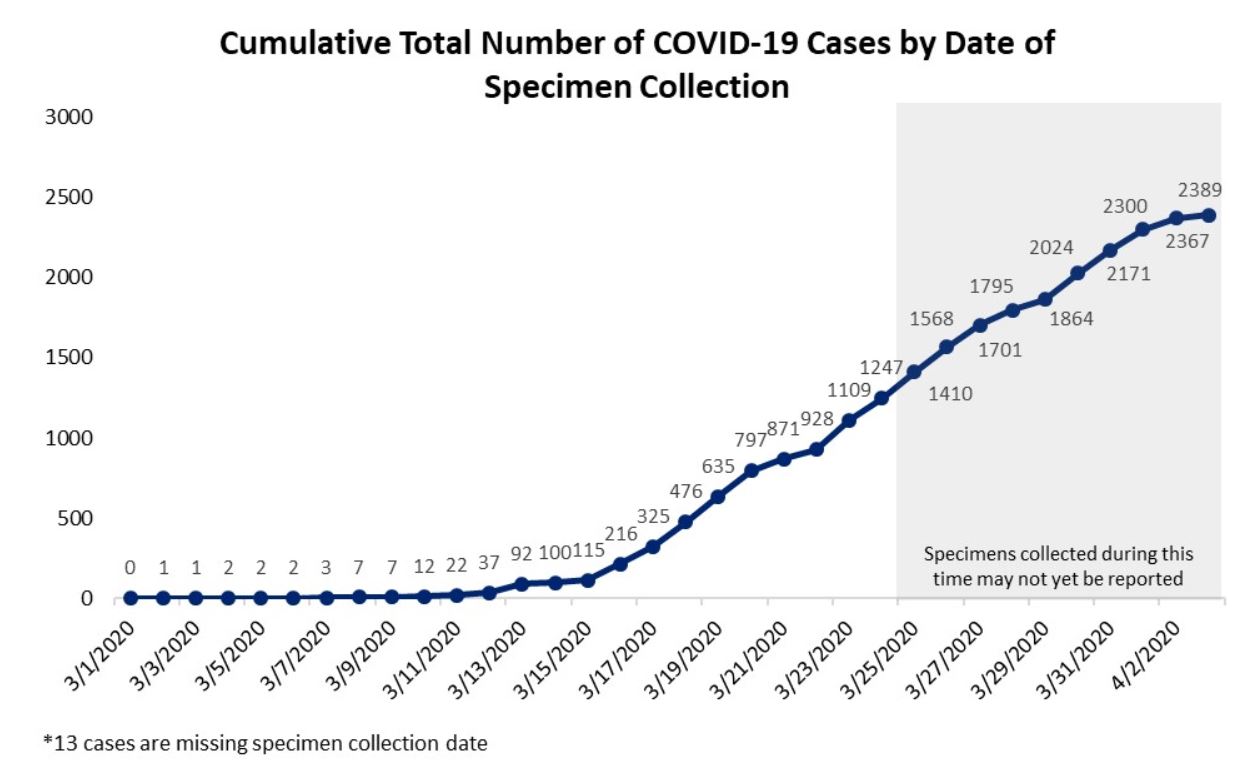
As of Saturday, April 4, around 11 a.m. North Carolina was reporting 2,402 positive Covid-19 cases out of 38,773 private and public tests. There have been at least 24 deaths, and 271 people are currently in the hospital. That includes at least 42 cases in New Hanover County, 24 cases in Brunswick County (including one death, on Friday morning), and the first case in Pender County.
Two weeks ago, North Carolina had 184 positive cases out of 5,276 tests; at the time, there were six cases in Brunswick and four cases in New Hanover.
Nationwide, there are roughly 300,000 cases and over 8,000 deaths. Two weeks ago, there were 15,219 cases and around 200 deaths.
In North Carolina, the cases have been roughly split between men and women; the majority of cases (42%) have been patients between 25 and 49 years old. Another 28% were between 50 and 64, and 20% were 65 and older. Just 9% were 18 to 24, and barely 1% were minors — however, it’s worth noting that up to a quarter of all cases may be asymptomatic, according to the CDC, and almost no patients without symptoms are being tested by either public health or private practices.
It’s also important to note that the daily increase in cases doesn’t track the spread of the virus in realtime. Public and private tests have different lag times.
Add that to an incubation period that can stretch up to two weeks, and it’s still probably too early to say, based on the current data, if efforts to ‘flatten the curve’ have been successful.
The state, as well as Brunswick and New Hanover counties, have all seen ‘community spread’ or ‘community transmission,’ meaning that public health officials were unable to trace the infection’s origin to travel or another patient. This, according to both Governor Roy Cooper and DHHS Secretary Mandy Cohen, has continued to move the state’s reaction from containment to mitigation and suppression.
The state has moved away from identifying cases and isolating them (containment) to restricting social interaction to combat the spread (mitigation) and ordering residents to stay at home (suppression). Local authorities have followed suit.
Restrictions, ‘stay at home,’ and enforcement
Over the last two weeks, Governor Roy Cooper has shuttered front-facing service industry businesses, including everything from hair salons to tattoo parlors to the dining rooms of restaurants. Two weeks ago, Cooper made the legally enforceable maximum size of a public or private gathering 100 people — on Monday of this week, that number was reduced to 10.
Two weeks ago, authorities from Cooper’s office down to officers with the Wilmington Police Department said they wanted ‘voluntary compliance,’ not criminal enforcement, when it came to adhering to these new restrictions.
WPD formed a ‘Community Compliance Unit‘ to help explain to residents and businesses how to avoid running afoul of the new regulations. They also issued the first citation for violating those new rules this week, acting on an anonymous tip.
While Cooper’s executive order was sweeping, it was also at times vague, with considerable wiggle room for what was considered an ‘essential business.’ This lead New Hanover County Chairwoman Julia Olson-Boseman to institute stricter local regulations that including a mandate for stores that sell both essential and non-essential items to rope off the non-essential areas.
These didn’t prevent swarms of people from descending on big box home improvement stores, including the garden centers (which aren’t considered ‘essential’). Representatives from one store lamented that it was difficult to draw a clear-cut line between essential and non-essential, asking, as an example, ‘is someone buying a new fridge because they want to upgrade, or do they need a new one because the old one died?’
The restrictions also didn’t stop boaters from congregating in large numbers on and around Palm Island, off the Intracoastal near Wrightsville Beach. This, at least in part, led to New Hanover County closing private and public boat slips and marinas. The move led to complaints on social media, and charges that County Chairwoman Olson-Boseman lacked the authority to close boat accesses.
Government aid
The collateral damage of attempts to ‘flatten the curve’ has been major: businesses closed, employees laid off, and the economy heading into a bear market.
Related: Wilmington’s service industry is being demolished. What can Raleigh do to help save it? [Free read]
Governor Cooper’s executive order relaxed several of the restrictions on the state’s unemployment program to make it easier for employees to get funds and to cushion the blow for employers. But for those who do make it through the state’s badly overloaded website and get registered for benefits, the checks will be some of the smallest in the country. The General Assembly can change that — but first, they have to actually convene (more on that, below).
Now that the White House and Congress have passed the latest stimulus bill, those that do get unemployment benefits will get an extra $600 per week through July. State officials aren’t sure when the money will show up, but according to the North Carolina Department of Commerce’s unemployment website, delayed benefits will still be paid retroactively.
There’s also the $1,200 stimulus checks — technically an advanced tax refund for the 2020 year. The IRS will use pre-existing direct deposit data from 2018 or 2019 to send electronic payments where possible, and mail checks to others. More info can be found at the IRS website. There are still questions about certain kinds of workers who might fall through the cracks (if you’ve got questions, email us at [email protected]).
Local government changes
Locally, municipal and county governments have had to dramatically change how they do business. Some agenda briefing meetings have been canceled, and meetings are being reshuffled and shifted to online and teleconference formats.
Next week, for example, the New Hanover County Board of Commissioners will hold Monday, April 6 meeting via teleconference. Live public audio, but no video, will be provided (details on how to listen, here).
It’s worth noting that this meeting has no public hearings or special use permit hearings. How local governments plan on handling those is still an open question (although the City of Wilmington is working on a response to some questions from Port City Daily about that issue — so stay tuned).
At the state level, things are moving forward, albeit slowly. By law, state representatives must vote in person — which poses obviously problems. State leaders are working on a plan to allow representatives to do committee work and vote on legislation without violating strict regulations on public gatherings.
Lastly, the Partnership Advisory Group, which is guiding the exploration of potential new owners or partners for New Hanover Regional Medical Center, will also be looking at ways to keep the public involved — but, for now, the process is on hold for about a month. The Save Our Hospital group, formed to oppose to sale of NHRMC, has issued a position paper asking for a longer-term freeze on the process, but officials have not signaled any additional plans to further delay an exploration of a sale or new partnerships. (More on that issue next week).
Hospital preparedness
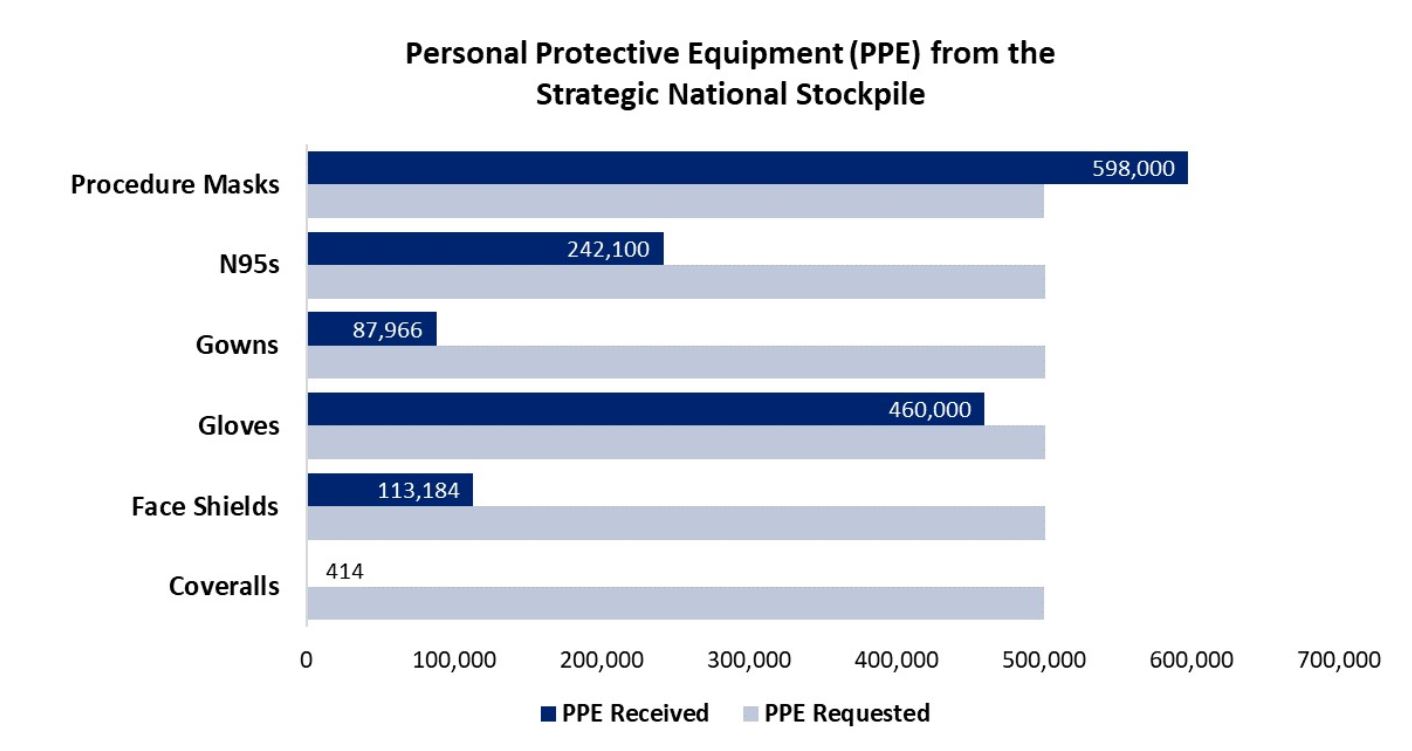
New Hanover Regional Medical Center (NHRMC) and other regional hospitals face a possible shortfall of beds, ventilators, and personal protective equipment that would be needed to respond to a potential spike in Covid-19 cases in the coming weeks.
Models for the potential increase in Covid-19 cases show that the demand could be several times the region’s total capacity — but a major factor is timing. Thousands of cases could still be handled if they are spread out over a long enough period of time. But a sudden surge in cases could create the need for thousands of hospital beds and ventilators, a situation currently unfolding in New York City, where Governor Andrew Cuomo has publicly clashed with President Donald Trump over unfulfilled requests for supplies for the national stockpile of personal protective equipment (PPE), ventilators, and other supplies.
Governor Cooper said the state has received about a third of the equipment it has requested from the national stockpile — he also said he was told not to expect any more in the near future.
Port City Daily crunched the numbers on local supplies and capacity compared to current worst-case and best-case models here: NHRMC and other regional hospitals face potential shortfall in beds, ventilators, and PPE [Free read]
Here’s the condensed version:
- The region may require between 3,000 and 27,700 beds
- The region has less than 1,000 beds
- The region may at least 2,000 ventilators
- NHRMC has about 100 ventilators
NHRMC has been actively soliciting donations of PPE, and has also set up additional temporary facilities, but the hospital — like most around the country — facing serious shortages and the very real risk of being overwhelmed if cases spike all at once.
Send comments and tips to Benjamin Schachtman at [email protected], @pcdben on Twitter, and (910) 538-2001
