


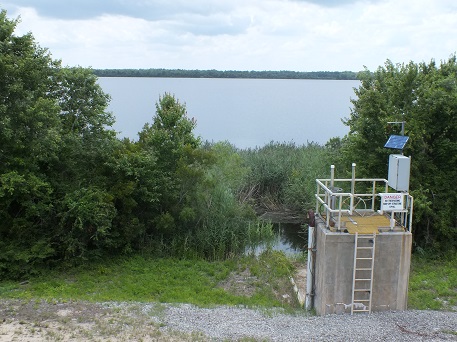
Evidence of coal ash at the bottom of Sutton Lake suggest multiple spills may have occurred before Florence. A Duke spokesperson said comparing the manmade lake to a natural waterway was “ludicrous,” and said the Sutton fishery was “thriving.”
New Hanover County — A research team from Duke University has discovered coal ash solids in sediments collected from Sutton Lake, located on the Cape Fear River about 11 miles upstream from Wilmington.
The evidence suggests the lake has been contaminated by multiple coal ash spills, most of them “apparently unmonitored and unreported until now,” according to a release from Duke University on Monday.
Sutton Lake served as an impoundment for a Duke Energy coal-fired power plant from the 1970s until 2013, when the plant was replaced by a natural gas-powered plant. It is now widely used for recreational boating and fishing.
Coal ash detected
Avner Vengosh, a professor of geochemistry and water quality at Duke University’s Nicholas School of Environment, led the research.
“Our results clearly indicate the presence of coal ash at the bottom of Sutton Lake and suggest there have been multiple coal ash spills into the lake from adjacent coal ash storage facilities after, and even before, floodwaters from Hurricane Florence caused major flooding in 2018,” Vengosh said.
In September, floodwaters from Hurricane Florence inundated the lake and an adjacent coal ash landfill before flowing back into the Cape Fear, according to the release. Coal ash contains high levels of toxic and carcinogenic elements that can pose ecological and human health risks if they leak into the environment.
Nicholas School of Environment spokesperson Tim Lucas said power plants in the United States generate about 100 million tons of coal ash every year, about half of which is stored in landfills or impoundments often adjacent to waterways. He said that while several lines of evidence suggest the coals ash solids found in the lake originate from multiple spills, further analysis is needed to determine the timeline of these spills and if similar unmonitored spills have occurred in other lakes near coal ash ponds in the state.
“What’s happened at Sutton Lake highlights the risk of large-scale unmonitored spills occurring at coal ash storage sites nationwide,” Vengosh said. “This is particularly true in the Southeast where we see many major land-falling tropical storms and have a large number of coal ash impoundments located in areas vulnerable to flooding.”
According to Vengosh, the spills could have been caused by floods but did not rule out accidental releases or past dumping practices. He and his colleagues published their peer-reviewed study on May 24 in the journal Science of the Total Environment.
”The levels of coal ash contaminants we detected in Sutton Lake’s sediments, including metals with known environmental impacts, are similar to or higher than what was found in stream sediments contaminated by the 2008 Tennessee Valley Authority coal ash spill in Kingston, Tennessee, or the 2014 Dan River spill here in North Carolina,” Vengosh said.
According to Lucas, the study was conducted using four independent sets of laboratory tests on bottom sediments collected in October 2018, shortly after Florence struck the region.
Duke Energy responds
Duke Energy spokesman Bill Norton said the study was trying to get attention for old sediment.
“It is ludicrous to compare decades-old ash at the bottom of a manmade wastewater facility to anything found in conventional lakes and rivers. This wastewater facility did exactly what it was designed to do, serve as a buffer between our former coal plant and the Cape Fear River to keep the public and environment safe,” Norton said.
“We’ve shared similar sediment results going back to the mid-90s with the NC Wildlife Resources Commission, so these findings are not at all surprising. Most importantly, the results are not relevant to anyone’s health. We have decades’ worth of surface water tests and fish tests, all shared with regulators, that demonstrate Sutton Lake is well within water quality standards and the Sutton fishery is healthy and thriving,” Norton added.
Norton also made several other points about the sediment issue:
- Sutton Lake was designed, constructed and operated as a permitted and integral part of the coal plant wastewater treatment system for decades.
- As such, it is not surprising that the lake sediment shows evidence of coal plant operations.
- Only recently (2014) has the lake been designated as public waters.
- The latest results as outlined in the recent paper published by Dr. Vengosh et. al. are not new or unexpected.
- Duke Energy scientists have conducted studies and have seen similar sediment results going back to the mid-90s. These results have been conveyed in numerous reports to the NC Wildlife Resources Commission.
- It is important to note that the lake’s water column data show metals levels within applicable surface water quality standards.
- Duke Energy has monitored Sutton Lake’s fish community for many years and our data indicates a healthy, self-sustaining and balanced fish community.
- The Sutton plant has a long history of operating well within all applicable regulatory standards.
- Historical routine documented inspections of the Sutton ash basins demonstrate that, with very brief exceptions during a couple major flooding events, all basins have operated as expected. Even during those events, no substantial quantities of ash were released to Sutton Lake.
- Even after Hurricane Florence, state regulator testing of the Cape Fear river demonstrated water quality remained protected and people remained safe from coal ash impacts.
A lasting legacy
Among the contaminants detected were many metals — including arsenic, selenium, and thallium, once used as rat poison — that have “toxic impacts at elevated levels,” Lucas said.
Past studies by Vengosh’s lab have shown that some of these metals, such as arsenic, can be released from coal ash solids into water trapped between grains of sediment at the lake’s bottom. They then build up and, over time, bioaccumulate up the local food web, according to Lucas.
A 2017 Duke University study revealed that 85 percent of all fish tissue samples collected from Sutton Lake still contained selenium at levels that exceeded Environmental Protection Agency (EPA) standards four years after the coal-fired power plant there was retired. Another study showed that strontium isotope ratios in the inner ears of fish from Sutton Lake now mirror the ratios found in coal ash, according to Lucas.
“A coal ash spill is not a one-time contamination,” Vengosh said. “It builds up a legacy in the environment. Even if you close the site, the legacy and threat remain, as our research has revealed at Sutton Lake and other coal ash spill sites such as Kingston, Tennessee. Collectively, these findings imply that the distribution and impact of coal ash in the environment is far larger than previously thought.”
(Editor’s note: Duke Energy did not respond to requests for comment at press time. This article will be updated with any response from Duke if and when it is received.)
