


In Brunswick County, a good amount of wealth. Its south-facing barrier-island beaches are lined with sizeable vacation properties and ultimate homes for retirees; a bit inland, plenty of golf to enjoy on fairways lined by fine houses.
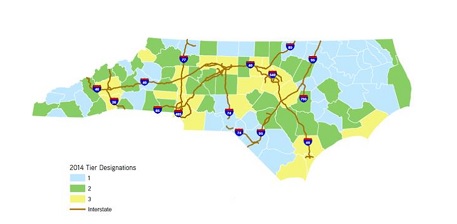
That adds up to “tier three” status for the county–generally meaning affluence, versus a “tier one” county like the economically distressed Columbus.
While that doesn’t mean Columbus County is void of ritzy property, it doesn’t mean Brunswick is poverty-free, either.
And that’s part of the spirit of a bill that went to the governor’s desk Monday. A section of House Bill 201 seeks to avail certain rural economic development dollars to disadvantaged parts of tier-three counties, like in the northern end of the geographically large and rural Brunswick.
It’s money the state has historically reserved for lower-tier counties.
“They were only looking at tier-one, tier-two counties, and a number of tier-three counties complained,” said Brunswick County Economic Development Corporation Director Jim Bradshaw, referring to N.C. Rural Development Division funds that can help lacking counties reuse old buildings in need of renovation or build new ones for health care.
The bill, Bradshaw said, “may help us get assistance that we ordinarily would not have been able to get.”
All of Brunswick County’s legislators–Reps. Frank Iler (R) and Susi Hamilton (D) along with Sen. Bill Rabon (R)–voted in favor of the bill’s final version.
“Not all parts of all counties are the same,” Iler argued.
House Bill 201 specifically promotes the reuse of old buildings, he noted. It reconfigures language in existing law to provide matching grants or loans to local governments in tier-three counties that have rural census tracts, meaning delineated areas with less than 500 people per square mile.
That money, the law says, should go to the productive reuse or demolition of buildings or to the construction or expansion of rural health care facilities. Ideally, these projects lead to jobs.
Under the building-reuse grant program currently, applicants in tier-one and -two counties are eligible for $10,000 for each new, full-time job created. The cap is $500,000, or one-half of the project’s cost, whichever is less, according to the Rural Development Division, which is under the N.C. Department of Commerce.
The program gives priority to towns or communities with fewer than 5,000 residents.
Bradshaw said the rural and industrial areas west of Leland in northern Brunswick County are distressed and may qualify under the change.
He said he’s looking into whether the pair of large, undeveloped industrial parks at the county’s west end are eligible.
The state has used its tier ranking system since 2007 to help program assistive economic development funds. Factors accounted for are property-tax base per capita, rate of population growth, median household income and average unemployment rate.
North Carolina currently has 20 tier-three counties and 39 tier-two, according to a 2014 report from the Department of Commerce. At 41 counties, most of the state–especially its easternmost third–is in tier-one status.
A commerce department spokeswoman was not immediately aware of how many tier-three counties House Bill 201 might benefit.
Another section of the bill perks parties moving into existing buildings. The state wouldn’t require they secure environmental documentation under the State Environmental Policy Act (though federal standards may apply).
That’s as long as associated redevelopment or construction work to the building in question doesn’t increase its total footprint beyond 150 percent of the existing configuration.
Ben Brown is a news reporter at Port City Daily. Reach him at [email protected] or (910) 772-6335. On Twitter: @benbrownmedia
